2 Corinthians 4:1Therefore seeing we have this ministry, as we have received mercy, we faint not; 2But have renounced the hidden things of dishonesty, not walking in craftiness, nor handling the word of God deceitfully; but by manifestation of the truth commending ourselves to every man’s conscience in the sight of God. 3But if our gospel be hid, it is hid to them that are lost: 4In whom the god of this world hath blinded the minds of them which believe not, lest the light of the glorious gospel of Christ, who is the image of God, should shine unto them. 5For we preach not ourselves, but Christ Jesus the Lord; and ourselves your servants for Jesus’ sake. 6For God, who commanded the light to shine out of darkness, hath shined in our hearts, to give the light of the knowledge of the glory of God in the face of Jesus Christ. 7But we have this treasure in earthen vessels, that the excellency of the power may be of God, and not of us. 8We are troubled on every side, yet not distressed; we are perplexed, but not in despair; 9Persecuted, but not forsaken; cast down, but not destroyed; 10Always bearing about in the body the dying of the Lord Jesus, that the life also of Jesus might be made manifest in our body. 11For we which live are always delivered unto death for Jesus’ sake, that the life also of Jesus might be made manifest in our mortal flesh. 12So then death worketh in us, but life in you. 13We having the same spirit of faith, according as it is written, I believed, and therefore have I spoken; we also believe, and therefore speak; 14Knowing that he which raised up the Lord Jesus shall raise up us also by Jesus, and shall present us with you. 15For all things are for your sakes, that the abundant grace might through the thanksgiving of many redound to the glory of God. 16For which cause we faint not; but though our outward man perish, yet the inward man is renewed day by day. 17For our light affliction, which is but for a moment, worketh for us a far more exceeding and eternal weight of glory; 18While we look not at the things which are seen, but at the things which are not seen: for the things which are seen are temporal; but the things which are not seen are eternal.
This chapter is a favorite of many Christians, mostly because of verse five, alluding to the beginning of time, when God separated light from darkness and called the light day and the darkness night. The entire chapter has a poetic metric that captivates our senses, a rhythm I have found only in the King James version.
A verse-by-verse commentary is not the most effective approach for explaining this passage. Paul assumes that readers possess familiarity with the operational concepts in the kingdom of heaven, and would thereby easily comprehend his message. Without such understanding, however, many verses would make absolutely no sense. The last verse is prime example of this.
While we look not at the things which are seen, but at the things which are not seen. How can we look at the things which are not seen? This can be answered by looking at the model of the kingdom of heaven.
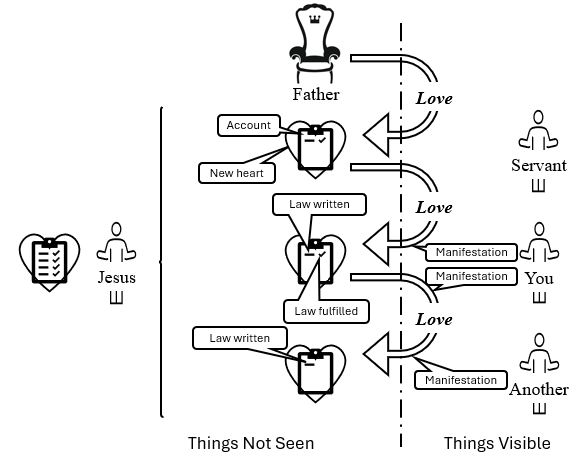
This is a model of the kingdom of heaven as constructed in the section on Modelling the Kingdom of Heaven. I have added Jesus and his account to the sphere of things not seen. During his earthly ministry, he was visible, but we see him no longer, yet he is still in the picture.
The point is that when you are loved by the servant, it is Jesus loving you. When you love one another, it is them being loved by Jesus (and you).
The left half of the model is the sphere of things not seen. Laws written on the heart and the fulfillment of those laws credited to the account reside in that sphere and can be seen only by God.
The only evidence we have that these things exist is when the servant loves you and then again when you love another. Keep in mind that this love is not the ”love your neighbor as yourself” variety. It is the “love one another as I have loved you” version. This love is performed in the power of the Spirit, not the weakness of the flesh. It is according to the first law, the law of the Spirit, not the second law, the law of the flesh: heart, soul, mind, and strength.
The only opportunities we have to see the things not seen is when love is being manifested as it travels from the servant to you, or when it travels from you to another. When we receive his love and feel the Spirit working in us, we should recognize that there is a corresponding law being written upon our heart, that a seed of faith has been planted in the ground where it is no longer seen. We should know it is there, even though we no longer see it. This is what it means to walk by faith, not by sight: we walk not by what we see, but by what we have seen: the evidence of things not seen.
What does it look like to look at things not seen? What are we watching for? Knowing that it is the Spirit who fulfills the righteousness of the law in us, we place ourselves in a position to give opportunity for the Spirit to fulfill the righteousness of the law in us. Once we are there, we wait on the Lord to fulfill his role in the partnership. The outcome is not ours to predict, for his actions are unpredictable. We wait to see what he will do; we become a spectator at this point. Often, he will work in ways that we will only recognize in retrospect.
Understanding this provides a basis for understanding verse 1.
2 Corinthians 4:1Therefore seeing we have this ministry, as we have received mercy, we faint not;
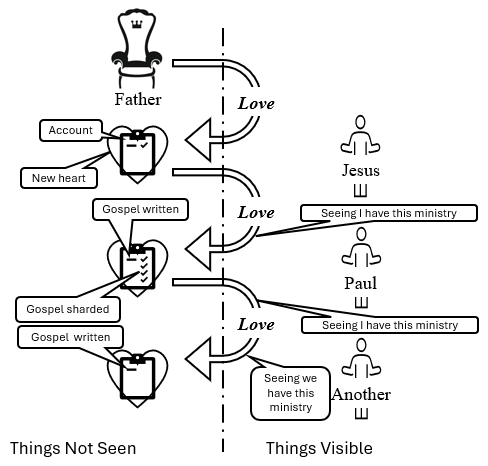
Paul had many opportunities to see the ministry he had. When Jesus circled back to the sphere of things seen to share the mysteries of the kingdom of heaven with Paul, the love Paul received directly from Jesus made an appearance as it transitioned through the sphere of things visible.
As Paul shared what he had received from the Lord with others, the Spirit working through him was also evidence of his ministry, and this evidence was seen repeatedly.
Those who received the gospel from Paul were able to see the love Paul shared with them as it transitioned through the sphere of things visible. Paul could see it, and they could see it. This is why Paul had the confidence to say seeing we have this ministry.
Paul, seeing that he had this ministry, having received mercy despite having started down the path of zealously persecuting the church, diligently pursued the ministry he had been given. Perhaps a more accurate term for fainting would be shirking (we faint not).
In Paul’s case, his ministry is winning souls and sharing the gospel. The thrust of his message is that each time someone receives love through him in this way, they have that same law written upon their heart, authorizing the same ministry in their lives.
2 Corinthians 4:2But have renounced the hidden things of dishonesty, not walking in craftiness, nor handling the word of God deceitfully; but by manifestation of the truth commending ourselves to every man’s conscience in the sight of God.
The first half of this verse deals with putting off the old man; the latter half deals with putting on the new. Let’s begin with the first half: putting off the old man.
It may look like there are three things to renounce: the hidden things of dishonesty, walking in craftiness, and deceitfully handling the word of God, but there is only one thing to renounce: dishonesty. walking in craftiness and handling the word of God deceitfully are the ways in which we are dishonest.
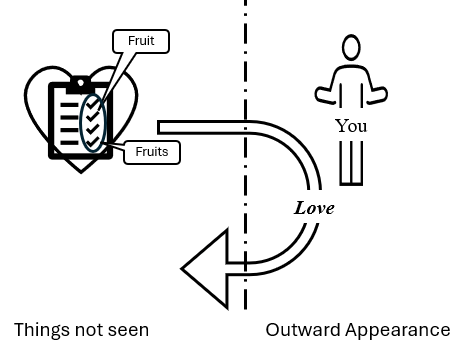
We are being dishonest when our outward appearance is not indicative of what is written upon our heart: the things hidden.
The Greek word for hypocrisy involves someone acting a part in a play. Often actors would wear masks to disguise themselves. When we stage our outward appearance to make it look like God is working in us, we are acting a part in a play designed to fool others into believing that our spiritual life is something that it is not. Others are impressed with our outward appearance, but when there is nothing happening on the spiritual front, we are being dishonest.
Matthew 7:20Wherefore by their fruits ye shall know them.
This verse is generally interpreted to mean that we will know them by their actions. But actions are in the sphere of things seen, and fruit is in the sphere of things not seen. Fruit becomes visible only when it travels from one to another, and then only for a moment.
James 2:8If ye fulfil the royal law according to the scripture, Thou shalt love thy neighbour as thyself, ye do well: 12So speak ye, and so do, as they that shall be judged by the law of liberty.
Man judges by the royal law (the law of sin and death), but God judges by the law of liberty (the law of the Spirit of life). Man judges by things that are visible, the outward appearance. God judges by the things written in the heart, things hidden in the sphere of things not seen. It is a good thing to keep the royal law, but that is not the law by which we will be judged.
Dishonesty comes into play when we take advantage of this dichotomy, looking for the approval of man knowing that man judges by outward appearance, rather than living a life pleasing to God, living in the Spirit as co-laborers together with him. We work hard to keep up outward appearances.
We act dishonestly by walking in craftiness and by handling the word of God deceitfully. Craftiness can be expressed in many ways, but the main intention is to keep hidden the things that would expose the discrepancy between our inward man and our outward appearance. The intention is to curry favor with man, not God.
There are many ways to deceitfully handle the word of God, but one thing that comes to mind is to use it to judge others.
Let us move on to the second half of this verse: putting on the new man. There is so much going on in this verse that I need to take it a phrase at a time.
2 Corinthians 4:2But have renounced the hidden things of dishonesty, not walking in craftiness, nor handling the word of God deceitfully; but by manifestation of the truth commending ourselves to every man’s conscience in the sight of God.
Manifestation of the truth needs to be isolated and illustrated separately. There is too much information is this verse to process all at once.
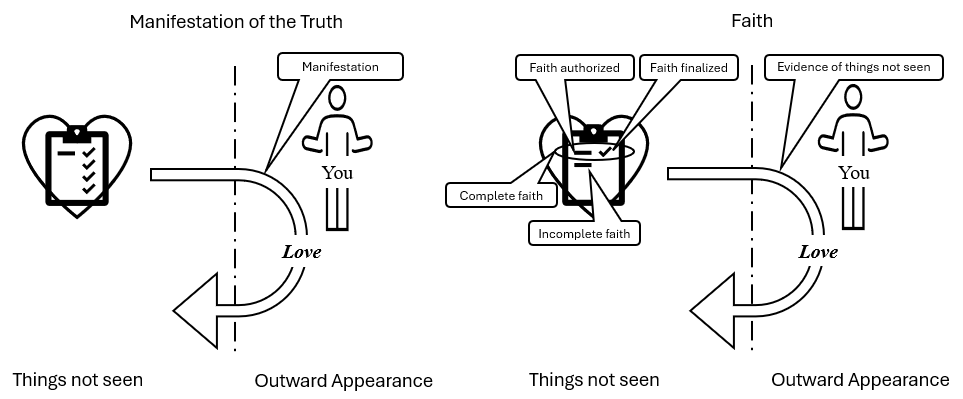
If I were to place manifestation in the model, I would place it where love becomes visible as it makes its way from you to another. Since truth means to reveal something that had been hidden, manifestation of the truth is equivalent to the evidence (manifestation ) of things not seen (truth). This is the finalizing component of faith.
The second half of the verse (but by manifestation of the truth commending ourselves to every man’s conscience in the sight of God) can now be illustrated.
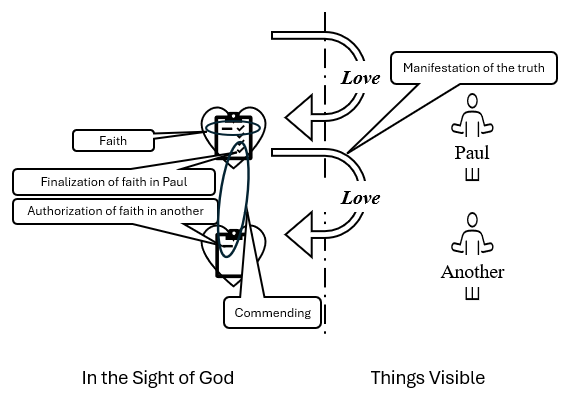
Where faith is two distinct events in one person (authorization and finalization), commendation is a single event affecting two people (finalization of faith in Paul, and authorization of faith in another – the law written upon their heart).
When we commend ourselves to every man’s conscience, we are writing laws into their account (their conscience) as we share the love of Jesus by the Spirit.
2 Corinthians 3:3Forasmuch as ye are manifestly declared to be the epistle of Christ ministered by us, written not with ink, but with the Spirit of the living God; not in tables of stone, but in fleshy tables of the heart.
When we commend ourselves to every man’s conscience, not only is a law written upon their hearts, our names are also written upon their hearts in the “ministered-by” column.
2 Corinthians 3:2Ye are our epistle written in our hearts, known and read of all men:
Not only that, but their names are written upon our hearts alongside the righteousness of God credited to our account.
There is traceability in both directions: written on my heart are the names of those ministered to by me, and my name is written on their hearts as well. For this traceability to work, however, everyone needs to have a universally unique identifier, a new name. You receive your new name when you enter the kingdom of heaven. “There’s a new name written down in glory.”
All this is done in the sight of God in the sphere of things not seen.
2 Corinthians 4:3But if our gospel be hid, it is hid to them that are lost:
Those who are lost have not been born again.
John 3:3Jesus answered and said unto him, Verily, verily, I say unto thee, Except a man be born again, he cannot see the kingdom of God.
To those who are not born again, the gospel is hid. Those who have not been born again are under a different law, the law of sin and death. Everything we have been talking about is contingent on being under the law of the Spirit of life.
Jeremiah 17:1The sin of Judah is written with a pen of iron, and with the point of a diamond: it is graven upon the table of their heart, and upon the horns of your altars;
Under the law of sin and death, the laws were written on tablets of stone delivered by Moses, and violations of the law were written in stone on the table of their heart.
If the gospel is hid to them, that does not mean that it will always be hid to them. If they harden not their heart, give their heart to Jesus and receive a heart of flesh, they will be welcomed into the family of God under the law of the Spirit of life. A person to whom the gospel is hid should not be written off as being eternally lost.
2 Corinthians 4:4In whom the god of this world hath blinded the minds of them which believe not (απιστων, apistōu), lest the light of the glorious gospel of Christ, who is the image of God, should shine unto them.
It is the god of this world who blinds the minds of them which believe not. There is more than one Greek word that is translated into English as belief. In this verse, faithless would be an accurate translation. In other places, belief corresponds to obedience, so it is important to know which belief is being referred to.
“Believe not” is a single Greek word, beginning with an alpha, the negative particle. Apistōu means having no faith. Since faith is a construct that only exists in the kingdom of heaven, those who are not born again cannot have faith. Faith requires a law written upon the heart, but laws are not written upon hearts of stone.
It is not God who blinds the minds, but the god of this world. He does this to prevent them from seeing the love that is knocking on the door of their hardened heart.
Those who are born again, who have received their heart of flesh, the light is able to shine unto them, becoming visible as the glorious gospel of Christ passes through the sphere of things seen and a new law is written upon their heart, and a seed of faith is planted, no longer visible, but no less real.
Romans 8:29For whom he did foreknow, he also did predestinate to be conformed to the image of his Son, that he might be the firstborn among many brethren.
Corinthians 4:4 talks about Christ being the image of God, and Romans 8:29 talks about us conforming to the image of Christ. In the case of Christ, he loves us as he has been loved by the Father. That is how Christ conforms to the image of God, by replicating to us all things he had received from the Father. To the extent that we love one another as he loves us, we conform to the image of Christ.
2 Corinthians 4:6For God, who commanded the light to shine out of darkness, hath shined in our hearts, to give the light of the knowledge of the glory of God in the face of Jesus Christ.
As God commanded the light to shine out of darkness, Jesus commands the light to shine out of the darkness of our hearts.
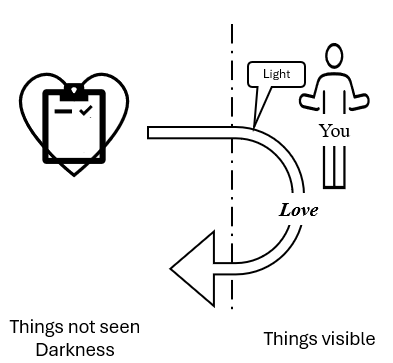
The darkness of our hearts is referring to the concept that our hearts are in the sphere of things not seen. Our hearts are in the dark, in the sight of God. Jesus’ commandment, love one another as I have loved you, causes the love to become visible as it passes through the sphere of things seen. The light of the knowledge of the glory of God shines in the face of Jesus Christ.
Jesus said that if you have seen him, you have seen the Father. In the same way, if you have “seen” me, you have seen the face of Jesus. You “see” me when Jesus’ love coming to you through me becomes visible on its way to your heart.
2 Corinthians 4:7But we have this treasure in earthen vessels, that the excellency of the power may be of God, and not of us.
We are the earthen vessels. Our account holds the records of God’s love as it travels from Christ to us, then to one another. This is like a distributed database, all records being held in our accounts with complete traceability.
Matthew 6:19Lay not up for yourselves treasures upon earth, where moth and rust doth corrupt, and where thieves break through and steal: 20 But lay up for yourselves treasures in heaven, where neither moth nor rust doth corrupt, and where thieves do not break through nor steal: 21 For where your treasure is, there will your heart be also.
We lay up treasure in heaven by keeping Christ’s commandments, loving one another as he has loved us. The “excellency of the power” is the power of the Spirit, not of us.
2 Corinthians 4:8We are troubled on every side, yet not distressed; we are perplexed, but not in despair; 9Persecuted, but not forsaken; cast down, but not destroyed; 10Always bearing about in the body the dying of the Lord Jesus, that the life also of Jesus might be made manifest in our body. 11For we which live are always delivered unto death for Jesus’ sake, that the life also of Jesus might be made manifest in our mortal flesh. 12So then death worketh in us, but life in you.
Not all love is warm fuzees. God’s love often comes with hardship: it was certainly the case with his own Son. To a lesser extent, it can also be the case for us. As we walk after the Spirit, we may find ourselves in precarious positions. When we find ourselves in situations that involve threats, our best strategy is to play the God card: invoke his name as did Shadrach, Meshach, and Abednego when they were about to be thrown in the fire. They boldly proclaimed that their God could save them. They put God’s reputation on the line, being confident that God could defend his own reputation. Although that did not prevent them from being thrown into the fire, they were protected by his hand.
2 Corinthians 4:13We having the same spirit of faith, according as it is written, I believed, and therefore have I spoken; we also believe, and therefore speak;
Jesus is the author and finisher of our faith. He authorizes our faith when he loves us. He finalizes our faith when his Spirit loves another through us. His authorization is the substance of things hoped for. It is like a seed planted with the hope that it will eventually bear fruit.
The finalization of our faith is the evidence of things not seen. The thing not seen is the law written upon our heart. The fulfillment of the law makes it visible, making it evidence. Faith is composed of two parts of grace: grace received, and grace delivered. Faith is not complete without the evidence.
Ephesians 2:8For by grace are ye saved through faith; and that not of yourselves: it is the gift of God:
We are saved by grace through faith: faith being two complimentary elements of grace. We are not saved by grace plus works of the flesh, but neither are we saved by partial, unfinalized faith; faith without works.
The importance of the first fruit is that it is the first fruit that completes the faith. Subsequent fruit is additive, but without the first fruit, grace is forfeited. This is what happened in the parable of the talents to the servant who had one talent and failed to gain a talent. He was to gain a talent by bearing fruit. He failed, lost the talent, and was sent to outer darkness.
2 Corinthians 4:14Knowing that he which raised up the Lord Jesus shall raise up us also by Jesus, and shall present us with you.
This verse refers to traceability. Those I have led to the Lord will have my name written upon their heart, and my name will be written on their heart. When their name is called, our name will be presented with them.
Remember how Jesus said the last would be first? I believe that this is how we will be processed on judgment day. He will begin with the last and proceed up the chain to the first. You will definitely want your name to be presented with someone when the rolls are called.
2 Corinthians 4:15For all things are for your sakes, that the abundant grace might through the thanksgiving of many redound to the glory of God.
The concept of abundant grace is best illustrated by the feeding of the five thousand. Jesus was not the one who fed the five thousand, it was his disciples: the bread was multiplied in the hands of the disciples. Jesus gave the disciples bread, but the magic happened in their hands. If you are the disciple, the bread given to you is the love with which he has loved you. That love is grace. When you love one another, your capacity to love is not diminished, even though you just gave it away. The bread given to you is like a seed planted with the intention that it would bear much fruit. You don’t just bear the first fruit and stop there. Each time a person receives love, it is the intention that they would love many more, bearing much fruit. The intention is that it would be like a nuclear reaction, love being multiplied with each one it encounters.
The thanksgiving of many is the thanks that are given by the bearing of many fruit. My “all things” being referred to here are the all things of Romans 8:28, the all things that God and I work together, they are all good, and they are given to us for the sake of the recipients of the love we spread abroad.
2 Corinthians 4:16For which cause we faint not; but though our outward man perish, yet the inward man is renewed day by day.
This is why we do not shirk. What we do here on earth will affect our eternity. Our outward man experiences physical death, but our inner man experiences spiritual life, union with God.
2 Corinthians 4: 17For our light affliction, which is but for a moment, worketh for us a far more exceeding and eternal weight of glory; 18While we look not at the things which are seen, but at the things which are not seen: for the things which are seen are temporal; but the things which are not seen are eternal.
Bearing fruit is a good investment: it is eternal. It involves pain, but it also involves life.
We look at the things which are not seen but watching grace as we receive it and as we deliver it. Things not seen does not mean they are never seen. They appear during the grace transactions: when grace is received and grace is delivered. It is the work of the Spirit in us, both the willing and the doing. Receiving his love and delivering his love are moments to remember. Knowing what is written upon our hearts and acting on those things is walking by faith, not by sight. Our faith is not blind when we have seen what we have seen.
Seeing God at work in our lives: there is nothing like it.
If you have little time left to acquire righteousness, you have learned these things late in life and there are only precious moments left with little opportunity, remember that your account is not closed until the day of Jesus Christ: you can continue to bear fruit even after death. Do your best to leave a legacy. The thief on the cross only had a moment, but his legacy was his testimony, recorded in the most popular book ever written. Accounts with his name written next to the ones affected by his testimony are still being credited to his account.
 New Wine