The True Vine
John 15:1“I am the true vine, and my Father is the vinedresser. 9As the Father has loved me, so have I loved you. Abide in my love. 10If you keep my commandments, you will abide in my love, just as I have kept my Father’s commandments and abide in his love. 11These things I have spoken to you, that my joy may be in you, and that your joy may be full. 12“This is my commandment, that you love one another as I have loved you.
As I explained earlier, true means unhidden. Jesus is the vine that unhides the hidden kingdom of heaven. Jesus, a priest after the order of Melchizedek, brought back the first law to those who accept his priesthood. Unlike before, however, the details of the law are revealed. But more than that, Jesus put the first law in context, showing us how it fits in the kingdom of heaven.
Verses nine and twelve provide the structure of the vine. It is diagrammed below.
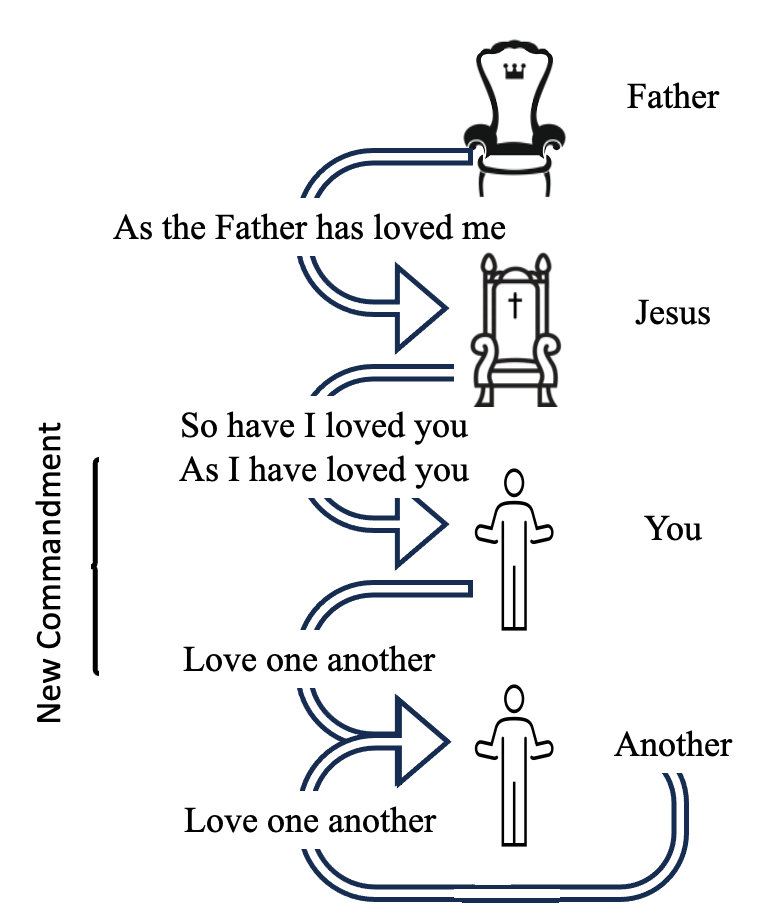
All the Old Testament saints were under the priesthood of Melchizedek. We know this because his was the only priesthood that featured righteousness by faith. Those under the Levitical priesthood could not be justified because the law of Moses had no power to justify, only the power to condemn. This is clear as we look at the structure of the law of Moses. Under the law of Moses, the only recordable events are violations. No credit is given for obedience – I get no credit for not killing.
Galatians 2:16yet we know that a person is not justified by works of the law but through faith in Jesus Christ, so we also have believed in Christ Jesus, in order to be justified by faith in Christ and not by works of the law, because by works of the law no one will be justified.
I would like to support my claim that the law under Jesus is the same as the law under Melchizedek. They share the same priesthood, but how do we know if they share the same laws?
I previously claimed that there is a one-way function that allows us to determine if a behavior is in compliance with the law, but that the law cannot be determined by observing obedient behavior. Now that we know what the first law is, however, let us examine some of the righteous behaviors in Hebrews 11 to determine whether they indeed complied with the law as expressed by Jesus. The behaviors I will examine are those of Abraham.
Hebrews 11:8By faith Abraham, when he was called to go out into a place which he should after receive for an inheritance, obeyed; and he went out, not knowing whither he went. 10For he looked for a city which hath foundations, whose builder and maker is God.
For this action to comply with the New Commandment – as I have loved you, love one another – we need to see the bigger picture. We need to see love flowing through the kingdom from it source, the Father.
This is diagrammed below. From left to right, the Father loved the Son by sending him from heaven to earth, the land of his inheritance. Jesus received the Father’s love by obeying the Father. the Father was left behind.
Jesus loved Abraham by instructing him to leave the land of Ur and travel to the land of his inheritance. Abraham received the Lord’s love by obeying the Lord. This was counted to him for righteousness. This event was recorded in Genesis 12, and even though it was not stated in that chapter that it was counted to him for righteousness, Hebrews 11 does credit this action to Abraham being by faith, and justification is by faith.
Hebrews 11:13These all died in faith, not having received the things promised, but having seen them and greeted them from afar, and having acknowledged that they were strangers and exiles on the earth. 14For people who speak thus make it clear that they are seeking a homeland. 15If they had been thinking of that land from which they had gone out, they would have had opportunity to return. 16But as it is, they desire a better country, that is, a heavenly one. Therefore God is not ashamed to be called their God, for he has prepared for them a city.
Through a long list of generations, Abraham gives us the hope of traveling to a country that is not our own, to the land of our inheritance.
This concept is depicted below.

Here is another example from Hebrews 11.
Hebrews 11:17By faith Abraham, when he was tried, offered up Isaac: and he that had received the promises offered up his only begotten son, (KJV)
Again, I will start at the beginning, where the love originated from the Father. I will begin with the diagram.
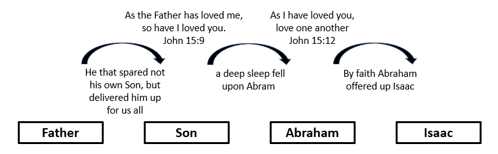
I will start at the source.
Romans 8:32He that spared not his own Son, but delivered him up for us all, how shall he not with him also freely give us all things?
The Father offered his Son on the altar. This was an act of love, believe it or not. Get used to the severe love of God because the Father’s love often made its appearance in severity, and Jesus’ love for you comes to you as it came to him. We are to receive love from Jesus in the same way he received that love from the Father.
Genesis 15:12As the sun was going down, a deep sleep fell on Abram. And behold, dreadful and great darkness fell upon him.
In Genesis 15, Abraham encountered the Lord. He was instructed to prepare a blood sacrifice, and although it did not specifically mention an altar, the setting had all the markings of an altar. Sacrifices were prepared and laid down, side by side. I suggest that this was the moment when the Lord offered Abraham on the altar.
The act that was counted to Abraham as righteousness was when he offered his son, Isaac, on the altar. It is also interesting that it was three days from the time when Abraham was instructed to offer his son to the time when he was placed on the altar. In the mind of Abraham, Isaac had been dead for three days.
The other examples in Hebrews 11 can be traced through the true vine, but the model of the kingdom is not yet fully developed.
Grace
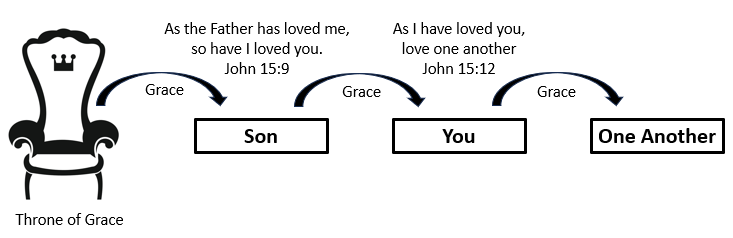
The model is developed to the extent that we can see something that can be tagged with a theological term. The love that begins with the Father being directed to the Son. From there it is directed to us, and then on to one another. What shall we call this divine love?
I should say at the onset that the assignment of terms is hypothetical in the scientific context. The assignment is subject to challenge if it is later found to be in conflict with the model as it is developed.
I should also stress that a term represents only one object and not be reassigned to cover an alternate context. This is a stringent requirement.
Perhaps you noticed the heading of this section, giving away the answer to the question. The love that originates with the Father is divine love. It is divine because the act of love is performed by the Spirit of Christ. The work of the Spirit of Christ is the work of Christ.
Notice how the diagram provides meaning to the term where a definition would fall short. For example, I could define grace in one word: love. But that definition would not do justice to the term. I need to see it in the context of the kingdom to appreciate what it represents.
Even in this simple model, grace shows up in many contexts. A few of them are shown below.
Hebrews 4:16Let us therefore come boldly unto the throne of grace, that we may obtain mercy, and find grace to help in time of need.
The throne of grace is where grace originates. Let us come boldly to the Father.
John 1:14And the Word became flesh and dwelt among us, and we have seen his glory, glory as of the only Son from the Father, full of grace and truth.
Incoming grace to Jesus was full in that all the love from the Father was directed through him. Outgoing grace from Jesus was full in that he did not improvise with some love of his own. He did not love us with love he did not receive from his Father. Jesus was the exact image of God.
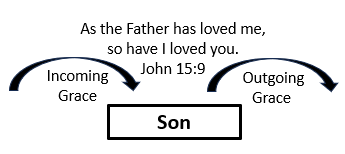
From our perspective, incoming grace is much different than outgoing grace. Our objective is to conform to the image of Christ like Jesus conformed to the image of God. We are to love one another with the love we have received from Christ. We are not full of grace in that we have not received every aspect of love Jesus received from the Father. Each of us have received different gifts, and we use these gifts to minister to one another.
The Greek word of grace is charis, from which we get the word charity. Grace is thought of as a gift, and that is one aspect of grace, but it does not tell the whole story.
There are more aspects of grace, but the model has not yet been developed to the point where these aspects can be appreciated.
The point is that the richness of grace cannot be understood without seeing it in the kingdom of heaven. This picture is worth more than ten thousand words.
The next section will continue to develop the model of the kingdom of heaven. If you have not been born again, you will not be able to see the kingdom. If that is the case, I direct you to a section that will introduce you to the priesthood of Jesus. Whether or not this is the case, you may want to visit this section. I assure you that it is material that is new to you. In either case you will find this section fascinating.
Welcome to the kingdom.
Here is a link to continue reading. The New Covenant
 New Wine
One thought on “Seek Ye First”