Recap
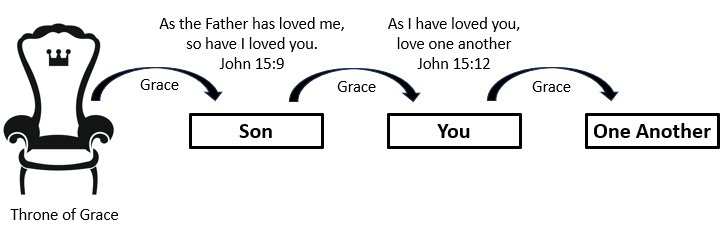
Here is the diagram of the kingdom of heaven developed thus far. It is based on John 15:9-12. Earlier I assigned grace to be the term that represents the love of God. This will be confirmed or adjusted as we continue the journey. As I mentioned before, terms do not have definitions, they represent objects.
As an aside, it is interesting that the curse put on Adam and the curse put on Eve are both lifted in the New Covenant. Something to look forward to.
Details of the New Covenant are also provided in the Old Testament. I will continue to develop the kingdom model by adding some of those details next.
A New Heart, a New Spirit
Ezekiel 36:26And I will give you a new heart, and a new spirit I will put within you. And I will remove the heart of stone from your flesh and give you a heart of flesh. (ESV)
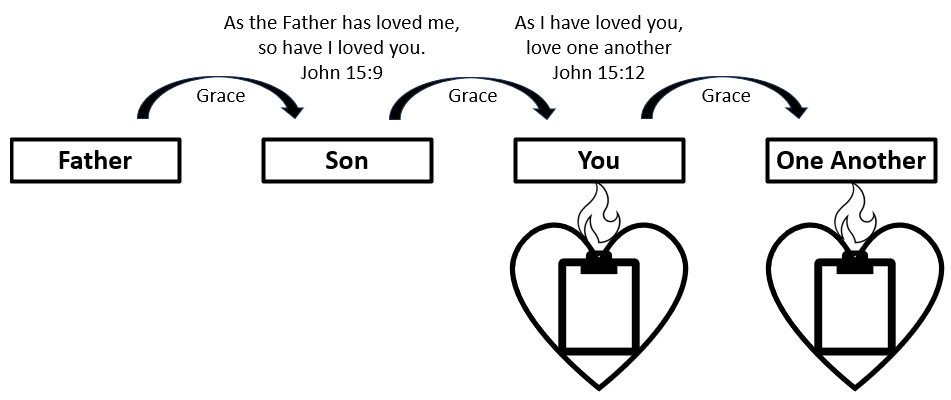
Both the new heart and the new Spirit play a big role in the kingdom of heaven. The new Spirit given to us is the Holy Spirit. Life is union with God, and because the Holy Spirit is now with us, we are alive, united with God. This life is everlasting because he never leaves us.
Genesis 2:7then the Lord God formed the man of dust from the ground and breathed into his nostrils the breath of life, and the man became a living creature.
Man was brought to life the first time by God breathing into him. The Greek words for spirit and air are the same word, pneuma. When we are born of the Spirit, we again become a living creature, a new creation.
The heart is where records are kept; your account is on the tables of your heart. When God looks on the heart, he is looking at your records. As we move forward, we will be identifying the kinds of things written on the heart. This will be extremely informative.
Jeremiah gave us more details concerning the New Covenant.
Jeremiah 17:33”For this is the covenant that I will make with the house of Israel after those days, declares the Lord: I will put my law within them, and I will write it on their hearts. And I will be their God, and they shall be my people. 34And no longer shall each one teach his neighbor and each his brother, saying, ‘Know the Lord,’ for they shall all know me, from the least of them to the greatest, declares the Lord. For I will forgive their iniquity, and I will remember their sin no more.” (ESV)
When we had a heart of stone, our sins were written on the tables of our heart. But he took our heart of stone (Ezekiel 36:26) and gave us a heart of flesh. Under the New Covenant our sins are remembered no more. Under the New Covenant, no longer does he write your sins on your heart. You are free from sin, so there is no longer a conflict where he must leave you because of sin. Sin is no longer recorded because you are no longer under the law of sin and death. You are now under the law of the Spirit of life.
A law comes from a commandment, and the New Commandment is the basis for the law written on your heart. Love one another as I have loved you. When Jesus loves you, and he love you in many ways, that love is written upon your heart as a law. You fulfill that law by loving one another, according to the law written on your heart.
Romans 8:4in order that the righteous requirement of the law might be fulfilled in us, who walk not according to the flesh but according to the Spirit.
But it is not in your power to fulfill the law. The righteous requirement of the law is fulfilled in you by the Spirit. We were loved by the Spirit, we fulfill the law by the Spirit. The work of love is done together using the power of the Spirit, our resources, for his purpose, credited to our account.
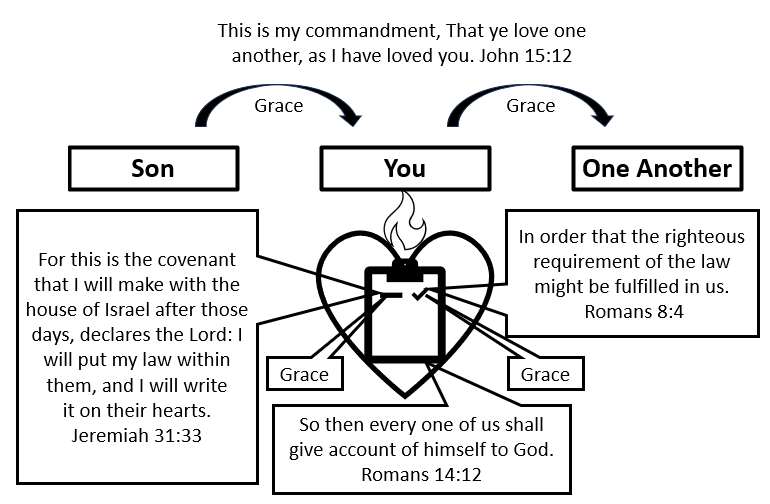
Grace, being the divine love of God, appears in many contexts. As you are loved, grace is the law written upon your heart. As you love one another, it is the fulfillment of the law. Receiving the love of God and loving one another are two separate events, and yet, when you love one another, that one grace event becomes the law fulfilled in you and a law written on the heart of the one receiving “your” love.
Make no mistake, although you are no longer under the law of sin and death, you are still held accountable under the law of the Spirit of life.
Romans 6:14For sin will have no dominion over you, since you are not under law but under grace.
Sin does not have dominion over you because you are no longer under is the law of sin and death. The law of the Spirit of life is called grace in this verse because the law you are under is grace. As we will see shortly, if you fail to fulfill a law (grace) you will forfeit the grace.
You are held accountable under grace because you are required to fulfill the laws written upon your heart, although they are actually fulfilled in you by the Spirit. The Spirit does the work, but you must make your resources available to him.
Romans 8:28And we know that for those who love God all things work together for good, for those who are called according to his purpose.
Remember, this is a partnership. You get no credit for what he does apart from you, and what you do apart from him is not credited to you. But whatever work you do together, all things, are counted as good and are credited to your account. The law is fulfilled with his strength, your resources, his purpose, and credited to your account.
Each time you fulfill a law, it is counted to you as righteousness and recorded on your heart. The law being referred to here is the law of the Spirit of life. The Greek word for counted, logizomai, contains log. Righteousness is counted by logging it into the account, the logon.
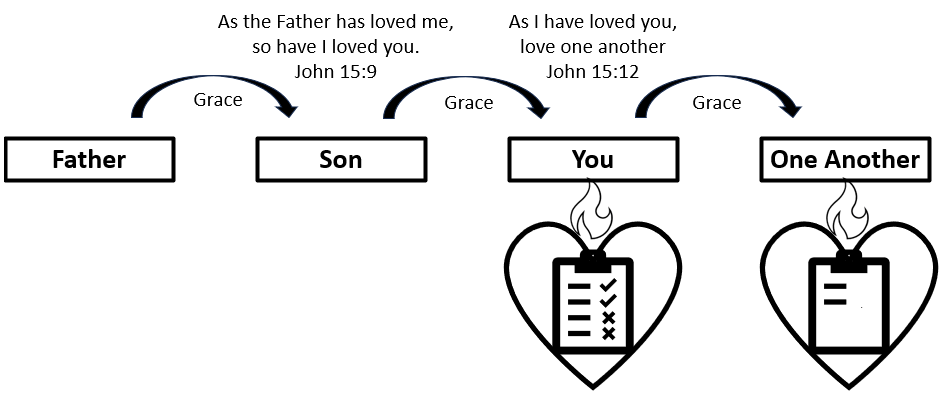
This diagram shows you having received four units of grace which translate to four laws. You have fulfilled two of them, once each. There is no limit to the number of times a law can be fulfilled, and you will be credited for each fulfillment. For example, in the parable of the pounds in Luke 19, each servant received one pound, and the most productive servant gained ten. The servant who gained no pounds lost the one he had.
Philippians 2:13For it is God which worketh in you both to will and to do of his good pleasure.
To will and to do are two separate activities. God the Spirit works in you to will by loving you, then writing his law on your heart. The law written on your heart is his will.
God the Spirit works in you to do by loving one another through you. The doing part is the fulfilling the righteousness of the law in you.
The Spirit works in you to will when he loves you, and he works in you to do when he loves another through you. The Spirit also keeps the records up to date, no small task.
Justification by Faith
The Greek words for justified and righteousness are different forms of the same word. Justification is not about the absence of sin, but the presence of righteousness. A clean record is not sufficient for justification, the presence of righteousness is necessary. There are works of the flesh and works of the Spirit, and when speaking of works it is important to know which is being spoken of.
Romans 4:1What then shall we say was gained by Abraham, our forefather according to the flesh? 2For if Abraham was justified by works, he has something to boast about, but not before God. 3For what does the Scripture say? “Abraham believed God, and it was counted to him as righteousness.” 4Now to the one who works, his wages are not counted as a gift but as his due 5And to the one who does not work but believes in him who justifies the ungodly, his faith is counted as righteousness, 6just as David also speaks of the blessing of the one to whom God counts righteousness apart from works:
Paul begins this discourse by establishing the context: it is according to the flesh. When Paul is speaking of works in verse two, he is talking about works of the flesh. Abraham was not justified by works of the flesh.
James 2:21Was not Abraham our father justified by works when he offered up his son Isaac on the altar? 22You see that faith was active along with his works, and faith was completed by his works; 23and the Scripture was fulfilled that says, “Abraham believed God, and it was counted to him as righteousness”—and he was called a friend of God. 24You see that a person is justified by works and not by faith alone.
When James speaks of works at the end of verse 22, he is talking about works of faith. He said that Abraham’s faith was completed by works, but these works are not of the flesh but of faith. Faith is not completed by works of the flesh. The example of the thing that Abraham did that was counted as righteousness was not in conformance with the law of Moses, but it was in compliance with the law of the Spirit of life, the first law. That is the other reason we know it was works of faith he was referring to.
Let’s see where faith fits into our model. I begin with the description of faith in Hebrews.
Hebrews 11:1Now faith is the substance of things hoped for, the evidence of things not seen.
Faith is comprised of two distinct elements: the substance of things hoped for, and the evidence of things not seen. Both elements of faith are distinctly different forms of grace. The substance of things hoped for is grace received. That is the only thing in the model that needs to be completed. This is subject to challenge. If it is found to be in conflict with other things, an adjustment can be made.
The evidence of things not seen is the fulfillment of the law, righteousness, grace. The evidence is the work of the Spirit, the Spirit being the thing not seen. The work is the part that is seen – the evidence. Without something to see, there is no evidence.
Substance without evidence is incomplete faith. There can be no evidence without substance because, unless there is a law, there can be no fulfillment of the law. Complete faith embodies both substance and evidence. Substance without evidence is dead. You are not justified by dead faith. You are not justified by faith plus works of the flesh, but neither are you justified by faith minus works of the Spirit. Faith embodies both.
I am ready to assign a new term, faith, to an object in the model.
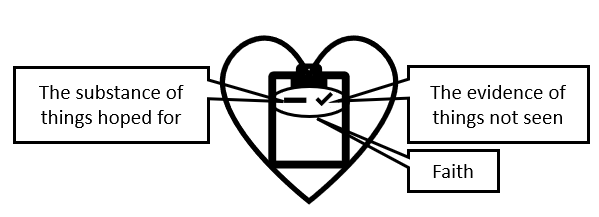
Faith represents a pair of elements. The law written upon the heart is the substance of things hoped for. The fulfillment of the law is the evidence of things not seen. It is this pair of elements by which we are justified. The evidence is righteousness.
There is an enigma concerning justification. We will be justified or condemned on judgment day, and judgment day is in the future, yet Abraham was justified in the past. This presents no conflict, however, because Jesus will justify or condemn in accordance with the content of our account. If faith, grace in and grace out, is found in your account on judgment day, you will be justified. If righteousness is written in your account today, it will be there on judgment day.
This may look very theoretical at this point. In the next section I will put some meat on the bones.
 New Wine
One thought on “The New Covenant”