The parable of the talents is perhaps the most revealing parable of them all. The beauty of diagramming the kingdom of heaven is that, when you map a parable into the model, it embellishes the model, adding details to what is already there. But the model also adds details that were left out of the parable. For example, this parable does not indicate how a servant would go about gaining a talent.
Here is the complete text of the parable.
Matthew 25:14“For it will be like a man going on a journey, who called his servants and entrusted to them his property. 15To one he gave five talents, to another two, to another one, to each according to his ability. Then he went away. 16He who had received the five talents went at once and traded with them, and he made five talents more. 17So also he who had the two talents made two talents more. 18But he who had received the one talent went and dug in the ground and hid his master’s money. 19Now after a long time the master of those servants came and settled (συναιρει, sunairo) accounts (λογον, logon) with them. 20And he who had received the five talents came forward, bringing five talents more, saying, ‘Master, you delivered to me five talents; here, I have made five talents more.’21His master said to him, ‘Well done, good and faithful servant. You have been faithful over a little; I will set you over much. Enter into the joy of your master.’ 22And he also who had the two talents came forward, saying, ‘Master, you delivered to me two talents; here, I have made two talents more.’ 23His master said to him, ‘Well done, good and faithful servant. You have been faithful over a little; I will set you over much. Enter into the joy of your master.’ 24He also who had received the one talent came forward, saying, ‘Master, I knew you to be a hard man, reaping where you did not sow, and gathering where you scattered no seed,25so I was afraid, and I went and hid your talent in the ground. Here, you have what is yours.’ 26But his master answered him, ‘You wicked and slothful servant! You knew that I reap where I have not sown and gather where I scattered no seed? 27Then you ought to have invested my money with the bankers, and at my coming I should have received what was my own with interest. 28So take the talent from him and give it to him who has the ten talents.29For to everyone who has will more be given, and he will have an abundance. But from the one who has not, even what he has will be taken away. 30And cast the worthless servant into the outer darkness. In that place there will be weeping and gnashing of teeth. (ESV)
The cast of characters in this parable is the lord and three servants. It is not difficult to assign these characters to their positions in the model.
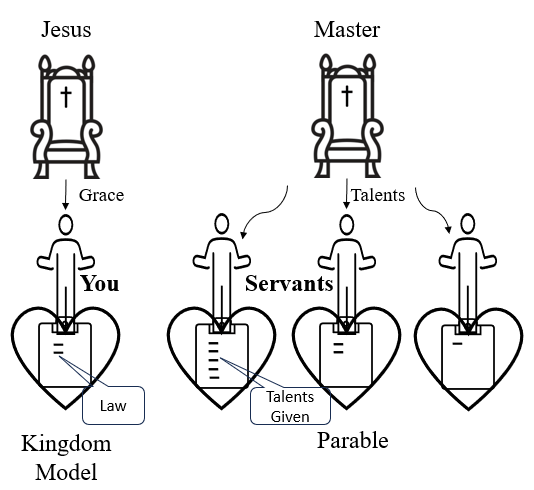
An abbreviated diagram of the kingdom model is on the left. There is only one thing you receive from Jesus: grace, divine love. That diagram shows that you received two units of grace. The model on the right is a diagram of the parable. Talents in the parable correspond to grace in the kingdom model. The number of talents given were written in their account as they were given. As we will see shortly, the account is referred to in the parable.
The master entrusted the first servant with five talents, the second with two, and the third with a single talent. The diagram on the right shows everyone’s status when the lord left.
According to verse 15, the talents were given to each servant according to his ability. The talents given correspond to grace. Grace is often thought of as favor, and it was unmerited because it was not given as a result of anything they had done to date. This translates to our situation because the talents given to us were determined before the foundation of the world, before we had opportunity to do anything.
In verse 16, the servant who received five talents went at once and traded with them and gained five more. The parable does not give any clue as to how the five talents were gained, but mapping the parable into the kingdom model adds that insight.
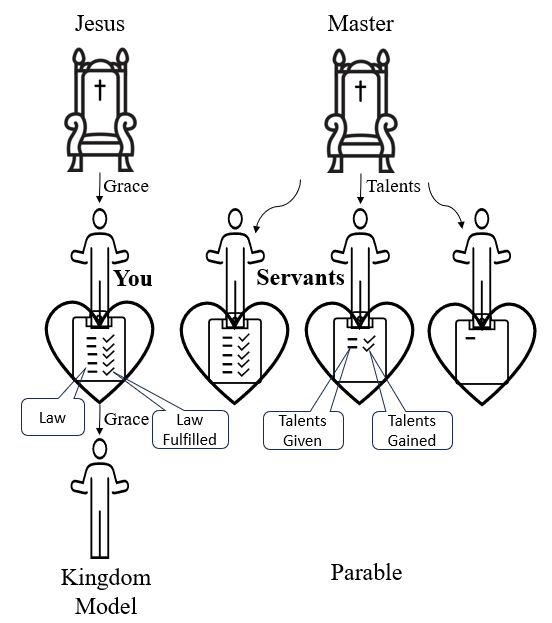
In the kingdom of heaven, you gain grace by fulfilling the law, by loving one another as you have been loved. The servant gained five talents by fulfilling all five laws. In a sister parable in Luke, the King James calls them pounds instead of talents. In that parable, each servant was given a single pound (talent), yet he was able to gain ten pounds (talents) from the single pound he was given. The point is that each law can be fulfilled many times over.
Although the first servant finished with ten talents, all the talents were not the same. The five talents given were unmerited favor, but the five gained were not. Had the five talents not been gained, all would have been lost. Not all grace is unmerited favor.
In verse 19, when the lord returned, the lord spent time with each of his servants reviewing with them the content of their account (logon). The first servant read from his account, “Master, you delivered to me five talents; here, I have made five talents more.” When he said here , he was pointing to his account showing the five entries of talents gained. The master’s approval of the servant was based solely on the content of the account.
This confirms that not only are the laws written upon the heart, but the fulfillments of the laws are also recorded there. This demonstrates Matthew 12:37 where it says that by the content of your account you will be justified and by the content of your account you will be condemned. It is not the absence of sin that justifies, but the presence of righteousness. All servants’ accounts were free from sin, but one was cast into the outer darkness because he lacked righteousness in his account.
The two-talent servant who had been given two talents gained two talents. The talents gained were entered in the fulfillment column as they were gained. The detail of them being added was not included in the parable, but we know the entries must have been made because, when the lord returned, they were found written in the account. This small detail answers a big question: when was the servant justified? Servants that were justified heard the words, Well done, good and faithful servant. Only the servants that gained at least one talent were justified. Had the single-talent servant gained a talent, no doubt he would have been justified as well. The point is that a servant is justified when a talent is added to his account.
This brings up an important issue. Persons not in the kingdom of heaven would not have been entrusted with the Lord’s goods, which indicates that all three servants were in the kingdom, however, not all of them heard the words, Well done, good and faithful servant. Did they lose their salvation? No. Even though they were in the kingdom, they were only justified when they gained a talent. Not everyone in the kingdom of heaven will be justified.
Another concept established by this parable is that when the goods were distributed, the servants had expected to give them back to the lord when he returned, along with any talents gained. We see this from verse 24. To their surprise, the lord gave each servant all their talents, both the ones they had been given and the ones they had gained. In the end, all the talents were gifts. Not all the gifts were equal, however, as the talents that had been given came with expectations. If those expectations were not fulfilled, the corresponding talents would be forfeited. The talents gained, however, were given with no strings attached. The Bible refers to those as free gifts. The talents given were also gifts, but they were not free. Talents given without corresponding talents gained are forfeited. This is the point of the second half of verse 29: But from the one who has not, even what he has will be taken away. The one who has not is the one who has not gained any talents. Talents that were given will be taken away unless they resulted in talents gained. This underscores the importance of the first fruits. Many talents can be gained from a single talent given, but it is the first talent gained, the first fruit, that secures the talent given.
John 15:11These things have I spoken unto you, that my joy might remain in you, and that your joy might be full.
This is exactly what Jesus was saying in John 15:11. The joy is the talent given. I am telling you to gain a talent (love one another as I have loved you) so that the talent (joy) might remain in you, and that your joy might be fulfilled, maximized.
Let’s look at the first half of verse 29. For to everyone who has will more be given, and he will have an abundance. Another question raised by the parable is this: what determined who would get the forfeited talent? And does it really matter, being only one talent? Given more refers to the person getting the talent(s) forfeited. The one who is given the talent forfeited is one who from whom the talent originated.
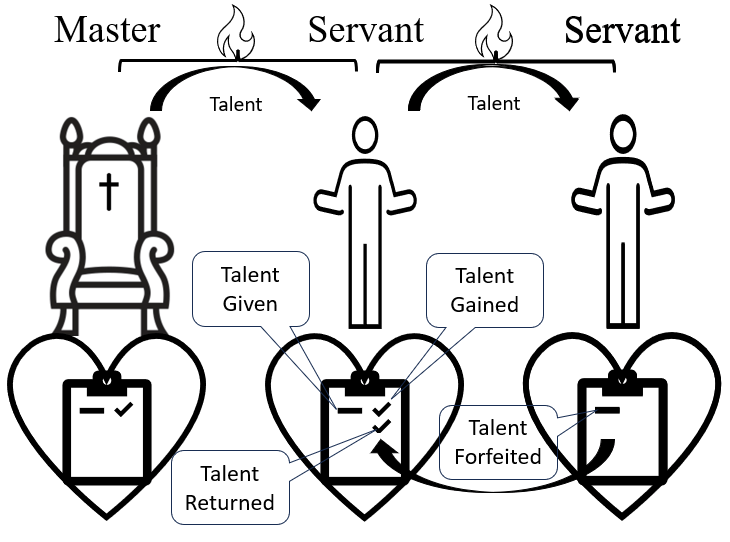
Do you see what just happened? The first servant gained a talent by loving the second servant. The second servant failed to gain a talent with the talent he had been given, he forfeited the talent. In the end, the servant who gained the talent was credited two talents for one-talent’s worth of work. This theme will resonate over and over again. We will see it in the parable of the sower, and again in the feeding of the five thousand. Amazing!
Another insight brought to us by this parable is that the talents were not given to the servants based on things they had done but were given to each according to his ability. Talents were given not because of work they had done in the past, yet to keep the talent, work needed to be done. Here is a verse that is typically used to support the concept that our salvation is not dependent upon our works.
2 Timothy 1: 9who saved us and called us to a holy calling, not because of our works but because of his own purpose and grace, which he gave us in Christ Jesus before the ages began, (ESV)
This verse makes it clear that our salvation is not according to our works. Look carefully at this verse, however. Not according to our works. This refers to work done on our own, apart from God. Works we do apart from God are dead works and have nothing to do with our salvation nor our holy calling.
And is his purpose and grace the reason for our salvation, or our holy calling? Is it salvation that is because of his purpose and grace, or is it his holy calling that is because of his purpose and grace? If our salvation was because of his purpose and grace, that would be a Calvinistic interpretation, where God singles out the ones he wants. If it is a holy calling that is because of his purpose and grace, the calling still needs to be fulfilled. The single-talent servant was given a holy calling, but failed to fulfill the calling. He was cast into outer darkness.
Consider the relationship between justification and righteousness. Compare the Greek for the two words.
Romans 4:5And to the one who does not work but believes in him who justifies (δικαιουντα) the ungodly, his faith is counted as righteousness (δικαιοσυνην),
The two Greek words are different forms of the same word. They are almost identical. Justification is not the absence of sin but the presence of righteousness. You have heard it said that a tree will naturally bear fruit, but Jesus also said that the branch that bears no fruit will be cut off and burned. A branch that bears no fruit is still a branch, and the branch being cut off must have been at one point attached to the tree. There are those in the kingdom of heaven that will, on the day of the Lord, be cast into outer darkness. Being in the kingdom of heaven does not guarantee eternal life.
In Matthew 12:37, Jesus said that we would be justified by the content of our account. Each time the law is fulfilled in you by the Holy Spirit, you are justified. Each time a law is fulfilled, righteousness is credited to your account. Justification is not a one-time event; it happens each time God works in you to do of his good pleasure. On judgment day, when your account is opened and righteousness is found therein, you will hear the words, Well done, good and faithful servant.
On that day, any grace that had not been fulfilled will be forfeited. To whom will it go? To the one who loved you and he had been loved. Which brings up another detail. Every record of grace credited to your account also includes the name of the one from whom you received that grace.
2 Corinthians 4:2But have renounced the hidden things of dishonesty, not walking in craftiness, nor handling the word of God deceitfully; but by manifestation of the truth commending ourselves to every man’s conscience in the sight of God.
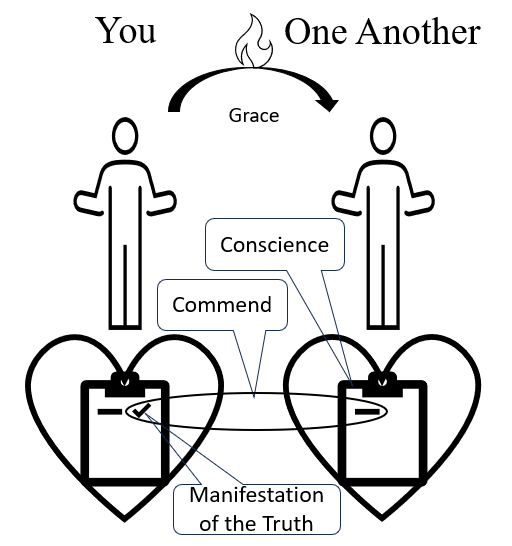
Here is an example of mapping a scripture into the model. Manifestation of the truth is the evidence part of faith, the evidence of things not seen. It is the work of the Spirit in you. The Spirit does not make an appearance, but his work is visible.
We commend ourselves to a man’s conscience with the transaction of love, writing the details of grace on both our accounts, with our name on his account, and his name on our account. Conscience is another word for the account. It may be more or less, but there is not enough to go on at this time to determine whether the two are equivalent.
This is done in the sight of God because he is the only one with access to everyone’s account. He is the one who looks upon the heart. We cannot.
2 Corinthians 3:2Ye are our epistle written in our hearts, known and read of all men:
I need another diagram to show what is going on here. I started to describe it in words, but it proved to be too confusing.

Paul received the gospel from Jesus. He wrote epistles to the churches (you), delivering unto them that which he had received from the Lord. Those in the churches were to share with others what they had received from Paul. – they became his epistles to be known and read of all men as they manifested the truth, commending themselves to every man’s conscience.
The value of the diagram should be apparent by now. Applying the diagram to this parable has brought to light many concepts that would not have been visible otherwise. We saw how talents were gained, we understood the distinction between gifts and free gifts, we appreciate that gifts were given not according to what we have done but that did not preclude the necessity for works of the Holy Spirit in us, and we see how justification in our past supports our future justification. Finally, it clarifies that not everyone in the kingdom of heaven will be invited into the joy of the Lord with the words well done thou good and faithful servant.
One thing that has disturbed me for a long time, and should disturb you as well:
Matthew 7:21“Not everyone who says to me, ‘Lord, Lord,’ will enter the kingdom of heaven, but the one who does the will of my Father who is in heaven. 22On that day many will say to me, ‘Lord, Lord, did we not prophesy in your name, and cast out demons in your name, and do many mighty works in your name?’ 23And then will I declare to them, ‘I never knew you; depart from me, you workers of lawlessness.’
The people Jesus was talking to clearly knew Jesus: they prophesied in his name and cast out demons. Surely, they were in the kingdom of heaven. They knew Jesus, but Jesus did not know them.
What did Jesus mean when he said I do not know you? When Adam knew Eve, they had children. When Jesus knows you, you will have children. When you fail to gain a talent, you will lose that talent, and this is not the talent you want to forfeit.
When you were born into the kingdom of heaven, a law was written on your heart. That was the first law, it was your first love. Each servant was given at least one talent. Whatever talents you have been given, you can be sure you have received this one.
Our primary duty is to bring children into the kingdom of heaven. Jesus is the father, we, the bride of Christ, are to bear his children. We were born into the kingdom of heaven, our rebirth being the first expression of love we receive. To keep a talent, we must gain a talent. This is one talent that we cannot afford to lose.
I am not saying that is the case, but the miracles done by the “workers of iniquity” look like righteousness to me. I am just raising the possibility, and making disciples is, after all, the Great Commission.
Birthing children into the kingdom of heaven changes your perspective. You go from “Jesus loves me, this I know” to “Jesus knows me, this I love.”
Continue to the next post. Parable of the Sower
You can return to the Home page here. Home
 New Wine
One thought on “Parable of the Talents”