“Grace” is one of the most important concepts in the Bible, Christianity, and the world. It is most clearly expressed in the promises of God revealed in Scripture and embodied in Jesus Christ.
Christianity.com.
The promises of God are bundled in the New Covenant. Christians typically think about grace in conceptual terms, having many definitions, each definition dependent on the context. In the English language, many words have multiple meanings, and we think of grace as being one of those words. But grace is more than a word, it exists as something tangible, a singular entity having characteristics, existing in many contexts. Like a dollar, that exists as something you put in your wallet, something that is recorded in a bank account, something that is owed, something that is loaned. Even though it exists in all these forms, a dollar is still a dollar. Unless we can picture grace for what it is, we are left with a bag of isolated attributes without any understanding of their inter-relationships, and that is where all the magic happens.
There are many elements that are unique to the New Covenant: righteousness, mercy, grace, and faith. If we had an accurate picture of the New Covenant, we would be able to identify these various elements; we would be able to picture grace as a single entity existing in many contexts, not just a collection of different ways the same word is used by the scriptures. We would be able to see grace for what it is, one entity that has its existence in many contexts, sometimes found in multiple contexts, even within the same verse. Confused? This is the mystery that has been hidden for ages and generations. The apostle Paul brought it to light, but the modern Church has subsequently all but hidden it.
Note: the New Covenant is not equivalent to what we call the New Testament. The New Covenant is found in both the Old and New Testaments. See the page on Rightly Dividing the Word.
One picture is worth ten thousand words – Chinese proverb
I call this page The True Gospel, because the Greek word for truth is αληθεια (Aletheia), Strong’s number G228. This word begins with alpha, a negative particle, which serves to negate the remainder of the word. You won’t know the meaning of truth unless you know what it is not. G228 is made up of two parts, G1 and G2990. G1 is alpha, a negative particle. G2290 is lanthanō, which is often translated into English as hidden.
What better way to unhide the gospel than with a picture.
Assembling the Picture
Jesus unwrapped the kingdom of heaven, documented most clearly in chapter 15 of the book of John where he begins with the statement, I am the true vine. By the time I am done, if I have done a good job, it should be clear how accurate the vine allegory is, how the kingdom of heaven is similar to a vine with all its entanglements, wrapping itself around everything, even back on itself just like a vine, covering the whole world.
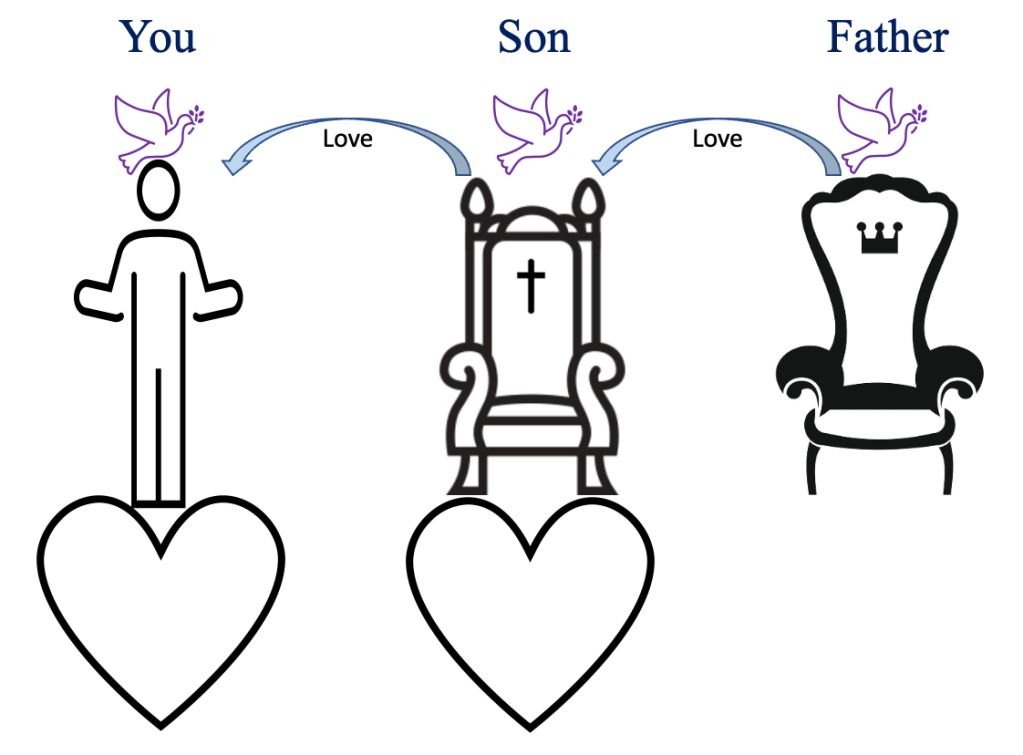
John 15:9As the Father hath loved me, so have I loved you:
My model starts with verse 9. This verse is pictured in Figure 1, where God the Father is seated on his throne, and Jesus is seated at his right hand. The love that the Father expresses to the Son is, in turn, expressed to you. Pretty basic, but more profound than it would seem.

Ezekiel 36:26A new heart also will I give you, and a new spirit will I put within you: and I will take away the stony heart out of your flesh, and I will give you an heart of flesh.
Ezekiel weighed in on the New Covenant in chapter 36. Figure 2 adds the details he provided. We have been given a heart of flesh and a new spirit, the Holy Spirit.
Matthew 3:16And Jesus, when he was baptized, went up straightway out of the water: and, lo, the heavens were opened unto him, and he saw the Spirit of God descending like a dove, and lighting upon him: 17And lo a voice from heaven, saying, This is my beloved Son, in whom I am well pleased.
In this verse, we see Jesus receiving the Holy Spirit as the Father expressed his love for his only begotten Son. This is a good example of the the Son loving us as the Father loved the Son. According to the model, when you are baptized, Jesus expresses his love for you, and the Holy Spirit is put within you. (Please put your “what abouts” aside – we are building a model, not solving world hunger – stay with me)
The next piece of the puzzle is taken from Jeremiah as he described the New Covenant.
Jeremiah 31:33But this shall be the covenant that I will make with the house of Israel; After those days, saith the Lord, I will put my law in their inward parts, and write it in their hearts; and will be their God, and they shall be my people.
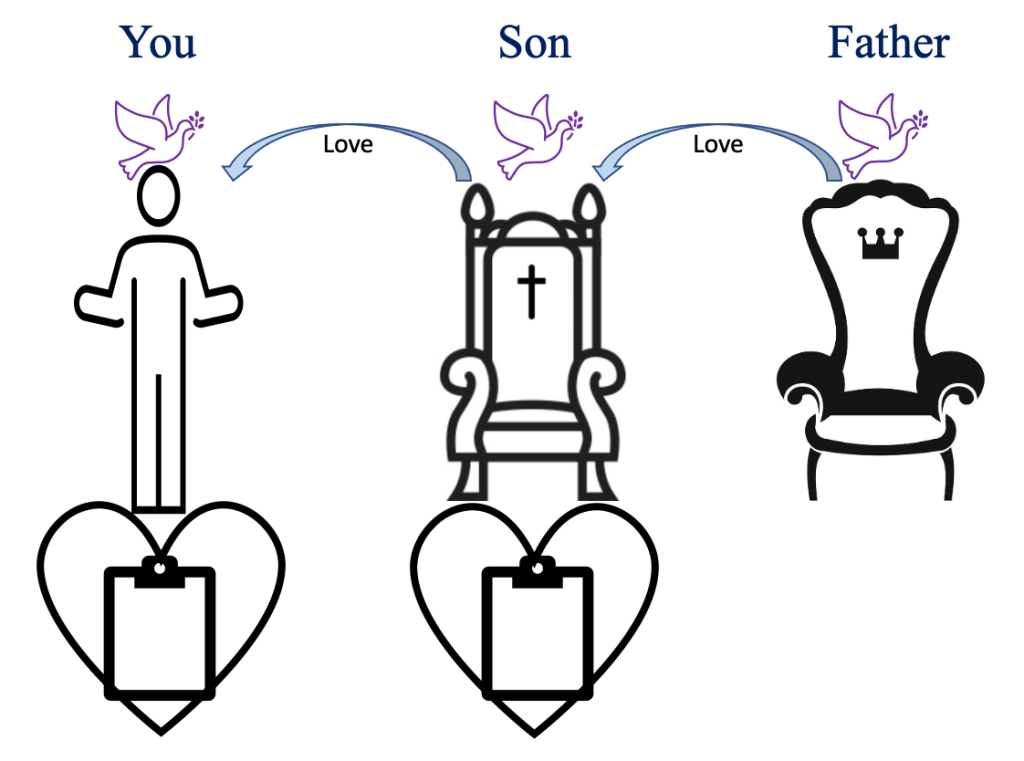
The law is written upon the table of your heart. On your heart is a table, a place to store data. According to Jeremiah, one piece of data recorded there is his law.
The next question is, what law is written there?
John 15:10If ye keep my commandments, ye shall abide in my love; even as I have kept my Father’s commandments and abide in his love. 12This is my commandment, That ye love one another, as I have loved you.
Jesus talked about keeping his commandments, plural, but then only gave us one commandment to keep. However, this one commandment is special in that no specifics are provided in the New Commandment. The point is, this commandment is structured in a way that no specifics are given until Jesus loves you. The specifics of the commandment are provided when he loves you, and each time he loves you, a new commandment, a new law is written upon your heart. This is how the singular commandment, the New Commandment, becomes plural, commandments that we are to keep.
It is informative to note that Jesus made a distinction between his own commandments and the commandments of the Father. He kept the Father’s commandments, and we are to keep his commandments.
Let’s add this further detail to the model from verse 12.
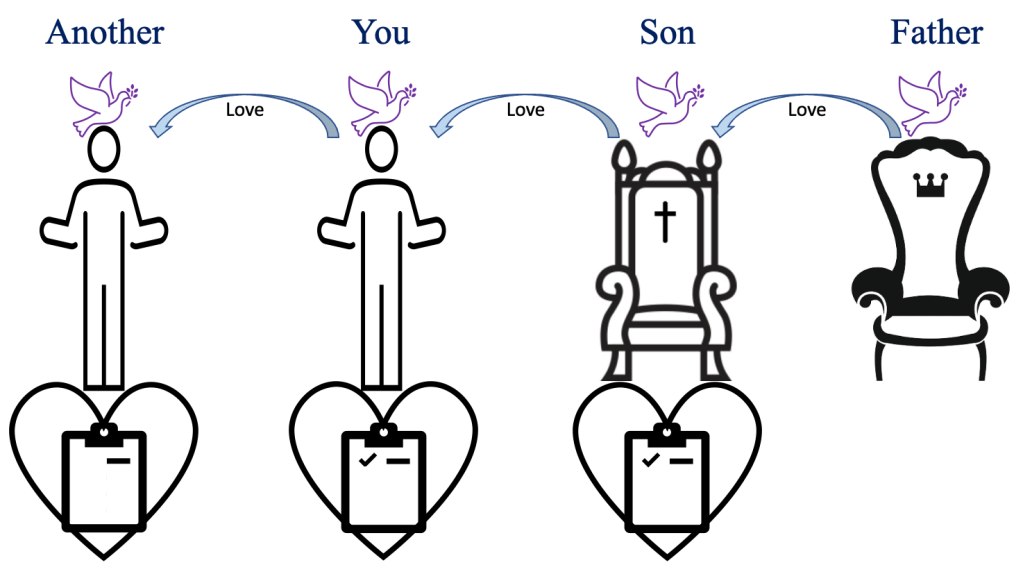
A new relationship has been added, the one between you and one another.
As you recall in the parable of the talents, the lord distributed his goods among his servants. The servants who were able to produce a gain were able to keep both the talents given and the talents gained. The servant who produced no gain could not keep even the talent he had been given. Although it is not stated in the parable, a servant gained a talent by keeping the commandment to love one another as he had been loved. The talent given was the divine love received from the Lord. For more details, see the Parables page.
Each law written upon your heart is God’s personal instruction to you. Each time he loves you, his incremental will for your life is written on the table of your heart. Each time a law is fulfilled in you, you produce a gain. When you do as he has commanded, when you love one another as he has loved you, you fulfill the corresponding law. But there is more to it than that; that is not the whole story.
Philippians 2:13For it is God which worketh in you both to will and to do of [his] good pleasure.
The love that flows from the Father to the Son, then to you, then from you to one another, is divine love. It is divine because it is the Holy Spirit that performs the work, both when you are loved and when you love one another. When you receive love from the Son, it is the Spirit that works in you to will of his good pleasure. When you love one another, it is the Spirit that works in you to do of his good pleasure.
Considering a single transaction of love, when you love one another, the Spirit works in you to do of his good pleasure. At the same time, the Spirit works in the other to will of his good pleasure.
The Lord’s prayer contains the request, thy will be done. That request involves the doing part, the will part having already been established in your heart. Thy will be done is an invitation to the Holy Spirit to use your resources to bear fruit in you as only he can, to fulfill the righteousness of the law in you. Thy will be done as it is in heaven is referring to the kingdom of heaven. The way it works in the kingdom of heaven is that the Holy Spirit works in you to fulfill the righteousness of the law, a law that was written on your heart during a prior transaction when you were on the receiving end of his love.
Hebrews 12:3Looking unto Jesus the author and finisher of [our] faith; who for the joy that was set before him endured the cross, despising the shame, and is set down at the right hand of the throne of God.
Jesus is the author of our faith; his divine love writing a law on your heart, providing a basis for your faith. Jesus is the finisher of your faith; the Holy Spirit, using your resources yielded to him by faith, fulfills the law, bearing fruit that will last, the righteousness of God. It will last on judgment day because it will endure the test by fire.
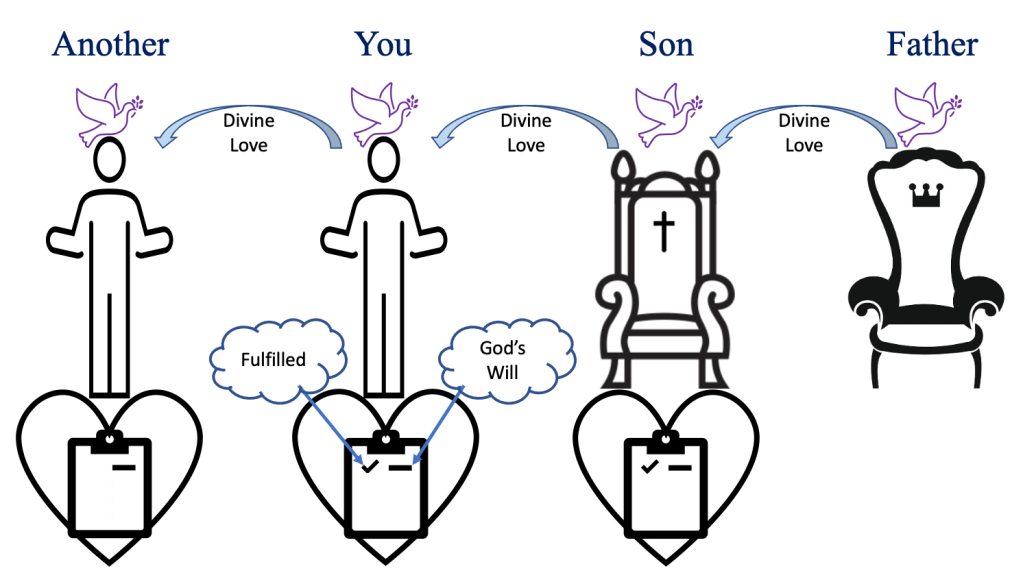
Romans 8:4That the righteousness of the law might be fulfilled in us, who walk not after the flesh, but after the Spirit.
Since it is the Spirit that does the work in you, the work is righteous. This work is also referred to as fruit of the Spirit.
Genesis 1:12And the earth brought forth grass, and herb yielding seed after his kind, and the tree yielding fruit, whose seed was in itself, after his kind: and God saw that it was good.
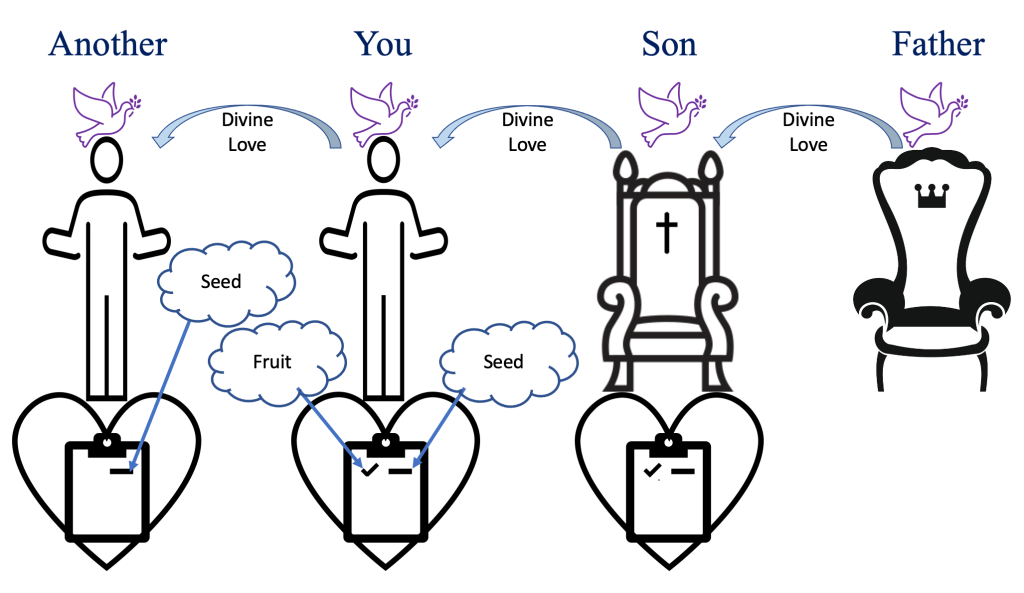
This is subtle, but the fruit contained the seed, after his kind. When you receive the love of God, the seed is planted. When that seed grows and bears fruit, that fruit has seed within it to reproduce after its kind. When you bear fruit, it is in the context of loving one another. That fruit is righteousness from your perspective, but it is seed from the perspective of the one being loved by God through you.
If you were to share the gospel with a group of people, for example, what came to you as seed would bear fruit that would provide seed from the perspective of those hearing you share the gospel. The model would look like this.
There is one more connection that needs to be addressed for our model to be complete.
Matthew 12:35A good man out of the good treasure of the heart bringeth forth good things: and an evil man out of the evil treasure bringeth forth evil things. 36But I say unto you, That every idle word that men shall speak, they shall give account thereof in the day of judgment. 37For by thy words thou shalt be justified, and by thy words thou shalt be condemned.
On the day of judgment, you will give your account to God. The Greek word for account is logon; it is a log, a record of things that have been done to you and through you. This account is on the table of your heart. It is the content of your account, the words written in your account, logōn, that will justify or condemn you.
Ephesians 3:2If ye have heard of the dispensation of the grace of God which is given me to you-ward:
The Greek word for dispensation means an administrative management. Under the New Covenant, there is significant administrative work involved. For every transaction, a record is logged in the account of the one in whom the law of love is fulfilled, and records are logged in the accounts of everyone receiving the love. This account is maintained by the Holy Spirit, who dwells in you. He is the one who keeps the records which will be brought forward on judgment day. If you had not yet guessed it, grace is the divine love whose source is the Father flowing through the Son, then on to you, then to another and then another. It is grace that is written in your account as a law; grace is also the fulfillment of the law.
Ephesians 1:10That in the dispensation of the fulness of times he might gather together in one all things in Christ, both which are in heaven, and which are on earth; even in him:
The dispensation of the fulness of times is talking about the period of time before judgment day, when all accounts are closed. Up until that time, the Spirit performs the administrative duties of record keeping. You may die before that day, but your account is not closed, even after you die. The work he began in you, he continues to perform it until the day of Jesus Christ. It is a good idea to leave a legacy wherein his work can continue long after you die, even until the day of Jesus Christ.
Romans 6:17But God be thanked, that ye were the servants of sin, but ye have obeyed from the heart that form of doctrine which was delivered you.
When you obey from the heart, you are fulfilling the law written therein, yet not you but the Holy Spirit that dwells in you. The form of doctrine that was delivered you was his divine love, written on the table of your heart by the Holy Spirit.
Now that the model is complete, are you able to identify grace as it exists in the New Covenant? I will provide one more figure of the New Covenant which labels grace so you can see its pervasiveness throughout.
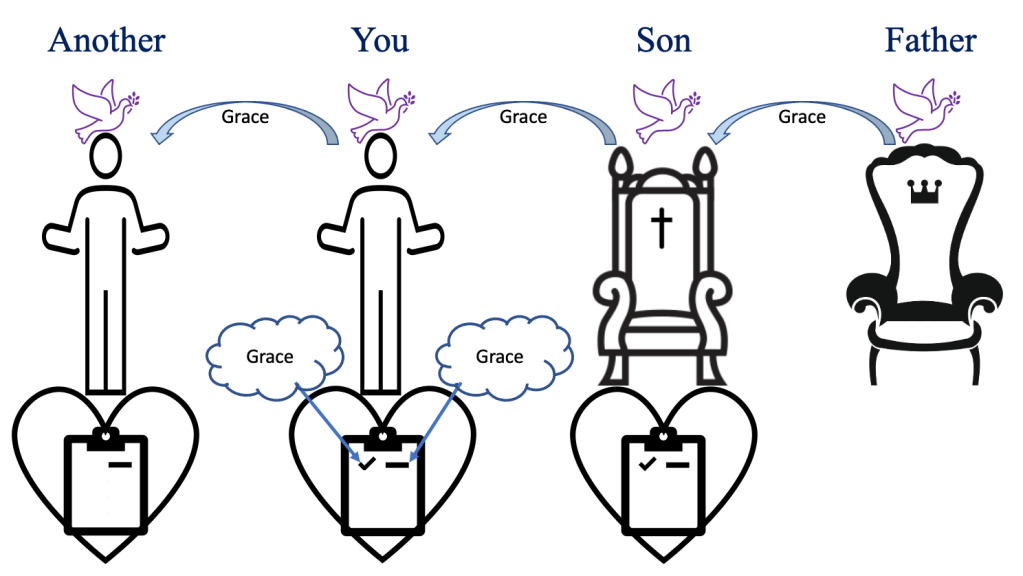
Grace is divine love which shows up throughout the model. Grace is the Father’s divine love for the Son. Grace is the Son’s divine love for you. Grace is your divine love for one another. Grace is the will of God written on the heart, also referred to as joy. Grace is the fulfillment of the law, righteousness of God written on the heart. Grace is also the fruit of righteousness, and the seed in the fruit.
Consider one instance of your divine love to another. To you it is the righteousness of God written on your heart, but to another, it is a law written upon their heart.
Grace is both the law, and the fulfillment of the law. All these different aspects of grace are interrelated, a concept that escapes our notice when we consider grace as merely a collection of separate attributes, each with their own definition. It is especially difficult to make sense of verses where grace is used more than once, each use in a different context.
Jeremiah 31:34And they shall teach no more every man his neighbour, and every man his brother, saying, Know the Lord: for they shall all know me, from the least of them unto the greatest of them, saith the Lord: for I will forgive their iniquity, and I will remember their sin no more.
One more observation. In this New Covenant model, sin is nowhere to be found. Sin is remembered no more, yet, if we look carefully, forgiveness of sin, known as mercy, is just one form of divine love automatically granted to you under the New Covenant. That love becomes a law written upon your heart in need of fulfillment lest you forfeit that love on judgment day. You are forgiven as you forgive. In this way you are still held accountable even though sin is remembered no more. Listen to what Jesus said right in the middle of his John 15 text:
John 15:11These things have I spoken unto you, that my joy might remain in you, and [that] your joy might be full.
The Greek word for joy, chara, is closely related to grace, charis. Joy is incoming grace. Jesus said, I am telling you these things so that, on judgment day, the grace you have been given will remain in you; you won’t forfeit it for lack of it being fulfilled. In the case of forgiveness, if you fail to forgive others for that which you have been forgiven, you will forfeit that forgiveness, and the measure you mete to another will be measured again to you.
Where does faith fit into the model? It takes faith to yield your resources to God as instruments of righteousness. It’s like trusting a friend with your brand-new car, handing him the keys and watching him drive away. What if he drives it into a tree and nearly totals it? Insurance will not cover it. Sometimes the Holy Spirit can be reckless with your resources. If he wrecks your car, will you let him use it again when he asks?
Faith without works is dead. Works without faith are dead works.
Where does circumcision fit into this model? Circumcision is the cutting off of the flesh. This was the seal of the covenant. You cut off the work of the flesh by yielding your resources to God as instruments of righteousness. Your salvation is sealed when the Spirit performs his first work of righteousness in you. That cannot happen unless you cut off the works of the flesh and allow the Spirit access to your resources.
Not every aspect of love the Father expressed to his Son was pretty. The Father gave his only begotten Son – not pretty. Yet the Son embraced this love. Jesus was persecuted, beaten beyond recognition – how about that love. Jesus embraced that love – he drank the cup that had been prepared for him. How are you to handle such love? By faith, trusting that, although others meant it for evil against you, God meant it for good. You take the love you have received, add faith, and allow the Spirit to love others through you with that same love. Not that you are to persecute others as you have been persecuted, but you share with one another the comfort and strength of the Holy Spirit that brought you through those trials.
Romans 8:17And if children, then heirs; heirs of God, and joint-heirs with Christ; if so be that we suffer with [him,] that we may be also glorified together. 18For I reckon that the sufferings of this present time [are] not worthy [to be compared] with the glory which shall be revealed in us.
Application of the Model
I will be using this model to explain various theological concepts, expanding on our understanding of the New Covenant. Righteousness, joy, peace, justification, imputation, faith, prayer, baptism, communion, forgiveness, the parables, and others, all explained in the context of the New Covenant. For the moment, if you are having difficulty understanding a passage, look at light of this model. I have been pleasantly surprised at the clarity this model brings to our understanding.
 New Wine