This section confirms the concept that grace is God’s divine love as it flows through the kingdom of heaven.
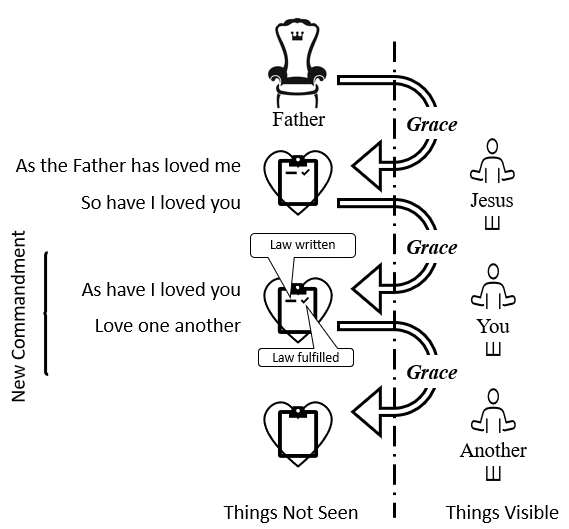
Grace touches everything in the kingdom of heaven. If I were to make an exhaustive study of grace, it would be exhaustive for you as well as for me, and I am not pleased to write more than you would be pleased to read.
Luke is the first book in the New Testament where charis is found. It is translated here as favour.
Luke 2:52And Jesus increased in wisdom and in stature and in favor (χαριτι, chariti) with God and man. (ESV)
This passage is interesting because charis (favor) is used once in this verse, but is found in two contexts: grace with God, and grace with man.
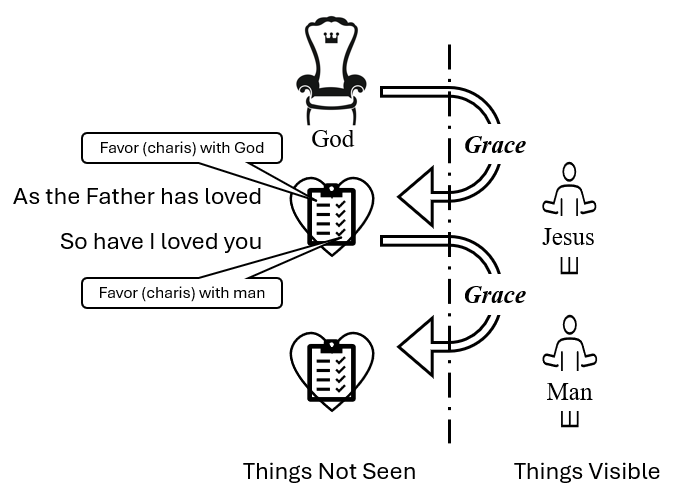
The first context is favor (grace) with God. In this context, grace is the law written on the heart. Each time the Father loved Jesus, a new law was written upon his heart. Each time the Father loved his Son, grace increased in the law column of his account.
The second context is favor (grace) with man. In this context, grace is the fulfillment of the law credited to the account. Each time the Son loved man as the Father loved him, the law written upon his heart was fulfilled and credited to his account.
In both cases, grace was the love of God.
John 1:14And the Word became flesh and dwelt among us, and we have seen his glory, glory as of the only Son from the Father, full of grace (χαριτος, charitos) and truth. (ESV)
Jesus was full of grace in that all God’s grace was channeled through him. Everything he received was grace from the Father, and everything he did was grace to others. Nothing he did was done apart from God.
John 1:16For from his fullness we have all received, and grace (χαριν, charin) upon grace (χαριτος, charitos). (ESV)
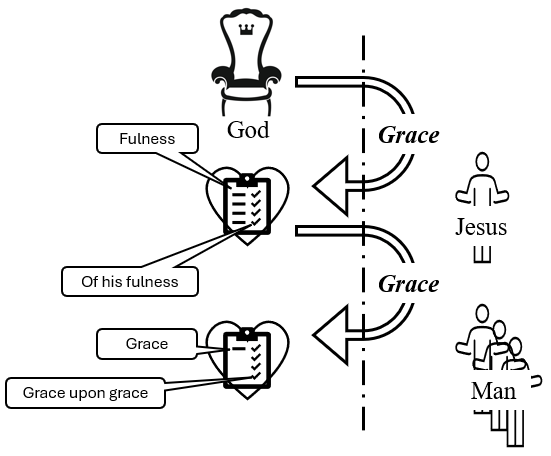
Jesus was full of grace, and that fullness was channeled to us through him. When we receive that grace, a law is written upon our heart, and the law is given so that it could be fulfilled. The reason he gave us grace was so that we would channel that grace to others.
King James says grace for grace instead of grace upon grace. Grace for grace would imply that we received grace for the purpose of distributing that grace, an action done by us, and in a sense it is something done by us, but not done apart from God. The law is fulfilled in us by the Spirit. Both grace received and grace delivered are gifts (grace) received from God. Both translations add a valid perspective.
John 1:17For the law was given by Moses, [but] grace (χαρις, charis) and truth (αληθεια, aletheia) came by Jesus Christ.
Grace came by Jesus Christ. As you recall, the first priesthood, Melchizedek, established the first law. The second law was given to Moses by God, written on tablets of stone. Jesus, a priest after the order of Melchizedek, came and restored the first law, grace. When you think of grace as the law, think of the New Commandment, love one another as I have loved you. This is grace, the law. The law of grace was with us from the beginning, even in the Old Testament. Those under the priesthood of Melchizedek were subject to that law.
Truth came with Jesus. The Greek word for truth is αληθεια, aletheia. It begins with an alpha, a negative particle, which negates the remainder of the word, lanthano. Lanthano means hidden. Truth reveals something that had been hidden. When Jesus came, he revealed the thing that had been hidden for ages and generations: the first law, the New Commandment: love one another as I have loved you.
Romans 12:3For by the grace (χαριτος, charitos) given to me I say to everyone among you not to think of himself more highly than he ought to think, but to think with sober judgment, each according to the measure of faith that God has assigned. (ESV)
When exactly did Paul receive this grace that was given unto him?
2 Corinthians 12:7So to keep me from becoming conceited because of the surpassing greatness of the revelations, a thorn was given me in the flesh, a messenger of Satan to harass me, to keep me from becoming conceited. 8Three times I pleaded with the Lord about this, that it should leave me. 9But he said to me, “My grace (χαρις, charis) is sufficient for you, for my power is made perfect in weakness.” Therefore I will boast all the more gladly of my weaknesses, so that the power of Christ may rest upon me. (ESV)
Paul received a thorn in the flesh to keep him from becoming conceited. Being conceited is when you think of yourself as being sufficient, apart from God. We all suffer from delusions of adequacy.
Paul characterized his thorn in the flesh as grace in Romans 12. Not all grace is pretty, and his advice is to avoid the unpleasantness of this grace by not thinking of ourselves more highly than we ought to think. We think of ourselves more highly than we ought when we think that just because we have received knowledge from God does not give us license to deliver the goods apart from the Spirit.
There are more scriptures that involve grace, but they are in conjunction with other elements for which words have not yet been assigned. As those elements are given word assignments, grace will be revisited. As an example of this, in Romans 12, Paul talks about measures of faith, faith being a word that has not yet been characterized. When you see what faith is, you will be able to better appreciate what Paul meant when he spoke of measures of faith.
 New Wine