Matthew 25:14For the kingdom of heaven is as a man travelling into a far country, who called his own servants, and delivered unto them his goods. 15And unto one he gave five talents, to another two, and to another one; to every man according to his several ability; and straightway took his journey. 16Then he that had received the five talents went and traded with the same, and made them other five talents. 17And likewise he that had received two, he also gained other two. 18But he that had received one went and digged in the earth, and hid his lord’s money. 19After a long time the lord of those servants cometh, and reckoneth (λογον , logon) with them. 20And so he that had received five talents came and brought other five talents, saying, Lord, thou deliveredst unto me five talents: behold, I have gained beside them five talents more. 21His lord said unto him, Well done, thou good and faithful servant: thou hast been faithful over a few things, I will make thee ruler over many things: enter thou into the joy of thy lord. 22He also that had received two talents came and said, Lord, thou deliveredst unto me two talents: behold, I have gained two other talents beside them. 23His lord said unto him, Well done, good and faithful servant; thou hast been faithful over a few things, I will make thee ruler over many things: enter thou into the joy of thy lord. 24Then he which had received the one talent came and said, Lord, I knew thee that thou art an hard man, reaping where thou hast not sown, and gathering where thou hast not strawed: 25And I was afraid, and went and hid thy talent in the earth: lo, there thou hast that is thine. 26His lord answered and said unto him, Thou wicked and slothful servant, thou knewest that I reap where I sowed not, and gather where I have not strawed: 27Thou oughtest therefore to have put my money to the exchangers, and then at my coming I should have received mine own with usury. 28Take therefore the talent from him, and give it unto him which hath ten talents. 29For unto every one that hath shall be given, and he shall have abundance: but from him that hath not shall be taken away even that which he hath. 30And cast ye the unprofitable servant into outer darkness: there shall be weeping and gnashing of teeth.
No doubt, this parable is familiar to you, and although the point of the parable seems to be that we should be diligent to gain talents, it is masked in mystery because it never indicated how talents are gained. Mapping this parable onto the model breathes life into the model, and the model breathes life into the parable. In my opinion, this is the most interesting of Jesus’ parables.
The cast of characters in this parable is the lord and three servants. As the story goes, the lord gave five talents to the first servant, two talents to the second, and one to the third. For simplicity sake, I will map only the two-talent servant into the model.
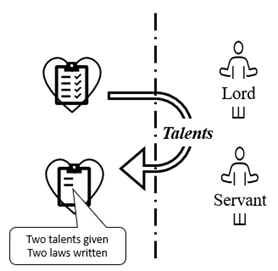
It is evident where the lord and the servant fit into the model, since the source of the talent is the Lord and the Servant is the recipient. Talents are the things being given, so it is mapped into the model as Love, the object of all transactions.
When talents are received, they are logged into the servant’s account. This diagram illustrates the status of the two-talent servant’s account at the time when the lord embarked on his journey. In verse 19, we see that it was the account (reckoneth = logon = account) that was referenced when the Lord returned. At this point, there are two talents written in his account, two laws written upon his heart, neither of which have been fulfilled.
Although not specifically stated in the parable, while the lord was away, the second servant gained two talents. We know this because when it was opened upon the return of the Lord, the talents gained were found in the account. The next figure shows the status of the account when the lord returned.
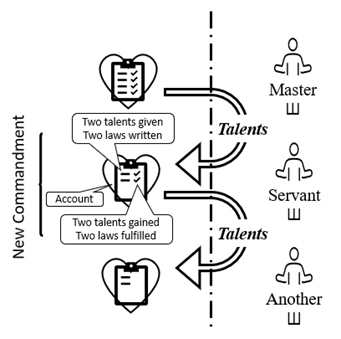
From the language of the parable, it is not clear how a servant would go about gaining a talent. However, when we map details from the parable into the model, it becomes clear how a talent is gained. In the model, there is only one thing given to the servant: divine love. When divine love is given, with it comes the expectation that the love was to be continued by loving one another. A talent is gained by obeying Christ’s New Commandment, to love one another as I have loved you.
In verse 19, when the lord returned, the lord did not ask the servant whether his beliefs were in alignment with essential doctrines. Rather, he spent time with each of his servants reviewing what had been written in their account. It says he reckoned, but the Greek word is logon, which is the account. The servant, reading from his account, said, Thou deliveredst unto me two talents: behold, I have gained two other talents beside them.
This confirms that not only are the laws written upon the heart, but the fulfillment of the laws is also recorded there. This agrees with Matthew 12:37 where it says that by the content of your account you will be justified and by the content of your account you will be condemned.
It is not the absence of sin that justifies, but the presence of righteousness, righteousness being the fulfillment of the law. The account of the third servant was free from sin but was also free from righteousness. The third servant was not justified because his account contained no righteousness. He was cast into outer darkness.
The two-talent servant who had been given two talents gained two talents. The talents gained were entered in the fulfillment column as they were gained. The detail of them being added was not included in the parable, but we know the entries must have been made because, when the lord returned, they were found written in the account. This small detail answers a big question: when was the servant justified? As we saw in the section on visualizing the language, we saw that the Greek words for justification and righteousness were almost identical: they share the same root word. Justification happened each time righteousness was added to the account. We are justified in the past when righteousness is added to our account. We will be justified in the future when the Lord returns and the righteousness that was entered into our account will be there on the day of the Lord.
Servants that were justified heard the words, Well done, good and faithful servant. Only the servants that gained at least one talent were justified. Had the single-talent servant gained a talent, he would have been justified as well. The point is a servant is justified when a talent is gained and credited to his account.
This brings up an important issue. Persons not in the kingdom of heaven would not have been entrusted with the Lord’s goods, which indicates that all three were in the kingdom of heaven. However, even though all three servants were in the kingdom, not all of them heard the words, Well done, good and faithful servant. Did they lose their salvation? No. Even though they were in the kingdom, they were only justified when they gained a talent. Not everyone in the kingdom of heaven will be justified.
Another concept established by this parable is that when the goods were distributed, the servants had expected to give them back to the lord when he returned, along with any talents gained. To their surprise, the lord gave each servant all their talents, both the ones they had been given and the ones they had gained. In the end, all the talents were gifts. Not all the gifts were equal, however, as the talents that had been given came with expectations. If those expectations were not fulfilled, the corresponding talents would be forfeited. The talents gained, however, were given with no strings attached. The Bible refers to talents gained as free gifts. Talents gained are equivalent to righteousness. The talents given were also gifts, but they were not free. Talents given without corresponding talents gained were forfeited. They were also gifts, but they were not free.
The concept of gifts having expectations emphasizes the importance of the first fruit. Talents gained are fruit. To keep a talent given, a servant need only gain a single talent. Additional talents can be gained, but it is the first one gained that secures the talent given. It is the first fruit that fulfills the expectation. Subsequent fruit produced is also credited, but it is the first fruit that secures the grace given.
1 Corinthians 3:13Every man’s work shall be made manifest: for the day shall declare it, because it shall be revealed by fire; and the fire shall try every man’s work of what sort it is. 14If any man’s work abide which he hath built thereupon, he shall receive a reward. 15If any man’s work shall be burned, he shall suffer loss: but he himself shall be saved; yet so as by fire.
Unsecured grace will be burned on that day. A man’s work abides if he has built thereupon. Grace, the law, is secured by grace, the fulfillment of the law. Belief is equivalent to obedience. The law to be obeyed is the first law: Love one another as I have loved you.
Another insight brought to us by this parable is that the talents were not given to the servants based on things they had done but were given to each according to his ability. Talents were given not because of work they had done in the past, yet to keep the talent, work needed to be done. Here is a verse that is typically used to support the concept that our salvation is not dependent upon our works.
2 Timothy 1: 9who saved us and called us to a holy calling, not because of our works but because of his own purpose and grace, which he gave us in Christ Jesus before the ages began, (ESV)
This verse makes it clear that our salvation is not according to our works. Look carefully at this verse, however. Not according to our works, does it refer to the holy calling, or to salvation? Is it salvation that is not according to our own works? Or is the holy calling not according to our own works? If we consider this verse in isolation, it seems like it could go either way.
But there is another clue in this verse, because it must refer to the same thing that but according to his own purpose refers to. Does he save us according to his purpose, or does he call us according to his own purpose?
It further states that this grace was given to us before the world began, which was before anyone had a chance to do any works, before there could be any fulfillment of the law. This grace was the talent given; it was the holy calling.
Consider the relationship between justification and righteousness. Compare the Greek for the two words.
Romans 4:5And to the one who does not work but believes in him who justifies (δικαιουντα) the ungodly, his faith is counted as righteousness (δικαιοσυνην),
The two Greek words are almost identical. Justification is not the absence of sin but the presence of righteousness. You have heard it said that a tree will naturally bear fruit, but Jesus also said that the branch that bears no fruit will be cut off and burned. A branch that bears no fruit is still a branch, and the branch being cut off must have been at one point attached to the tree. There are those in the kingdom of heaven that will, on the day of the Lord, be cast into outer darkness. Being in the kingdom of heaven does not guarantee eternal life.
There can seem to be a conflict on the topic of justification. Jesus said we would be justified or condemned on judgment day, yet the Bible is clear that we can be justified in the past, as Abraham was justified (past tense) by his faith. This conflict is resolved by the account, the contents of which are used to determine whether we are to be justified or condemned. Entries to the account are made prior to judgment day. We are justified when righteousness is credited to our account. We will be justified when righteousness is found in our account on judgment day. If we are justified in the past (before judgment day), we will be justified on judgment day.
The value of the diagram should be apparent by now. Applying the diagram to this parable has brought to light many concepts that would not have been visible otherwise. We saw how talents were gained, we understood the distinction between gifts and free gifts, we appreciate that gifts were given not according to what we have done but that did not preclude the necessity for works of the Holy Spirit in us, and we see how justification in our past supports our future justification. Finally, it clarifies that not everyone in the kingdom of heaven will be invited into the joy of the Lord with the words well done thou good and faithful servant.
There is one more observation to be made. The single-talent servant forfeited his talent, and it was given to the five-talent servant. The question is, what determines who gets the forfeited talents? In the model, each time love is transacted, the Spirit does the work, but a person is also involved. Future observations will confirm that forfeited talents are returned to the person whose resources were used to give the talent. This should provide motivation to love another, even when that servant is unlikely to continue in that love. It is in the interest of the sower to cast his seed everywhere, without regard to the type of soil upon which the seed is cast.
 New Wine