Mapping this parable into the kingdom model establishes some important aspects of the kingdom. It would easy to think that being free from the law means we are free from consequences, that if our sins are remembered no more, we will not be held accountable for them. That would be a mistake. In the kingdom of heaven, accountability is just handled differently.
Let’s dive right in.
Matthew 18:23Therefore is the kingdom of heaven likened unto a certain king, which would take account of his servants. 24And when he had begun to reckon, one was brought unto him, which owed him ten thousand talents. 25But forasmuch as he had not to pay, his lord commanded him to be sold, and his wife, and children, and all that he had, and payment to be made. 26The servant therefore fell down, and worshipped him, saying, Lord, have patience with me, and I will pay thee all. 27Then the lord of that servant was moved with compassion, and loosed him, and forgave him the debt.
This parable begins with the king reviewing the accounts of his servants. He sees an outstanding debt and confronts the servant, asking for payment. When the payment is not forthcoming, the judgment was that the servant and his family would be sold to satisfy the debt. The servant begged for mercy, and mercy was granted.
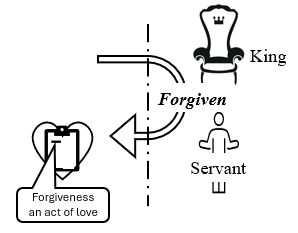
This is the status of the servant’s account immediately after the king forgave him. The servant’s debt to the king equates to sin, and although sin is remembered no more, grace is remembered. When the king forgave the debt, it was an act of mercy, which is an act of love. Mercy is a type of grace, God’s divine love. All mercy is grace, but not all grace is mercy.
At this point the servant is forgiven, but his forgiveness is dangling, a law in need of fulfillment.
Matthew 18:28But the same servant went out, and found one of his fellowservants, which owed him an hundred pence: and he laid hands on him, and took him by the throat, saying, Pay me that thou owest. 29And his fellowservant fell down at his feet, and besought him, saying, Have patience with me, and I will pay thee all. 30And he would not: but went and cast him into prison, till he should pay the debt.
An opportunity to fulfill the law presented itself when a fellow servant who owed him money, a much smaller debt, asked for mercy when confronted by his lender, the first servant. It is interesting to note that the words used by the fellow servant were identical to the words used by the servant when confronted by the king.
The servant failed to extend mercy, and law of grace was not fulfilled.
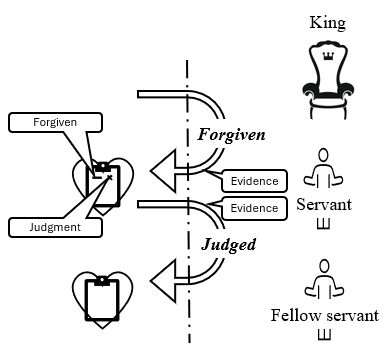
Being free from the debt, the servant considered himself exonerated, freed from the consequences. He had requested that he would be given more time to repay the debt, but instead, the debt was totally forgiven. Little did he know that the grace he had received from the king was contingent upon him fulfilling the law written upon his heart. The gift was not a free gift; there were strings attached. This gift was given with the expectation that the servant would continue in the love, to forgive as he had been forgiven.
Not all gifts are free. Dōron, translated as gift in all English translations, is more like a contribution with the undertone of investment. Perhaps gift is not an accurate word to be used when describing this Greek word, dōron. However, the Bible sometimes differentiates by calling some gifts free gifts, but I have not found this distinction to be always accurate.
Matthew 18:31So when his fellowservants saw what was done, they were very sorry, and came and told unto their lord all that was done. 32Then his lord, after that he had called him, said unto him, O thou wicked servant, I forgave thee all that debt, because thou desiredst me: 33Shouldest not thou also have had compassion on thy fellowservant, even as I had pity on thee? 34And his lord was wroth, and delivered him to the tormentors, till he should pay all that was due unto him.
When the servant responded to his fellow servant , the response passed through the realm of things seen, witnessed by other fellow servants. This would not have been significant, except that when the servant’s debt had been forgiven by the king, it had also passed through the realm of things seen, and was witnessed by the other fellow servants.
Notice that the initial judgment passed by the king was different from the judgment passed by the servant on his fellow debtor. The king would have sold the servant , his family, and all his possessions to settle the debt, whereas the servant threw the fellow servant into prison. In the end, the servant received the judgment he had passed on his fellow servant, not the original judgment.
Matthew 18:35So likewise shall my heavenly Father do also unto you, if ye from your hearts forgive not every one his brother their trespasses.
Isn’t this interesting: forgive his brother from your heart. The account is where the records are kept, on the tables of your heart. You do not have access to see what is in your heart, nor do you have the capability to write to your heart, yet you are expected to forgive from your heart. You have received mercy, to retain that mercy, you must grant mercy. Mercy is the love of God enacted through the agency of the Spirit.
That said, your conscience is a window into your heart. Every now and then, you are reminded of some unresolved issue in your heart. This is the Holy Spirit bringing to the surface something you should deal with. When that happens, an appropriate response would be to say to the Holy Spirit, Now that you bring it up, let’s deal with it, you and me. I am ready. I’ll follow your lead.
The only one with access to your heart is the Holy Spirit. You have received mercy by the Holy Spirit, and you must grant mercy by the Holy Spirit. This is the single greatest obstacle to forgiveness. We attempt to forgive in our own strength, apart from God. We try and try again to forgive, yet we know deep down that we still harbor unforgiveness against them (him? her?)
When I would be offended, I would say the words, I forgive you, and then avoid interaction with them, putting them out of my mind. I would be fine with them as long as I didn’t need to interact with them. The problem with my response was that my judgment was passed back to me, and I felt distant from God.
How do you deal with forgiveness in your own strength? Does the bitterness continually resurface?
Next time unforgiveness knocks on your door, pray this prayer. Holy Spirit, I sense unforgiveness in my heart against (the name of your debtor). I realize that the offenses that bother me the most are the ones of which I am guilty. The first thing I ask is that you show me how I have offended you, or even offended the least of these your brethren, so that I can first take the log out of my own eye. I realize that my offense is a log when compared to the sliver of the offense against me. Break my heart over my reckless behavior. Only then, I ask you to use me to love the one who offended me, using your strength, not mine. Do this in a way that will fulfill the righteous requirement of the law in me. Please do this, whatever it takes.
Romans 6:14For sin shall not have dominion over you: for ye are not under the law, but under grace.
It is so easy to think that being under grace relaxes accountability. This is not the case. In the kingdom of heaven, even though the law is configured in a way that works for us and not against us, we are still held accountable.
Matthew 7:1Judge not that ye be not judged. 2For with what judgment ye judge, ye shall be judged, and with what measure ye mete, it shall be measured to you again.
In order for God to measure to you the measure you metered, you must be given the opportunity to judge another. In the language of the kingdom, you must be given an opportunity to fulfill the righteous requirement of the law. That opportunity happens when someone offends you with the offense of which you are guilty.
Romans 5:20Moreover the law entered, that the offence might abound. But where sin abounded, grace did much more abound:
In fact, you may be given multiple opportunities to fulfill the righteous requirement of the law. When you are loved and love as you have been loved, grace is not a one-and-done deal. From a single sin, your grace may abound. You may be given multiple opportunities to forgive as you have been forgiven, each one a talent gained. This might seem like an easy strategy to accumulate grace to your account, but Paul immediately dissuades us from this notion.
Romans 6:1What shall we say then? Shall we continue in sin, that grace may abound? 2God forbid. How shall we, that are dead to sin, live any longer therein?
The general purpose of grace is God’s purpose, not ours. If we are intentionally committing offences to accumulate grace, it is according to our purpose, not God’s. But there is another reason not to do this.
Galatians 6:7Be not deceived; God is not mocked: for whatsoever a man soweth, that shall he also reap.
When we sow sin, we necessarily invite trespasses against ourselves. The seeds we sow often take years to mature and, when they do, you may become overwhelmed when they mature, some bearing thirty, sixty, even a hundred fold. You may wonder why God would allow all these bad things to happen to you, but it is just God giving you opportunity to fulfill the righteous requirements of the law. Grace for grace.
This is so important that Jesus established an ordinance that would allow us to keep current with our forgiveness obligations. It is important to keep them current because each time we procrastinate forgiveness, God brings more opportunities to fulfill the righteousness of the law, each time bringing to us a more severe offense. It may rise to a level you cannot overlook, forcing your hand to pass judgment. If you continue to put it off, the opportunity to fulfill the law may become overwhelming.
So, what is the ordinance that he put in place? Communion.
 New Wine