
Ephesians 2:8For by grace are ye saved through faith; and that not of yourselves: it is the gift of God. 9Not of works lest any man should boast.
A verse often quoted, little understood.
The Gift
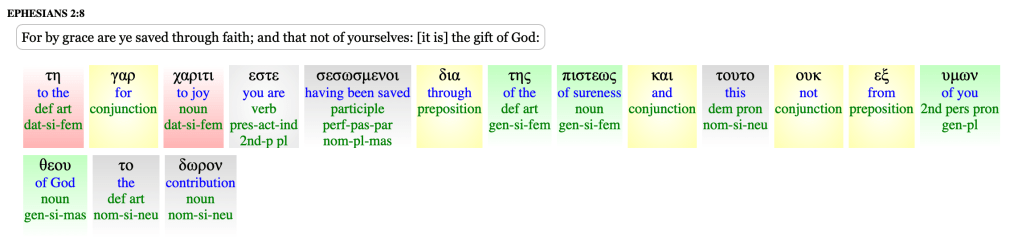
Here is a description of the Greek word for gift as found in Abarm, a website resource:
The noun δωρον (dōron), which describes the thing transacted, handed over, or transposed by means of the parent verb διδωμι(didomi). This word is not necessarily an equivalent of our English noun “gift” but rather of “contribution” with the undertone of “investment”. It’s the predominant New Testament word that describes periodic “offering” or “sacrificing”. The temple of YHWH in Jerusalem was not so much a house of worship, like a modern church, but rather a central bank and (inter)national academy combined (read our article on ναος, naos, meaning temple). The “offerings” the Israelites were told to make were not mere religious exercises, but rather contributions to the larger templar effort (Exodus 35:5, 35:29). Our noun δωρον (dōron) may denote templar or tax obligations (MATTHEW 8:4, HEBREWS 8:4), or a “gift” that has the obvious purpose of returning clout for the giver (LUKE 21:1). Likewise, the celebrated gifts of the wise magi were not expressions of mere veneration but rather a preliminary investment in Christ’s preordained ministry. Note also the use of this word in EPHESIANS 2:8, where it describes salvation as the “gift” from God. But where the Holy Spirit is a δωρεα (dorea) or “gratis gift” for all mankind (ACTS 2:17), man’s salvation has a distinct purpose to God, is a gift with expected return, and is thus bestowed with a formidable conditional footnote (MATTHEW 7:13-14, MATTHEW 7:21-23, PHILIPPIANS 2:12). Our noun δωρον (doron) occurs 19 times;
We hear so much about God’s unconditional love. What about God’s conditional love? Grace can be both conditional love and unconditional love, even at the same time. Does this even make sense? It does if you understand what grace is, and what makes something unearned from a Biblical perspective.
In Ephesians 2:8, the Greek word for gift is dōron, an investment given with the expectation of a return. Here grace is a conditional gift which, when faith is added, yields salvation. Grace alone does not save. Grace apart from faith does not save.
This is a sobering thought; a gift of God given as an investment, expecting something in return. Let us look at this from the perspective of the new covenant.
John 15:9As the Father hath loved me, so have I loved you: continue ye in my love.
Grace is the river of love that flows from the Father to the Son to us and through us to one another. That grace is given to us with the intention that we will continue in that love, loving one another until the Lord returns.
There is an incentive for us to conform to this process. In the parable of the talents, the lord distributed his goods to his servants. The goods were called talents. The servants who fulfilled his expectations were allowed to keep both the talents given and the talents gained. These talents were gifts in the long run, the servants’ eternal inheritance, even though the servants assumed that the lord, when he returned, would claim both the goods that he had given them and the talents they gained. The talents given were dōron, gifts given as an investment, and talents gained, dorea, free gifts, no strings attached.
The origin of the grace was God the Father, the Father of all glory. The grace was not given because of past performance. As in the parable of the talents, the talents were given severally according to their ability. Grace was not earned: it was not given because of something they had previously done. Grace was deserved because the Lord deemed them to have the ability to produce a gain in the future. They deserved a chance to do just that. It is easy to confuse earned and deserved, something that is done regularly from pulpits across America and beyond..
John 15:11These things have I spoken unto you, that my joy might remain in you, and [that] your joy might be full.
In the parable of the talents, the servant who did not gain a talent lost the talent and was cast into outer darkness. He did not get to keep his talent, even the one he had been given. That talent is grace. Jesus said that he told us what was expected of us so that his grace might remain is us: that we should comply so as not to lose the talents we had been given.The thing that he told us was to love one another as we had been loved – or else. In this verse, joy is grace received as opposed to grace gained.
If I were to tell someone that Jesus did it all and there is nothing we can do to contribute to our salvation, when we see that person on the day of the Lord being ushered into outer darkness and they glance back at us in sheer horror, I would know what was on their mind. “You said what Jesus did was sufficient, there was nothing I needed to do, and I believed you.” That would haunt me. If that was the message I was expected to deliver as the gospel, I would never share it with anyone.
Contrary to conventional theology, salvation is about works, just not your works. But how many works are required to be saved? Just one.
Romans 10:9That if thou shalt confess with thy mouth the Lord Jesus, and shalt believe in thine heart that God hath raised him from the dead, thou shalt be saved.
This is so subtle, that we would not even consider this as work. In the parable of the talents, to keep a talent, one had to gain a talent. The first talent one receives is the gospel of Jesus Christ. According to that principle, to keep that talent, one must gain a talent using that talent. Romans 10:9 refers to sharing the gospel with at least one other person. Salvation is about getting you invited into heaven. That is the only talent you will need to get to heaven. Even though all other talents are optional, without them, your inheritance would be severely limited. Our impression of heaven is that there will be no regrets, that just being in God’s presence will be enough. When we arrive at the other side with little or no inheritance, our main thoughts will likely begin with the phrase, if only.
Ephesians 2:10For we are his workmanship created in Christ Jesus unto good works, which God hath before ordained that we should walk in them
God has ordained works for us to do. These are actually works that he will do using the members of our body as instruments of righteousness. You may fear that you “miss his will” and fail to do the works he has before ordained. Not to worry. If you yield your members to him, he will do the works and they will be good, they will be righteous, and they will be credited to your account, contributing to your eternal inheritance. When you envision yourself in heaven, do you envision any difference between the eleven-talent servant and the four-talent servant. It may not matter to you now, but do you think it will matter then?
Faith plays an important role. Faith is not passive, not just letting go and letting God. “OK, God, you do your thing and I’ll do mine.” Faith is actively yielding our members as instruments of righteousness to God for him to use in ways beyond our control and beyond our imagination. God’s work in us is righteous; works that we do apart from him are not righteous, called sin. Anything we do on our own is not added to our account because our account only contains righteousness, as long as we are under grace and not under the law. Apart from God, our contribution to the account is nothing. The trick is to exercise our faith in a way that gets God to use our members as instruments of righteousness.
To make that work, our faith must be grounded; not just based on a whim, a feeling that “God is telling me to do… fill in the blank.” Jesus is the author of your faith. Every act of his love directed at you is a commandment written on your heart. What he commands you to do, he will also fulfill in you by the Holy Spirit who indwells you, but you need to trust him. You need to make your resources available to him, and that takes faith.
 New Wine