
Matthew 9:13But go ye and learn what [that] meaneth, I will have mercy, and not sacrifice: for I am not come to call the righteous, but sinners to repentance.
Sacrifice is the process used to absolve sins under the Old Covenant. Mercy is the way sin is handled under the New Covenant. God prefers the New Covenant approach.
What is the difference between grace and mercy? The two are intimately connected, yet distinctly different.
Where grace is the law of the New Commandment, love one another as I have loved you, mercy is the law of the golden rule.
Matthew 7:12Therefore all things whatsoever ye would that men should do to you, do ye even so to them: for this is the law and the prophets.
The golden rule is similar to the New Commandment. Where the New Commandment is the law of grace, the golden rule is the law of mercy. The law of mercy is a transposition of the law of grace. Under the New Commandment the precedent is set by you being acted upon, you being loved, and the antecedent is your response to that action, how you are to love others. Under the golden rule the precedent is your action, how you treat others, and the antecedent is God’s response as to how he should treat you, which you indicated by treating them the way you wanted to be treated. This is a rare moment when God follows your lead. Normally we are to follow his lead.
So how is this handled in the model?
Mercy is forgiveness; letting people off the hook for their sins. When God lets me off the hook, he gives me grace, divine love. This divine love is automatically logged to my account as a law, complete with the details of the offense. As in any other law, I fulfill this law when I forgive others as I have been forgiven.
Am I required to forgive all offenses? Where there is no law, no fulfillment of the law is required. Forgive us our trespasses as we have forgiven those who trespass against us. We are not obligated to forgive others for things we are not guilty of. However, it is not always clear whether I am guilty of a particular offense. It is best for me to assume that I am guilty, and it is safest to assume that the law of forgiveness has been written upon my heart.
We have not yet talked about the consequences for not fulfilling the law. This is covered in the discussion on the parable of the talents. Suffice it to say that grace received is lost when that grace is not fulfilled. Forgiveness is a gift, but it is not a free gift: there are strings attached. Forgiveness is conditional. Let us consider the parable of the unforgiving servant.
Matthew 18:21Then came Peter to him, and said, Lord, how oft shall my brother sin against me, and I forgive him? till seven times? 22Jesus saith unto him, I say not unto thee, Until seven times: but, Until seventy times seven. 23Therefore is the kingdom of heaven likened unto a certain king, which would take account of his servants. 24And when he had begun to reckon, one was brought unto him, which owed him ten thousand talents.25But forasmuch as he had not to pay, his lord commanded him to be sold, and his wife, and children, and all that he had, and payment to be made. 26The servant therefore fell down, and worshipped him, saying, Lord, have patience with me, and I will pay thee all. 27Then the lord of that servant was moved with compassion, and loosed him, and forgave him the debt. 28But the same servant went out, and found one of his fellowservants, which owed him an hundred pence: and he laid hands on him, and took him by the throat, saying, Pay me that thou owest. 29And his fellowservant fell down at his feet, and besought him, saying, Have patience with me, and I will pay thee all. 30And he would not: but went and cast him into prison, till he should pay the debt. 31So when his fellowservants saw what was done, they were very sorry, and came and told unto their lord all that was done. 32Then his lord, after that he had called him, said unto him, O thou wicked servant, I forgave thee all that debt, because thou desiredst me: 33Shouldest not thou also have had compassion on thy fellowservant, even as I had pity on thee? 34And his lord was wroth, and delivered him to the tormentors, till he should pay all that was due unto him. 35So likewise shall my heavenly Father do also unto you, if ye from your hearts forgive not every one his brother their trespasses.
Taking this from the top, when Jesus told Peter that seventy times seven was the number of times he should forgive his brother for sins against him, he was referring to the seventy weeks of Daniel. According to Daniel, sacrifices were to be made for the forgiveness of sins for seventy weeks; seventy times seven. Once a year for four hundred ninety years, on the day of atonement, God would forgive the sins of his people. Jesus did not choose this number at random. Peter was not required to forgive more times than God.
I refer to this parable to add the concept of mercy to the kingdom of heaven, and to provide a system of accountability in a kingdom where sins are remembered no more.
In this parable, a certain king, while taking account (the word for account is logon, where all divine transactions are logged) of his servants, came across a servant who owed ten thousand talents. In that the servant was not able to pay, the king commanded that the servant’s family be sold to settle the debt. The servant begged for mercy, and the king had pity and forgave the debt.
There might seem to be a conflict here. Under the New Covenant, sins were to be remembered no more. How is it that, when reviewing the account, this debt was discovered? The debt was embedded in the description of the forgiveness he had received which had become a new law written upon his heart.
The law the servant had to fulfill was that he had been forgiven for the unpaid debt he owed the king. To fulfill that law, he would have to extend that forgiveness to another.
After he had asked for and received mercy, it seemed like the slave thought he was in the clear. However, that was not the case, for the righteousness of the law had not yet been fulfilled in him. His forgiveness was unsecured at this point.
The servant begged for mercy, and the king forgave the debt. Let us invoke the model at this point to see where we are.
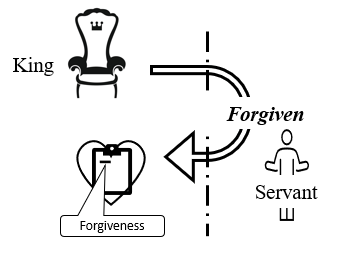
At this point the servant is forgiven, and it would seem that all is well. The mercy that the servant received was an act of love, recorded in the servant’s account as a law. To retain that mercy, that law must be fulfilled.
An important point to consider: we have all heard sermons about how God’s love is unconditional, and we have wholeheartedly bought into that concept. However, the mercy this servant received was God’s conditional love. This love became a law that required fulfillment, otherwise it would be forfeited. Selah.
(Selah is a word found in some of the Psalms that means to pause and absorb what has just been said.)
This situation creates a problem. In order for you to be able to fulfill the law of mercy, you must be given the opportunity to fulfill it.
A new character enters the parable, a fellow servant. This new character gives the servant an opportunity to fulfill the law that had been written upon his heart when the king showed him mercy. God will enlist someone who will offend you as you have offended him. Now is your chance to fulfill the law of mercy and secure your forgiveness!
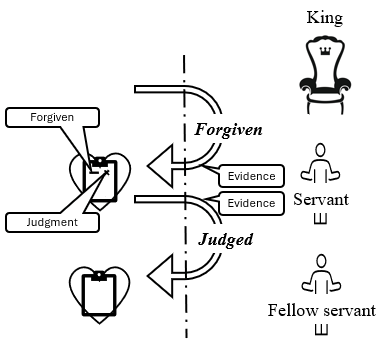
Instead of forgiving his fellow servant, he cast him into prison, and this is the judgment that was later imposed on him. This judgment was not the same as the one the king originally imposed on the servant, which was to sell him and his family to settle the debt.
When the king heard how the servant had treated the fellow servant, mercy was withdrawn, and the judgment imposed on the fellow servant became the new judgment that would be imposed on the servant.
Matthew 18:35So also my heavenly Father will do to every one of you, if you do not forgive your brother from your heart. (ESV)
Seeing mercy as a component of the kingdom of heaven, forgiveness from the heart is a concept that takes on a whole new meaning. Forgiveness from the heart is an act of love performed in you by the Holy Spirit. How many times have you tried to convince yourself that you forgave that person who offended you, yet you know in your heart it did not stick? No matter how many times you say the words, you know it didn’t work. That is because forgiveness was not performed by the Spirit. But the concept of God’s conditional love is foreign to many of us.
The concept of God’s love being conditional flies in the face of everything we have been taught. This is considered a foundational truth upon which much of our theology rests. Everyone knows that all God’s love is unconditional, right? That is a given, or so we have been told. – Selah –
Matthew 6:12and forgive us our debts, as we also have forgiven our debtors. (ESV)
We pray this prayer, yet the concept of God’s conditional love remains foreign to us. We have lived with this apparent conflict for how long?
Let’s take a moment to walk together through the stages of grief, stages that also are typical of cognitive dissonance. The first stage is denial:
All God’s love is unconditional! I cannot accept the notion of God’s conditional love!
The second stage is anger:
How dare anyone insinuate that God’s love could be conditional!
Please do not continue until you at least pass through this stage.
The next step is depression:
I have tried my hardest to forgive. I have said the words, but I know it hasn’t worked. I don’t know how to make it right. The power is not within me to forgive.
You can be stuck in this stage for years.
Then comes bargaining:
I’m willing to try again. I can see how important this is. I’m ready to forgive, help my unforgiveness.
Selah.
Once you reach the bargaining stage, you are ready to move into the acceptance stage. At this point, you are ready to continue to solve your dilemma and forgive from the heart.
The final phase is acceptance. This is where you forgive from the heart. Forgiving from the heart involves the work of the Spirit in you. This is why, more often than not, saying the words, I forgive you, doesn’t work. You say the words, but you still feel the resentment of unforgiveness.
You have been given the opportunity to determine the judgment that you would be pleased to receive if you were the offender (and you are).
Lord, I am willing to love this person, my enemy. I know this must be done in the Spirit; it is not something I can do on my own. I trust you with my resources and offer them to you for the purpose of bearing fruit. Provide the opportunity and the strength, I will provide the resources. I am ready for you to forgive through me.
At this point, you make yourself available as opportunity arises. When you are in the vicinity of your offender, you approach them and wait on God. You wait to see what he will do. Your eyes are on God, not on your offender. This is what it means to walk by faith. You know there is a law written on your heart, even though you cannot see it. You know it is the job of the Holy Spirit to fulfill the righteousness of the law in you. You may not see his work, but you will experience the outcome of his work as you take your resentment temperature. Has your relationship with that person been normalized? It may take more than one session. Just keep your eyes on Jesus. Wait on him to do his work.
To fulfill the law of mercy, you love one another as you have been loved; you extend mercy to the one who has offended you. The operative word here is love. Forgiveness is an act of love, extending love to the offender. I find the best vengeance taken against an enemy is to love them.
Matthew 5:44But I say to you, Love your enemies and pray for those who persecute you, (ESV)
Loving your enemies is supernatural love, but that is what the love of the Holy Spirit is. If you can do this, it can only come from the heart, it is not something you should attempt on your own. But why should you do this? Forgiving from the heart involves the Holy Spirit. You could intentionally forgive by asking the Holy Spirit to love that person through you, acknowledging that he must do it, because you have no idea how to proceed, and proceeding without him is not doing it from the heart.
This is the prayer I pray when I need to forgive someone: I make myself available to you, Lord, to love this person that has offended me deeply. If I have offended you in this way, please show me. If I could see how I have offended you in this way, it would give me appreciation for how deeply I hurt you. I recognize that if I had done it to the least of these, our brethren, I would have done it unto you. Bring to mind those I have hurt so that I can mend the relationships I have destroyed, giving them reason to not want anything to do with either one of us.
What about sins committed before you became a Christian? Before you received your new heart? When you consider how Jesus will implement his judgment, the basis for his judgment will be the content of the account that we will give him. When you gave your heart to Jesus, the sins listed in your account became his responsibility. When you received your new heart, you received a new identity, a new name, universally unique. The link to your old identity was lost.
That said, when you are offended by an offense you committed before you gave your heart to Jesus, thinking that forgiveness in this case is optional is not a safe strategy. It is sometimes elusive to determine if your heart contains an unfulfilled law. The safe bet is to forgive from the heart for all offenses.
 New Wine