Faith
The Greek word for faith is pistis. This word or a derivative thereof is found 244 times in the New Testament.
As in the chapter on grace, I will make an initial guess as to what faith might be, examine this guess in the various contexts in which it is found, and make adjustments as needed. I think you will find, as I did, that faith is the most challenging, but most interesting word in the Biblical vocabulary.
Characteristics of Faith
Before making an unwarranted guess as to what faith might be, I want to make sure my hypothesis takes into consideration a few of its key characteristics.
Hebrews 12:2Looking unto Jesus the author and finisher of our faith;
Jesus is the author and finisher of our faith. Jesus is the one who authorizes our faith, and he is the one who finalizes it. Faith that is authorized but not finalized is incomplete faith.
Hebrews 11:1Now faith is the substance of things hoped for, the evidence of things not seen.
Here is another verse that supports the concept that faith is a two-part construct: the substance of things hoped for, and the evidence of things not seen. Unless I find otherwise, my speculation is that these two parts correspond to the two previous parts, where authorization of faith is the substance of things hoped for, and finalization of faith is the evidence of thing not seen.
Ephesians 2:8For by grace are ye saved through faith; and that not of yourselves: [it is] the gift of God:
We are saved by grace through faith. Grace through faith is a gift of God. Drawing from the parable of the talents, we learned that the talents, both talents given and talents gained, were gifts.
My guess is that faith authorized is very much like the talent given, and faith finalized is like the talent gained. Salvation is by grace through faith.
Grace Reviewed
Since my claim is that grace and faith are intimately related, we should refresh our understanding of grace from the chapter on grace. As it relates to faith, grace shows up in the model in two contexts: the law written on the heart, and the fulfilment of that law.
The figure below illustrates grace, as determined by the chapter on grace. From the parable of the talents, we recognize both the law and the fulfillment of the law as gifts.
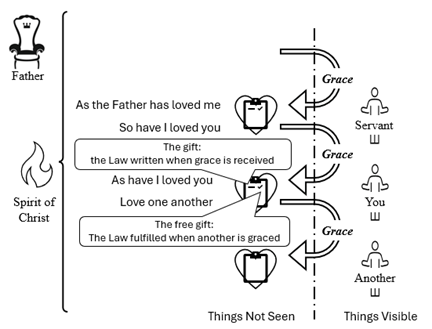
On the left are the things visible only to God. When the scriptures mention in the sight of God, it refers to things on the left.
The law written on the heart is a gift given with the undertone of expectation of a return on the investment. As we saw in the parable of the talents, the gift was forfeited when it was not secured by gaining a talent. In other words, grace is lost when the law is not fulfilled.
The free gift is the grace associated with the fulfillment of the law. This gift is given without strings attached.
Faith Visualized
This is a word study on faith. I will be considering many verses where faith is found, illustrating faith in its context
Hebrews 12:2
Hebrews 12:2Looking unto Jesus the author and finisher of our faith;
Faith has two distinct elements: authorization, and finalization. Faith is authorized when Jesus loves me, and faith is finalized when Jesus loves another through me. This is illustrated below.
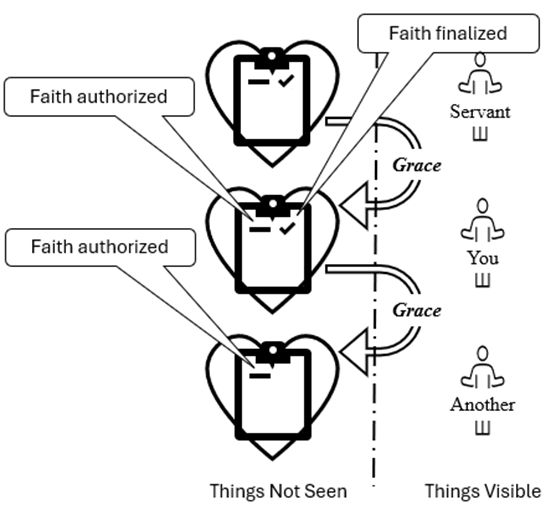
Faith is authorized when Jesus loves you. It is finalized when you fulfill the New Commandment : love one another as I have loved you. Complete faith is the law and the fulfillment of the law.
As you can see from the diagram, when you fulfill a law, that grace propagates to another by writing that law on their heart.
Using language from the parable of the talents, the talent given by the master relates to Jesus authorizing the servant’s faith. The talent gained relates to the finishing of the servant’s faith as he fulfills the righteousness of the law. This illustrates the importance of faith being finished: unfinished faith results in grace being forfeited.
Hebrews 11:1
Hebrews 11:1Now faith is the substance of things hoped for, the evidence of things not seen.
Using different language, Hebrews 11 also describes faith as a two-part entity: the substance of things hoped for, and the evidence of things not seen. This perspective is illustrated in the following figure.
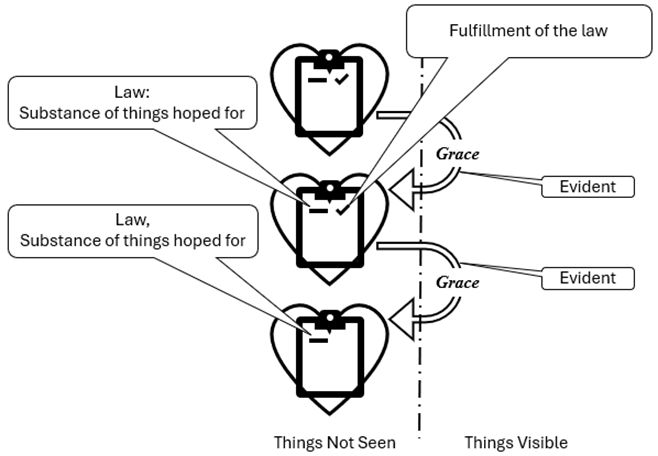
The substance of things hoped for is grace, the law written on the heart. This grace makes an appearance as it is received, travelling through the domain of things visible. Once it is received, however, it is written in the account, hidden in the heart where it can only be seen by God.
When the law is fulfilled, that grace once again becomes visible, becoming evidence of things not seen. For a brief moment, that grace can be seen by you and the other person.
Being able to see that grace, as it comes and as it goes, is the only way to know what is being written on your heart. The laws written on your heart are God’s will for you. If you fail to recognize this, you will forever wonder what his will for your life is.
Faith is like a seed. Before you plant it, you can see it. Once you plant the seed, it is buried, and you can no longer see it. You plant it in the hope that it will bear fruit. This is the substance of things hoped for. Hopefully you remember what you planted, because it will not be visible again until after it grows and bears fruit. The fruit is the evidence of things not seen; the thing not seen is the seed planted in the ground, the law written on your heart, the substance of things hoped for.
Like the seed, when Jesus loves you, it is tangible; you can see it. When you see it, make a note of what has been planted in your heart, because you will be expected to bear fruit after its kind.
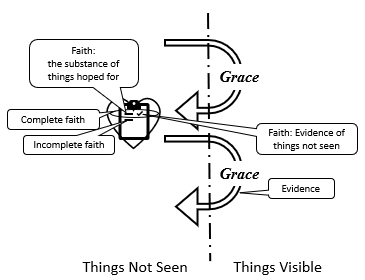
The substance of things hoped for is faith. The evidence of things not seen is also faith. Complete faith is the combination of the two: faith authorized, and faith finalized. Either part can exist independently, but grace through faith is the combination of the two. We are saved by grace through faith.
Ephesians 2:8
Ephesians 2:8For by grace are ye saved through faith (πιστεως, pisteōs); and that not of yourselves: [it is] the gift (δωρον, dōron) of God:
We are saved by grace through faith. As I have claimed, faith is two elements of grace: the law, and the fulfillment of the law. Grace through faith includes both elements of grace.
Grace is performed in partnership with God, not something you can accomplish apart from God; it is not of yourselves.
The gift spoken of here, dōron,refers to the law, because dōron refers to a gift given with the expectation of a return on the investment, not a free gift.
2 Corinthians 6:1
2 Corinthians 6:1Working together with him, then, we appeal to you not to receive the grace of God in vain.
This is an example where the substance of things hoped for is not completed by the evidence of things not seen.
Receiving the grace of God in vain refers to when you receive the love of Jesus, but do not fulfill the righteousness of the law by loving one another as he has loved you. This is like in the parable of the talents, when the single-talent servant received his talent in vain. When the master returned, the talent was forfeited and given to another. Having failed to gain any talents, he was cast into outer darkness, for there was no righteousness in his account when the master returned.
Not all laws require fulfillment, but to be saved you must have completed at least one. All unsecured grace will be lost, but having fulfilled at least one law, you will be saved.
The point is that both elements of grace are required for the grace to be secured. Here is an example where the evidence of things not seen is found in isolation, having not been authorized by Jesus.
Matthew 7:21“Not everyone who says to me, ‘Lord, Lord,’ will enter the kingdom of heaven, but the one who does the will of my Father who is in heaven. 22On that day many will say to me, ‘Lord, Lord, did we not prophesy in your name, and cast out demons in your name, and do many mighty works in your name?’ 23And then will I declare to them, ‘I never knew you; depart from me, you workers of lawlessness.’
Those Jesus was addressing had entered the kingdom of God, for the Spirit was clearly working in them. Yet they were denied entry into the kingdom of heaven because they lacked grace through faith. The manifestation of the Spirit was there, but no law had been written.
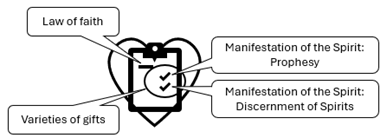
Figure 5‑1 – Grace through faith
Grace through faith includes both elements of grace: the law and the fulfillment of the law. Operating in the gifts of the Spirit is a manifestation of the Spirit, but the gift is given according to the will of the Spirit, according to his purpose, but not authorized by Jesus. These gifts (charisma) are grace (charis), and the manifestation of the Spirit is considered faith (since faith is in the list of spiritual gifts), but where there is no law there can be no fulfillment of the law. Salvation is by Jesus alone.
Righteousness is fruit, produced through the process of fertilization, which requires a male and a female. Fertilization happens when we yield our resources as instruments of righteousness to God.
1 Corinthians 12:31But earnestly desire the higher gifts. 13:1If I speak in the tongues of men and of angels, but have not love, I am a noisy gong or a clanging cymbal 2And if I have prophetic powers, and understand all mysteries and all knowledge, and if I have all faith, so as to remove mountains, but have not love, I am nothing. 3If I give away all I have, and if I deliver up my body to be burned, but have not love, I gain nothing.
The higher gifts Paul is referring to are gifts that edify the body, not just the individual, like speaking in tongues. These gifts are from the varieties of gifts (charisma) mentioned in 1 Corinthians 12. Paul says we should earnestly desire these gifts, but the purpose of these gifts is to enhance our ability to fulfill the New Commandment. If we fail to perform in the varieties of service arena where Jesus presides, performance in the gifts of the Spirit will not be accounted to us for righteousness.
Romans 6:17
Although faith is not explicitly mentioned here, it is relevant to the subject at hand: it illustrates the concept of faith.
Romans 6:17But God be thanked (χαρις, charis), that ye were the servants of sin (αμαρτιας, hamartias), but ye have obeyed from the heart that form of doctrine which was delivered you.
Obedience from the heart is obeying the law written upon your heart. This is how faith is completed. Faith is initiated with God’s grace and completed by obedience: yielding your members as instruments of righteousness to God.
The form of doctrine which was delivered you is the law, the love with which you have been loved.
As a servant, there are three elements of the service: the individual he reports to, the one to whom he renders the service, and the thing being served. Concerning the servant of sin, the sin referred to is the thing being served. Sin is the seed planted in the heart of the one being served. A servant of righteousness plants seeds of righteousness. A servant of sin plants seeds of sin.
This concept is illustrated here.
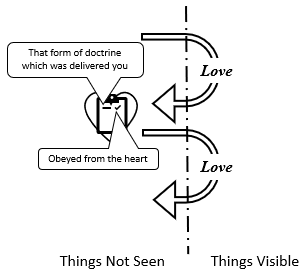
Figure 5‑2 – Obedience
James 2:20
James 2:20But wilt thou know, O vain man, that faith without works is dead? 21Was not Abraham our father justified by works, when he had offered Isaac his son upon the altar? 22Seest thou how faith wrought with his works, and by works was faith made perfect?
Abraham’s faith was made perfect when he obeyed the form of doctrine that was delivered him.
Genesis 22:2He said, “Take your son, your only son Isaac, whom you love, and go to the land of Moriah, and offer him there as a burnt offering on one of the mountains of which I shall tell you.”
This verse shows where Abraham was delivered the form of doctrine, the commandment delivered to him. In the Old Testament, people were given personal assignments to be fulfilled. Under the New Covenant, we are also given personal assignments, but now those assignments are delivered by the love of God through Jesus in partnership with his servants.
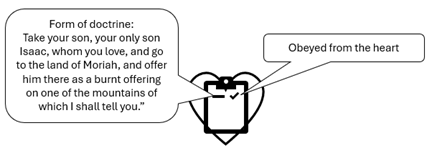
Figure 5‑3- By faith Abraham
This form of doctrine was specific to Abraham, not like the Ten Commandments that applied to everyone under the covenant. The law of the covenant Abraham was under was the law of faith, where commandments are given to individuals.
When Abraham obeyed the Lord’s command, his faith was made perfect, complete, and it was counted as righteousness. But this was not the first time Abraham’s faith was counted as righteousness.
Genesis 12:1Now the Lord saidto Abram, “Go from your countryand your kindred and your father’s house to the land that I will show you.
In chapter 12, the Lord gave Abram a commandment: to leave his country and go to a land that God would show him. The fulfillment of this commandment was counted to Abram as righteousness, as confirmed by Hebrews 11.
Hebrews 11:8By faith Abraham obeyed when he was called to go out to a place that he was to receive as an inheritance. And he went out, not knowing where he was going.
Although Abraham was given this command in Genesis 12, it was not until Genesis 15:6 that the Bible declares that his faith was counted as righteousness, but verse 7 provides the context for Abram’s belief: obedience to the commandment he had been given.
Genesis 15:6And he believed the Lord, and he counted it to him as righteousness. 7And he said to him, “I am the Lord who brought you out from Ur of the Chaldeans to give you this land to possess.”
Belief is established through obedience.
This brings up another point. The Greek words for justified and righteousness share the same root word. A person is justified whenever righteousness is credited to his account. When justified refers to a status – having been justified – it means that the account contains righteousness. When justified refers to what will be determined on judgment day – justified or condemned – it means that they will be ushered into heaven because righteousness is found in their account.
Salvation is not by faith plus works of the law (of sin and death), but neither is it by faith minus works of faith.
The work of the Spirit of Christ in us is the righteousness of Christ. Works done by Christ apart from us are not credited to our account. Works done by us apart from Christ are not credited as righteousness to our account. Only works done together with Christ are credited to our account. These works are performed with his power using our resources for his purpose.
James is confirming that faith that has been authorized but not finalized is dead.
Galatians 3:11
Galatians 3:11But that no man is justified by the law in the sight of God, it is evident: for, The just shall live by faith.
When seeing “law” in the scriptures, it is paramount to understand which law is being referred to: the law of sin and death, or the law of the Spirit of life. The law being referred to here is the law of sin and death. There is no provision for righteousness under that law.
In the sight of God refers to the account which resides on the heart, visible to God but invisible to man. The content of that account will determine our future destiny: justification or condemnation.
It is evident because obedience to the law of sin and death lacks the evidence of things not seen. There is no manifestation of the Spirit when one keeps the law of sin and death.
The just are those who are justified. The just live (union with God) by faith that has been completed by fulfilling the righteousness of the law.
Romans 9:1
Romans 1:5By whom we have received grace and apostleship, for obedience to the faith among all nations, for his name:
The laws of faith are not rules set in stone that apply to everyone. Each law is individually packaged and personally delivered. In the Old Testament, the saints were specifically told to do things, and their instruction was specific to them. Abraham was told to sacrifice his only son on the altar. That law was specific to him, and it was to be done once. When he obeyed, it was counted as righteousness. But that law does not apply to us.
The grace we receive is the substance of things hoped for, and that is a law written upon our heart. We are sent (apostle) to obey the law and fulfill the righteousness of the law written on our heart. The first part of faith is the law. The second part is obedience to the faith, the law written on our heart.
2 Corinthians 5:7
2 Corinthians 5:7(For we walk by faith, not by sight:)
This is not to say that our faith is blind. We walk by the laws that are written upon the tables of our heart, hidden in the realm of things not seen. If we are to obey laws we cannot see, how is that not blind faith?
Whenever grace is transferred to you from another, it manifests itself, becoming evidence of things not seen. It becomes visible to the one serving righteousness, and also to the one being served.
When you are the one being served, you should take note of it: you have just been served You will be expected to that grace to others. The grace you have been given is not for your own consumption. The single-talent servant let the talent he received stay dormant, buried in his heart. Do not make that mistake.
God’s laws written on your heart are God’s will for your life. These laws are perpetual in that they are not one-and-done commandments. This is the nature of grace: when you love one another as you have been loved, your capacity to love yet another is not diminished. The law, having been fulfilled, remains in place, ready to bear fruit again and again.
Romans 1:17
Romans 1:17For therein is the righteousness of God revealed from faith to faith: as it is written, The just shall live by faith.
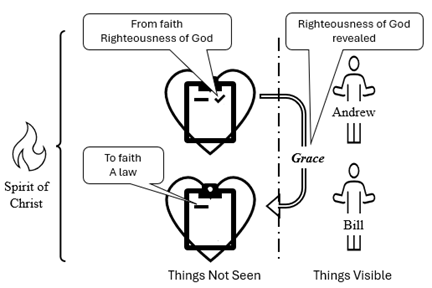
Figure 5‑4- Romans 1-17
In this figure, Andrew just lead Bill to the Lord (see the figure above). This single event was recorded in the hearts of both Andrew and Bill. Both records involved faith: Andrew’s faith was accounted for righteousness, and Bill’s faith was authorized, as a law was written on his heart.
This grace being transferred was the righteousness of God, since it was performed by the power of the Spirit of Christ. As it passed from Andrew to Bill, it crossed the boundary between Things Not Seen and Things Visible, and the righteousness of God was revealed for those involved to see. God’s righteousness was revealed from faith to faith.
This figure also illustrates the concept of overshadowing, where the Spirit acts on more than one person at the same time.
Matthew 21:21
Matthew 21:21Jesus answered and said unto them, Verily I say unto you, If ye have faith, and doubt not, ye shall not only do this [which is done] to the fig tree, but also if ye shall say unto this mountain, Be thou removed, and be thou cast into the sea; it shall be done.
The Greek work for this is a definite article, meaning that he is referring to a specific mountain. That said, it would be interesting to know which mountain he was referring to. We could just go to that mountain, take him at his word, tell it to go jump in the sea and see what happens. That faith, however, would not be saving faith.
1 Corinthians 13:2And if I have prophetic powers, and understand all mysteries and all knowledge, and if I have all faith, so as to remove mountains, but have not love, I am nothing.
Under the varieties of service, faith cannot exist without love. In that domain, faith is the love of God flowing through you. It cannot exist without love.
In the domain of the gifts of the Spirit, however, faith can be independent of love.
Matthew 23:23
Matthew 23:23Woe unto you, scribes and Pharisees, hypocrites! for ye pay tithe of mint and anise and cummin, and have omitted the weightier [matters] of the law, judgment, mercy, and faith: these ought ye to have done, and not to leave the other undone.
The weightier matters of the law are weightier because those are the matters that will matter on judgment day.
James 2:8If you really fulfill the royal law according to the Scripture, “You shall love your neighbor as yourself,” you are doing well. 12So speak and so act as those who are to be judged under the law of liberty.
Jesus is not saying that keeping the laws of Moses is a bad thing, but they are not the more important things. Judgment, mercy, and faith are the things by which we will be judged.
Why obedience to the law of sin and death does not directly affect the outcome on judgment day will be covered in detail in the chapter on forgiveness. It is interesting how, even when our sins are remembered no more, we can still be held accountable. Stay tuned.
Luke 22:32
Luke 22:32But I have prayed for thee, that thy faith fail not: and when thou art converted, strengthen thy brethren.
Although Peter would deny Christ three times, Jesus prayed for him that his faith would not fail. Jesus prayed that Peter would not receive the grace of God in vain. Once Peter was converted, he would bring many into the kingdom of God.
Acts 15:9
Acts 15:9And put no difference between us and them, purifying their hearts by faith.
This is Peter speaking, saying that there is no difference between us and them, Jews and Gentiles, in that their hearts are also purified by faith.
Exactly how are hearts purified by faith?
John 15:3Already you are clean because of the word (λογον, logon) that I have spoken to you.
We recognize the Greek word, logon, as being the account. The word spoken to us is the account we receive when we get a new heart. When Gentiles and Jews give their heart to the Lord, he takes their heart which includes their unclean account, and gives them a new heart with a clean account. This account remains clean because their sins are remembered no more.
Under the Old Covenant, sins would be covered by the blood of animals. That would cover sins written on the tables of their account, but would not cover future sins. The covering of their sins allowed them to come into the presence of God, but that process would need to be repeated before coming into his presence. Everlasting life is not just about longevity, but also about continuity.
Under the New Covenant, sins would be removed from them as far as the east is from the west, as Jesus would take custody of their accounts. They would no longer have their unclean account.
Having custody of their accounts, he would be responsible for the sins written in their accounts, just as if he had committed the sins himself. Those sins would eventually be covered by his own blood. Past sins would be removed by the transfer of the account to Jesus, and future sins would be remembered no more.
Mark 4:40
Mark 4:40And he said unto them, Why are ye so fearful? how is it that ye have no faith?
They are in a boat, facing a raging sea, but they are with Jesus. They should have been confident that God would not allow the story to end this way, lost at sea. They should have been faithful, not fearful.
Romans 3:30
Romans 3:30Seeing it is one God, which shall justify the circumcision by (εκ, ek) faith, and uncircumcision through (δια, dia) faith. 31Do we then make void the law (δια, dia) through faith? God forbid: yea, we establish the law.
God justifies Jews by faith, and Gentiles through faith. The interesting thing about this verse is that instead of voiding the law through faith (Gentiles only), we establish the law.
Gentiles were lawless, not subject to the law of Moses or the law of the New Covenant. Through faith, they enter the New Covenant and for the first time, the law is established on their hearts. They are no longer lawless.
Romans 4:9
Romans 4:9Is this blessing then only for the circumcised, or also for the uncircumcised? For we say that faith was counted to Abraham as righteousness. 10How then was it counted to him? Was it before or after he had been circumcised? It was not after, but before he was circumcised.
Abraham was justified before he was circumcised, when he was told to leave his country and go to a land he would be shown. Contrast this with James chapter 2.
James 2:21Was not Abraham our father justified by works when he offered up his son Isaac on the altar?
Abraham was also justified when he offered his son Isaac on the altar, when both he and Isaac had been circumcised. Abraham was justified before he was circumcised, and after.
Hebrews 11:8By faith Abraham obeyed when he was called to go out to a place that he was to receive as an inheritance. And he went out, not knowing where he was going. 17By faith Abraham, when he was tested, offered up Isaac, and he who had received the promises was in the act of offering up his only son,
These two by-faith actions are the two instances where Abraham’s faith was counted as righteousness. Both represent the fulfillment of the command that had been given. Justification is not a singular event.
Romans 4:22
Romans 4:22And the father of circumcision to them who are not of the circumcision only, but who also walk in the steps of that faith of our father Abraham, which [he had] being [yet] uncircumcised.
The process of salvation has multipole steps. These steps will be explained in detail in the chapter on Salvation. It shows how Gentiles become eligible to enter the New Covenant, a covenant which was made exclusively with the house of Judah.
Galatians 5:22
Galatians 5:22But the fruit of the Spirit is love, joy, peace, longsuffering, gentleness, goodness, faith,
The fruit of the Spirit is not the same as the fruit of righteousness. This fruit is not hidden in the heart, but a manifestation of the Spirit for all to see. The fruit of the Spirit is in the domain of the Spirit, the varieties of gifts.
1 Timothy 1:2
1 Timothy 1:2Unto Timothy, [my] own son in the faith: Grace, mercy, [and] peace, from God our Father and Jesus Christ our Lord.
This is a delicate topic. If Timothy is Paul’s son, does that make Paul his father? And if Paul is Timothy’s father, who is Timothy’s mother? This is a delicate matter because we are not supposed to talk about this, if we are to follow the steps of faith of Abraham. This is a secret to be kept.
In this verse, Paul claims that Timothy is his spiritual son. There is another term that is related to faith that is worth covering at this time. The term is commendation. It is like faith, but rather than being two related grace events and one person, it is a single grace event involving two persons.
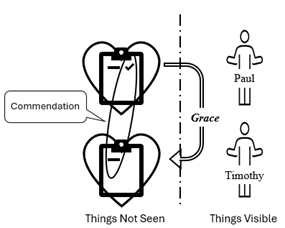
Figure 5‑5 – Commendation
2 Corinthians 3:2Are we beginning to commend ourselves again? Or do we need, as some do, letters of recommendation to you, or from you? 2You yourselves are our letter of recommendation, written on ourhearts, to be known and read by all. 3And you show that you are a letter from Christ delivered by us, written not with ink but with the Spirit of the living God, not on tablets of stone but on tablets of human hearts.
When Timothy became Paul’s son in the faith, Timothy’s name was written on Paul’s heart, and Paul’s name was written on Timothy’s heart. The traceability of the genealogy is written upon the hearts. For this to be practical, everyone in the kingdom of God must have a universally unique name, otherwise there would be no traceability. When we enter the kingdom of God, we get a new name.
Hebrews 11:31
Hebrews 11:31By faith Rahab the prostitute did not perish with those who were disobedient, because she had given a friendly welcome to the spies.
Here Rahab, a Gentile, was saved by grace through faith, because she acted in accordance with the immunity offered to her by the spies.
This is an interesting observation, because although the New Covenant applied to the house of Judah, written into the covenant were promises to the Gentiles.
Genesis 12:3I will bless those who bless you, and him who dishonors you I will curse, and in you all the families of the earth shall be blessed.
Rehab was blessed because she blessed Israel.
First Fruit
The concept of the first fruit is an important thing to understand. When we receive grace, a law is written on our heart. If that law is never fulfilled, that grace was received in vain, only to be lost on the day of the Lord.
Romans 8:22For we know that the whole creation groaneth and travaileth in pain together until now. 23And not only they, but ourselves also, which have the firstfruits of the Spirit, even we ourselves groan within ourselves, waiting for the adoption, to wit, the redemption of our body.
Paul makes a distinction between those who have the firstfruits of the Spirit and those who do not. Those who have the firstfruits are justified. In this verse he is saying that pain is common to everyone, even those who are justified. But the point is this: to be perfect in Christ, each element of grace received needs to be secured.
The first time a law is fulfilled is when the grace is secured. Subsequent fulfillments of the law are credited as righteousness, but it is the first fruit that secures the grace.
Colossians 1:28Whom we preach, warning every man, and teaching every man in all wisdom; that we may present every man perfect in Christ Jesus:
As spiritual parents, we should assist all our spiritual children to be perfect in Christ, that means no unsecured grace. We should give them opportunities to lead others to the Lord, and provide opportunities for ministry.
As important as first fruits are, they should not be treated as having a box checked. Nothing should deter us from bearing additional fruit. The concept of abundant grace relies on us bearing much fruit.
Matthew 8:5-13
Matthew 8:5When he had entered Capernaum, a centurion came forward to him, appealing to him, 6“Lord, my servant is lying paralyzed at home, suffering terribly.” 7And he said to him, “I will come and heal him.” 8But the centurion replied, “Lord, I am not worthy to have you come under my roof, but only say the word, and my servant will be healed. 9For I too am a man under authority, with soldiers under me. And I say to one, ‘Go,’ and he goes, and to another, ‘Come,’ and he comes, and to my servant, ‘Do this,’ and he does it.” 10When Jesus heard this, he marveled and said to those who followed him, “Truly, I tell you, with no one in Israel have I found such faith.
The thing that was marvel-worthy to Jesus was the way in which the centurion understood how faith works in the kingdom of God. Jesus had told Nicodemus that no one could see the kingdom of God, yet the centurion had seen it. He did not call it faith, but his description of faith was parabolic.
The centurion drew an analogy between Jesus and himself: Jesus, being under the authority of God, gave him authority to command others, just like being under the authority of Rome gave the centurion authority to command his soldiers.
John 15:9As the Father has loved me, so have I loved you. 10If ye keep my commandments, ye shall abide in my love; even as I have kept my Father’s commandments, and abide in his love. 12“This is my commandment, that you love one another as I have loved you.
These verses show how Jesus, being under authority, gave him authority, and how, being under authority, you also have authority.
But the question is this: who were the soldiers under Jesus’ command? Who would carry out his orders?
Could they be angels. Recall that angels were the ones who restored Jesus health after forty days of temptation in the wilderness. If he was to love the servant “as the Father loved him,” he would use angels to heal the servant, as the Father had done for him. That would make this healing an act of faith on the part of Jesus.
But not only was the servant healed, the centurion was saved
Matthew 8:11I tell you, many will come from east and west and recline at table with Abraham, Isaac, and Jacob in the kingdom of heaven, 12while the sons of the kingdom will be thrown into the outer darkness. In that place there will be weeping and gnashing of teeth.” 13And to the centurion Jesus said, “Go; let it be done for you as you have believed.” And the servant was healed at that very moment.
The one who received the healing was the centurion’s servant, not the centurion. Yet it was the faith of the centurion that was marveled at. It was the servant who received the healing, but it was the centurion who would recline at the table with Abraham, Isaac, and Jacob. The servant was healed, but the centurion was saved.
That does not mean the centurion was born again. Those who are born again do not make a pitstop in paradise.
Luke 8:43-48
Luke 8:43And there was a woman who had had a discharge of blood for twelve years, and though she had spent all her living on physicians, she could not be healed by anyone. 44She came up behind him and touched the fringe of his garment, and immediately her discharge of blood ceased. 45And Jesus said, “Who was it that touched me?” When all denied it, Petersaid, “Master, the crowds surround you and are pressing in on you!” 46But Jesus said, “Someone touched me, for I perceive that power has gone out from me.” 47And when the woman saw that she was not hidden, she came trembling, and falling down before him declared in the presence of all the people why she had touched him, and how she had been immediately healed. 48And he said to her, “Daughter, your faith has made you well; go in peace.”
Healing is a gift of the Spirit, not a service; it belongs to the domain of the varieties of gifts, not the varieties of service. Being such, this example does not exhibit the properties of faith as it has been modelled. Her healing was not the law written upon her heart, such that it would be something she would lose if she did not heal someone else. And being healed did not give her the power to heal others.
The concept of faith traveling through the realm of things visible still applies. When the woman received her healing, it was evident both to Jesus and to her. Jesus felt the power leaving him, and the woman immediately noticed the healing. It was not evident to others until Jesus made it known to everyone present. To this extent, faith in this example is like faith as it has been modelled.
My understanding of faith beyond the varieties of service has not been revealed to me at this time. I must admit that I do not have a fully generalized, context-free definition of faith.
 New Wine