Consider these two verses:
1 Peter 1:5Who are kept by the power of God through faith unto salvation ready to be revealed in the last time.
Ephesians 2:8For by grace are ye saved through faith; and that not of yourselves: it is the gift of God:
These two verses are saying the same thing, but First Peter uses the term, the power of God, and Ephesians calls it grace. My starting point is that grace is the power of God.
The Model
Here is the kingdom of God as visualized in the model. This model was developed in the context of the varieties of service as found in 1 Corinthians 12:5.
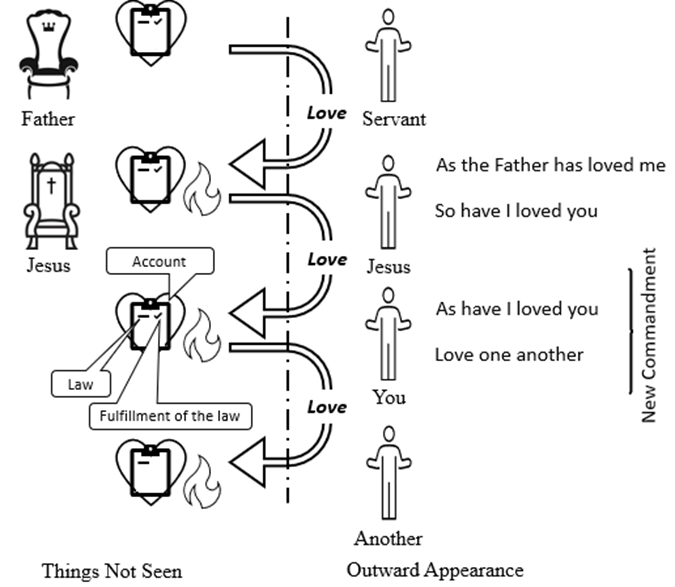
In the context of the varieties of service, grace, the power of God, is the love of God. It flows from the Father to the Son, then to you, then to another, and from them to another. As it travels from one heart to another, it makes an appearance, a burst of light revealing God’s glory. Each time it lands on a heart, a seed is planted, and each seed planted has the capacity to bear much fruit.
Grace touches everything in the kingdom of God, changing its appearance with each touch. Grace becomes the seed planted in your heart, where it is hidden. That seed is a law written upon your heart.
When the law is fulfilled in you, grace becomes the fruit of righteousness, the law fulfilled in you. As it travels from you to another, it makes an appearance and becomes the evidence of things not seen. The things not seen are the seeds that were buried.
When you see grace for what it is, you wonder how you missed it. But just when you think you understand what grace is, it pops up in a context which at first frustrates you, then delights you.
Grace is the word that made me realize that this model does not apply to the entirety of the kingdom of God; it just models one of the realms, of which there are three (that I know of.) I’ll briefly allude to the other realms, and that will have to serve as a disclaimer for the contexts that fall outside the scope of this book. Allow me to briefly explain.
There are three realms in the kingdom: varieties of gifts (charisma), varieties of service, and varieties of activities.
My model illustrates the second realm, the varieties of service: it is the servant model. The three varieties are like three branches of government: gifts, service, and activities: one for each of the three persons in the Godhead. Jesus is the Lord of the varieties of service.
Grace is not unique to the varieties of service. The Greek word for gifts (v. 4 – varieties of gifts) is charismatōn, which contains charis, the word for grace. Charismatic gifts are grace, but they are operations in the varieties of gifts. Seeing grace in my model applies only in I have developed applies only to grace in the context of service. But if we can understand grace in the context of the varieties of service, it will allow us to generalize the concept of grace void of context, which will be done at the end of this chapter.
Consider what happens when someone operates in the realm of charismatic gifts, but fails to fulfill the law in the realm of services.
1 Corinthian 13:1If I speak in the tongues of men and of angels, but have not love, I am a noisy gong or a clanging cymbal. 2And if I have prophetic powers, and understand all mysteries and all knowledge, and if I have all faith, so as to remove mountains, but have not love, I am nothing. 3If I give away all I have, and if I deliver up my body to be burned, but have not love, I gain nothing.
All the gifts mentioned in this passage are charismatic gifts found in chapter twelve. Operating in the realm of charismatic gifts is not counted as righteousness, a requirement for entry into heaven.
The love that was lacking is the love found in the righteousness column of the heart. The charismatic gifts are apportioned by the Spirit as he wills, not planted in the heart by the love of the Lord. Salvation is exclusive to the varieties of service: Jesus is the only way to the Father, but you knew that. Consider this passage:
Matthew 7:21“Not everyone who says to me, ‘Lord, Lord,’ will enter the kingdom of heaven, but the one who does the will of my Father who is in heaven. 22On that day many will say to me, ‘Lord, Lord, did we not prophesy in your name, and cast out demons in your name, and do many mighty works in your name?’ 23And then will I declare to them, ‘I never knew you; depart from me, you workers of lawlessness.’
They expected to hear, well done my good and faithful servant. Instead they were told, depart from me, you workers of lawlessness.
What about the times when the Spirit worked in us to do miracles? They argued. Those miracles were grace, but they did not spring from the seed planted in the heart by Jesus. The seed was the law, and they were lawless because the law of love was never fulfilled.
This can be somewhat deceptive. When you are operating in the varieties of gifts arena, you are working with God. This is grace in action because it is charismatic. It is a manifestation of the Spirit, so it is visible evidence of God at work in you. You experience life because life is union with God, but it does not result in eternal life.
Righteousness is the fulfillment of the law, which is unique to the varieties of service. Laws are associated with the priesthood. There are two priesthoods and two laws. Jesus is after the priesthood of Melchizedek. Operating in the varieties of gifts or the varieties of activities is not working within the law of the Spirit of life in Christ Jesus, the only arena that results in eternal life. These people were in the kingdom of God, but did not make it into heaven.
To know Jesus is to love him. Love involves intimacy between partners. Seeds must be fertilized before they can germinate and grow to produce fruit. Fertilization involves a partnership between two parties. The law of the Spirit of life, love one another as I have loved you, is intimate. As I have loved you is the pollination, and love one another is the fruit of righteousness.
That said, when the context of grace falls within the servant model, which it does in most cases, the kingdom model applies. As you will see, it is extremely helpful when interpreting scripture. The model of the varieties of service will shed light on even the most challenging passages.
Although I am not a fan of contextual definitions – grace found in any context is still grace – the model, itself being contextual, still provides valuable insight into how grace appears in the realm of the varieties of service. Understanding it in this context will help us understand it apart from context.
The Contexts of Grace
Here is where we look at the contexts where grace, charis, is used in the scriptures. In most cases, grace is used in the context of varieties of service, and in those cases the model will clarify the meaning of the scriptures. When it is outside the context of the service model, I will explain what it looks like in that context.
One thing I should say is that the Greek word, χαρις, is not always translated into English as grace. The words used in the King James Charis are favor, thank, thanks, pleasure, acceptable, benefit, gift, gracious, joy, liberality, thanked, and thankworthy. These words were used instead of grace to make the text more understandable.
The purpose of this section is to show how the model illustrates the usage of charis in the different contexts. By visualization of grace, we do not need to redefine the word for each context. No matter what the context, grace is still grace.
For the purposes of this study, I will be using a Greek concordance.
In most cases, verses that include faith will be handled in the chapter on Visualizing Faith. Grace and faith are intimately connected, and faith deserves its own chapter.
Grace as Grace
In the King James version, charis is translated as grace 121 times. I will not address all instances – that would be exhausting for me to write and equally exhausting for you to read – but I will cover examples for all the different contexts.
John 1:14
John 1:14And the Word became flesh and dwelt among us, and we have seen his glory, glory as of the only Son from the Father, full of grace (χαριτος, charitos) and truth. (ESV)
Jesus was full of grace in that he did nothing apart from God. He was the express image of God the Father.
John 15:9As the Father has loved me, so have I loved you.
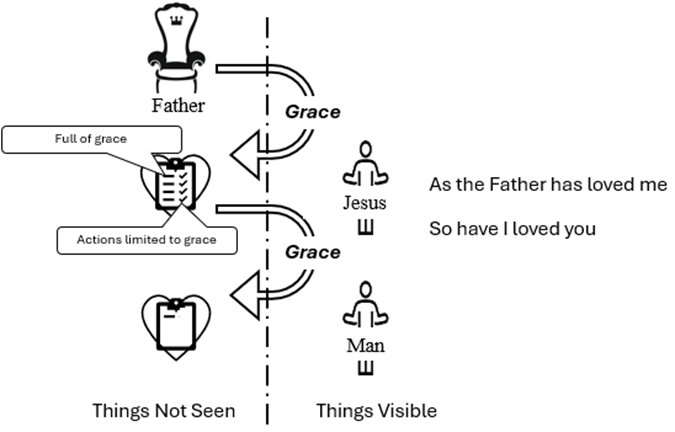
Everything that comes to us from Jesus came from the Father. That should be both comforting and frightening. Not every packet Jesus received from the Father was pleasant. That means not every packet of love we receive from Jesus will be pleasant. But God had plans for his Son, and Jesus has plans for you and me.
John 1:16
John 1:16For from his fullness we have all received, and grace (χαριν, charin) upon grace (χαριτος, charitos). (ESV)
The love we receive from Jesus is from the fulness of his grace. We receive grace by measure; he received grace without measure.
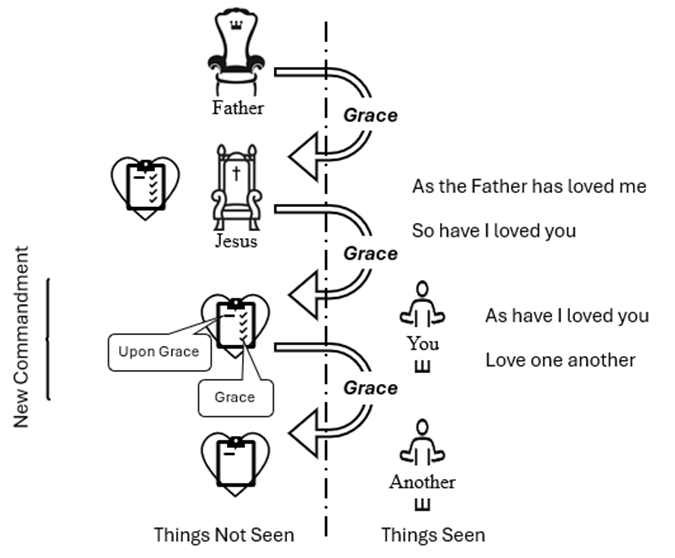
We receive grace to build upon grace. The grace we receive is a law that needs to be fulfilled. The challenge we face is that the law, once written, is hidden in the heart in the sight of God alone. That law is God’s will, and that is why when we pray the Lord’s prayer, Thy will be done. If we knew what his will was, we could pray explicitly, but we do not know the will of God because it is hidden in our heart.
Romans 8:26Likewise the Spirit also helpeth our infirmities: for we know not what we should pray for as we ought: but the Spirit itself maketh intercession for us with groanings which cannot be uttered. 27And he that searcheth the hearts knoweth what is the mind of the Spirit, because he maketh intercession for the saints according to the will of God.
We do not know what we should pray for because God’s will is written on our hearts where we cannot see it. We ought to know what his will is because, when we received the grace, it became visible to us and to others. If we were paying attention, we would know what his will is.
To mitigate this problem, if we ask God to do his will, he knows what we are asking for because he is the one who searches the heart, and he can see the laws written on our heart. But it is better than that. Interceding for us is more than just pleading with the Father to do what we ask. Interceding is performing the work, answering the prayer, fulfilling the righteousness of the law in us. He intercedes according to the will of God, as it is written on our heart.
How can we know what laws are written upon our heart? There are two ways, perhaps three. First and foremost is the first packet of love you received from Jesus. That packet was the first one receive by everyone who is born again. That also was the first law written on the heart of Jesus. Jesus was the only conceived Son of God, the firstborn among many brethren. The Greek word for firstborn is where we get the English word, prototype. Jesus was conceived by God, and we are conceived again by Jesus.
Having been conceived again by Jesus, that is the first law written upon our heart. If you want to know what God’s will for you is, this is one law you can count on. It is the first law written upon your heart. It is your first love.
The second chance to see God’s will for your life is to pay attention when he loves you. When he loves you, grace makes its appearance in the domain of things seen.
The third chance to see God’s will for your life is to pay attention when he loves others through you. Grace appears again when the law is fulfilled in you. This is grace showing up as the evidence of things not seen. If the Spirit does it once in you, he can do it again and again. This grace is evidence that the law is written on your heart.
Now that you know the will of God for your life, you now know how to pray according to God’s will. You can come to him and ask boldly, as a wife would come to her husband and ask, as partners. Ask wisely. Esther is a good example of how it is done.
John 1:17
John 1:17For the law was given by Moses, grace (χαρις, charis) and truth (αληθεια, aletheia) came through Jesus Christ. (ESV)
The law was given to Moses by God.
Hebrews7:11If therefore perfection were by the Levitical priesthood, (for under it the people received the law,) what further need was there that another priest should rise after the order of Melchisedec, and not be called after the order of Aaron? 12For the priesthood being changed, there is made of necessity a change also of the law.
Law comes to us through the priesthood. When the priesthood changes, the law must change. The law of Moses is documented in Deuteronomy, which means second law. This was the second law because Moses was the second priesthood.
The first priesthood was Melchizedek, but the details of the first law were never documented. The details of that law remained hidden even to this day.
Jesus came after the order of Melchizedek and restored the first law. The details of the law remain hidden, written in the heart of man in the region of things not seen.
Under Moses, the commandments were written on tablets of stone, and the corresponding sins were written on the tablets of hearts of stone. The Great Commandment is from the second law: Love the Lord your God is found in Deuteronomy, the second law. Love your neighbor as yourself comes from Leviticus, the second priesthood.
Under Jesus, laws are written on hearts of flesh, and the corresponding righteousness is credited right next to them.
Truth came with Jesus. The Greek word for truth is αληθεια, aletheia. Aletheia begins with an alpha, a negative particle. The negative particle negates the remainder of the word, lanthano, and lanthano means hidden. Truth undoes the concealment, revealing that which had been hidden.
Truth came with Jesus when he revealed the first law: the New Commandment: love one another as I have loved you.
Acts 4:33
Acts 4:33And with great power the apostles were giving their testimony to the resurrection of the Lord Jesus, and great grace (χαρις, charis) was upon them all.
This verse underscores the power of the testimony. Those who had seen the resurrection of the Lord Jesus had a great story to tell. Witnessing the resurrection was the grace they received, and this grace was great. Having had received that grace, it was incumbent on them to deliver to others what they had received from the Lord.
Although I was not a witness to the resurrection of the Lord Jesus, I am a witness to the things I have seen. When winning souls to the Lord, do not underestimate the power of the testimony. It may not be as great as those who witnessed the resurrection of the Lord, but it may be the greatest grace in your arsenal.
Acts 11:23
Acts 11:20But there were some of them, men of Cyprus and Cyrene, who on coming to Antioch spoke to the Hellenists also, preaching the Lord Jesus. 21And the hand of the Lord was with them, and a great number who believed turned to the Lord. 22The report of this came to the ears of the church in Jerusalem, and they sent Barnabas to Antioch. 23When he came and saw the grace (χαριν, charin) of God, he was glad, and he exhorted them all to remain faithful to the Lord with steadfast purpose,
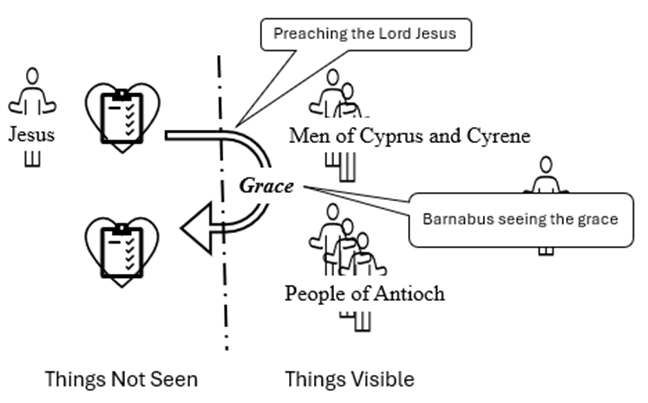
Barnabus saw the grace of God working in the people in Antioch. Grace becomes visible when it travels from one heart to others. What Barnabus saw was the great number who believed and turned to the Lord, and that was evidence that God was at work in them.
Acts 13:43
Acts 13:43And after the meeting of the synagogue broke up, many Jews and devout converts to Judaism followed Paul and Barnabas, who, as they spoke with them, urged them to continue in the grace (χαριτι, chariti) of God.
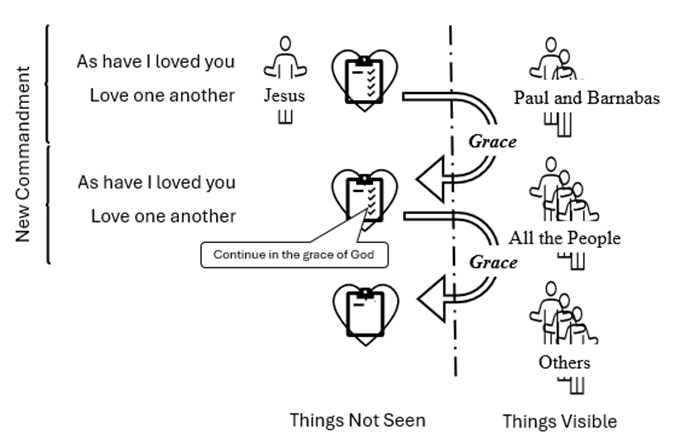
Jesus had moved to the region of things not seen. Divine grace is the result of a partnership, God working in us and with us: Jesus is one of the partners, and we are the other. We, being in the realm of things seen, partner with Jesus in the realm of things not seen. There is more to us than meets the eye.
This diagram illustrates the iterative nature of the kingdom of heaven. The others who receive the gospel are to become the ones who share the gospel. Those who receive grace of God are to continue in the grace of God.
Paul was urging them to continue in the grace.
Romans 3:24
Romans 3:24and are justified by his grace as a gift (δωρεαν, dōrean), through the redemption that is in Christ Jesus,
The Greek words for justified and righteousness share the same root word. We are justified, past tense, whenever grace is added to our account. We will be justified in the future if righteousness is found in our account on judgment day.
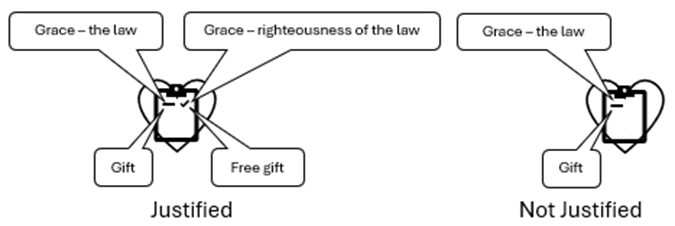
The Greek word for gift is dōrean, a free gift. Abarim, a Greek interlinear website, translates this word as for no reason, but it is translated this way because it is a gift given without the motive of gain. In other words, it is given with no expectation of return. This does not mean that it was given without cause.
Romans 4:4
Romans 4:4Now to him that worketh is the reward not reckoned of grace, but of debt. (KJV)
Work in this verse is considered works of the law, but which law? The law of the Spirit of life, or the law of sin and death?
Romans 4:1What shall we say then that Abraham our father, as pertaining to the flesh, hath found?
Romans 4 begins with the context of pertaining to the flesh, so the works referred to in this chapter pertain to the law of sin and death.
The law of sin and death, the law of Moses, is performed in the weakness of the flesh: all your heart, soul, mind, and strength: just the Spirit. The law of the Spirit is performed in the power of the Spirit. That is the power of grace.
Works done in partnership with the Spirit are righteous, and rewarded with grace added to your account. Works done in the flesh are done to avoid the penalties associated with disobedience.
Romans 5:15-17
Romans 5:15But the free gift (χαρισμα, charisma) is not like the trespass (παραπτωμα, paraptōma). For if many died through one man’s trespass (παραπτωματι, paraptōmati), much more have the grace (χαρις, charis) of God and the free gift (δωρεα, dōrea) by the grace (χαριτι, chariti) of that one man Jesus Christ abounded for many. 16And the free gift (δωρημα, dōrema) is not like the result of that one man’s sin. For the judgment following (κριμα, krima) one trespass brought condemnation, but the free gift (χαρισμα, charisma) following many trespasses brought justification. 17For if, because of one man’s trespass (παραπτωματι, paraptōmati), death reigned through that one man, much more will those who receive the abundance of grace (χαριτος, charitos) and the free gift (δωρεας, dōreas) of righteousness (δικαιοσυνης, dikaiosunes) reign in life through the one man Jesus Christ.
Considering the model of the kingdom of God, the explanation of this passage should convince you of the precision of the Greek language. That said, plan to spend some time in this passage as it is quite technical. This is an example of how English translations can obfuscate the meaning of the text.
To untangle this passage, it needs to be unwrapped, one piece at a time.
Romans 5:15But the free gift (χαρισμα, charisma) is not like the trespass (παραπτωμα, paraptōma).
The Greek word for free gift is charisma. When the suffix “ma” is added to a word, it refers to the result of the word’s root, so charisma is the result of charis: grace. Two words in verse 15a have this suffix: charisma, and paraptōma. A more accurate rendition of this first sentence would be: but the result of the free gift (grace) is not like the result of the offense.
Basically, this is saying that the result of grace is different from the result of sin. Romans 6:23 tells us the expected outcomes:
Romans 6:23For the wages of sin is death, but the gift (charisma) of God is eternal life in Jesus Christ our Lord.
The result (wages) of sin is death, and the result of grace is eternal life in Christ Jesus.
Romans 5:15bFor if many died through one man’s trespass (παραπτωματι, paraptōmati),
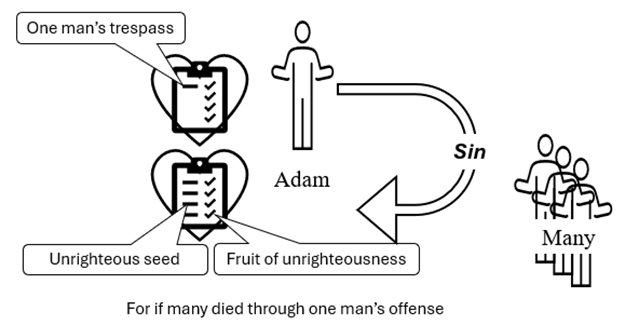
This figure illustrates how many died as the result of one man’s offense in verse 15. Adam ate the fruit of the tree of the knowledge of good and evil and was separated from God, spiritual death. The seed from the fruit of that tree propagated just like grace propagates through the kingdom of God.
Romans 5:15bmuch more have the grace (χαρις, charis) of God and the free gift (δωρεα, dōrea) by the grace (χαριτι, chariti) of that one man Jesus Christ abounded for many.
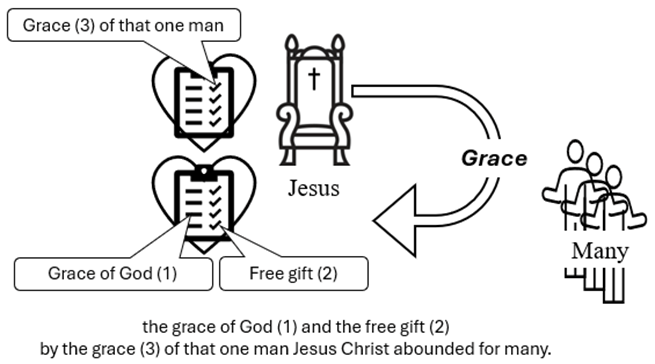
The grace of God (1) is the law written on the heart of the believer, and the free gift (2) is the fulfillment of the law. Righteousness is essentially the same Greek word as justification. Without righteousness, the fulfillment of the law of the Spirit, no one is justified.
Romans 5:15But the free gift (χαρισμα, charisma) is not like the trespass. For if many died through one man’s trespass, much more have the grace of God and the free gift (δωρεα, dōrea) by the grace of that one man Jesus Christ abounded for many.
Taking verse 15 as a whole, free gift is found twice. The first time it is used, the Greek word is charisma, but the second time it is used, the Greek word is dōrea. Dōrea is a gift that is free and clear, as opposed to dōron which is a gift given with the expectation of a return on an investment: i.e. a favor looking for a favor in return. The grace of God would be dōron; a gift that comes with expectations. As we saw in the parable of the talents, it was the combination of the gift and the free gift, the talent given and the talent gained, that resulted in eternal life.
The grace of God and the free gift abounded for many because of the nature of its exponential propagation: every piece of fruit contains many seeds, each with the capability to produce much fruit.
Romans 5:16And the free gift (δωρημα, dōrema) is not like the result of that one man’s sin. For the judgment following (κριμα, krima) one trespass brought condemnation, but the free gift (χαρισμα, charisma) following many trespasses brought justification.
This verse reiterates verse 15, but with the addition of one point. Both contrast the result of the free gift to the result of sin. In verse 15, the result of the trespass was death, and the result of the free gift was abundance. In verse 16, the result of the trespass was condemnation (equivalent to death) but the result of the free gift was justification: life. And this justification was in spite of many transgressions: both forgiveness of former sins and future sins which are remembered no more.
Romans 5:17For if, because of one man’s trespass (παραπτωματι, paraptōmati), death reigned through that one man, much more will those who receive the abundance of grace (χαριτος, charitos) and the free gift (δωρεας, dōreas) of righteousness (δικαιοσυνης, dikaiosunes) reign in life through the one man Jesus Christ.
This verse seals the link between verses 15 and 16, connecting the dots between abundance of grace and eternal life.
Romans 5:20
Romans 5:20Now the law came in to increase the trespass, but where sin increased, grace (χαρις, charis) abounded all the more, 21so that, as sin reigned in death, grace (χαρις, charis) also might reign through righteousness leading to eternal life through Jesus Christ our Lord. 6:1What shall we say then? Are we to continue in sin that grace may abound?
What is the mechanism whereby increasing sin abounds grace all the more? What logic would cause one to think that continuing in sin would be a good strategy to increase grace all the more as it implies in Romans 6:1?
This had puzzled me for over forty years, but the following reasoning is the only logic I can imagine as being justified:
This logic has to do with how forgiveness works. Although under the New Covenant, our sins are remembered no more, when sin is forgiven, it is forgiven by the love of God. When we receive love in the form of forgiveness, that love is recorded in the law column of our account, and we are bound by that law to forgive others as we have been forgiven.
Each time another law is written in our account, it is as if we get another talent with which we can use to gain more talents. If I offend God, I get a talent, and I fulfill that law each time I forgive another as I have been forgiven. Using this strategy, I can become a very wealthy man.
However, this is playing the system. There are only downsides to this strategy, because doing this, you are only creating a minefield for yourself. You will be judged as you judge others. Any negative judgments you met to others for offending you as you have offended God (when you offend others, you offend God), the same judgment will be meted to you. This can only be bad, and eternity is a long time for a grudge to be held against you.
Forgiveness is tricky business, and it is covered in detail in the chapter on forgiveness.
Romans 6:14
Romans 6:14For sin will have no dominion over you, since you are not under law but under grace.
Being under grace is not a get-out-of-jail-free card. You are accountable whether you are under the law or under grace. Found in the context of this verse, grace is the law under the New Covenant.
Romans 3:27Then what becomes of our boasting? It is excluded. By what kind of law? By a law of works? No, but by the law of faith. (ESV)
The law of grace is equivalent to the law of faith. I defer the logic behind this to the section describing faith.
Romans 6:23
Romans 6:23For the wages of sin is death, but the gift (charisma) of God is eternal life in Jesus Christ our Lord.
Romans 6:23 is one of the verses we have all memorized, but it is generally misunderstood when viewed apart from its surrounding verses, which is pretty much all the time.
Charisma is the Greek word translated as gift in this verse, and although charisma is used here, that does not make eternal life a charismatic gift.
As was established before, adding the suffix, ma, to a word changes the meaning of the word to the result of the word, so charisma is the result of grace. The second half of this verse is a summary of the previous verse:
Romans 6:22But now being made free from sin, and become servants to God, ye have your fruit unto holiness, and the end everlasting life.
Fruit unto holiness is righteousness, which is grace. When there is righteousness in your account, on judgment day you will be granted eternal life. Eternal life is not the gift, it is the result of the gift.
Romans 11:5So too at the present time there is a remnant, chosen (εκλογη, ekloge) by grace (χαριτος, charitos). 6But if it is by grace (χαριτι, chariti), it is no longer on the basis of works; otherwise grace (χαρις, charis) would no longer be grace (χαρις, charis). (ESV)
The Greek adds another clause at the end, and works is no more works. This clause is included in the King James version.
In the Greek, the root word for chosen (ekloge) is logos, which is also the root word for account (logon). The remnant is “chosen” when they receive a heart of flesh with a clean account.
John 15:3Already you are clean (καθαροι , katharoi) because of the word (λογον, logon) that I have spoken to you.
The Greek word for clean is where we get our English word, katharsis. Logon is the Greek word for word. The word Jesus has spoken to you is the account (logon) he gave you when he gave you a new heart.
You are clean if your account is clean, meaning it is free from sin. Your account will remain clean because your sins are remembered no more. That is part of the New Covenant, the new deal. This will be discussed in more detail in the chapter on salvation.
Jeremiah 17:1“The sin of Judah is written with a pen of iron; with a point of diamond it is engraved on the tablet of their heart, and on the horns of their altars,
Sin is fruit of the tree of the knowledge of good and evil. Righteousness is the fruit of the tree of life. Sin is what you do apart from God; righteousness is what you do together with God. Contrary to popular opinion, sin is not only evil; it often appears to be good.
Before you received a new Spirit, you had no opportunity to work together with God, so everything you did was sin. When you had a heart of stone, you were under the law of sin and death, and under that law, your sins were written on your heart in your account.
Romans 8:2For the law of the Spirit of life has set youfree in Christ Jesus from the law of sin and death.
Under the law of the Spirit of life, your account is based on grace, it is no longer based on works of the flesh, i.e. sin.
Philippians 2:13For it is God which worketh (ενεργων, energōn) in you both to will (θελειν, thelein) and to do (ενεργειν, energein) of his good pleasure.
God internally works (energōn) in us, both to will and to do. We recognize energy embedded in the Greek word for work. God wills (thelein) in us when he writes his law upon our hearts. He does (energein) in us when he fulfills the righteousness of the law in us, loving one another through us.
Each act, both to will and to do, involves a partnership – two entities working together. This is like a husband and a wife bearing children or to generalize the concept, bearing fruit, which also involves fertilization.
In this passage, works are things we do apart from God. These works are characterized as filthy rags, menstrual rags. These rags are the result of eggs being delivered without first having being fertilized.
When a person transitions from being under the law of sin and death to being under the law of the Spirit of life, he surrenders to Jesus his heart of stone and receives a heart of flesh (I will take your heart of stone and give you a heart of flesh). Under the new law, sin (works of the flesh) are no longer credited to his account (I will remember your sin no more). The only things credited to the account are grace. Grace is both the law and the righteousness of the law fulfilled in us. Both are recorded in our account.
If the remnant were to be chosen on the basis of works, then the law of sin and death would be divorced from death. In this scenario, works would no longer be what works are, and grace would no longer be what grace is. This would violate their very nature.
It is worth noting that Jesus took your heart of stone where all your sins are listed. You get a new account, but he takes custody of your old account and assumes the responsibility for the sins listed there. Jesus is the scapegoat that takes the sins of the nation. Those sins, everyone’s sins, will be purged by his own sacrifice.
Jesus will need to be forgiven for the things we have done.
Romans 12:3
Romans 12:3For by the grace (χαριτος, charitos) given to me I say to everyone among you not to think of himself more highly than he ought to think, but to think with sober judgment, each according to the measure of faith that God has assigned. (ESV)
When exactly did Paul receive this grace that was given unto him?
2 Corinthians 12:7So to keep me from becoming conceited because of the surpassing greatness of the revelations, a thorn was given me in the flesh, a messenger of Satan to harass me, to keep me from becoming conceited. 8Three times I pleaded with the Lord about this, that it should leave me. 9But he said to me, “My grace (χαρις, charis) is sufficient for you, for my power is made perfect in weakness.” Therefore I will boast all the more gladly of my weaknesses, so that the power of Christ may rest upon me. (ESV)
Paul received a thorn in the flesh to keep him from becoming conceited. Being conceited is when you think of yourself as being self-sufficient, sufficient apart from God. We all tend to suffer from delusions of adequacy.
Paul characterized his thorn in the flesh as grace in Romans 12. Not all grace is pretty, and his advice was to avoid the unpleasantness of this grace by not thinking of ourselves more highly than we ought to think. We think of ourselves more highly than we ought when we think that just because we have received knowledge from God does not give us license to get ahead of God and deliver the goods apart from the Spirit.
Romans 12:6
Romans 12:6Having gifts (χαρισματα, charismata) that differ according to the grace given to us, let us use them: if prophecy, in proportion to our faith;
This verse describes grace in the context of the varieties of gifts. I should not expect it to be found in the service model. It does, however, confirm the concept that grace is also found in the realm of the Spirit. It also establishes the concept of faith existing in the realm of the Spirit.
The love of God found in the model is always grace, but not all grace is the love of God as pictured in the model.
That is not to say that the Spirit is not active in the varieties of service realm, but the importance of this distinction cannot be overstated. Eternal life is exclusive to the varieties of service. Jesus is the only way to heaven.
2 Corinthians 6:1
2 Corinthians 6:1Working together with him, then, we appeal to you not to receive the grace of God in vain.
We receive the grace of God in vain when we receive his grace but fail to deliver his grace to others. When the righteousness of the law is not fulfilled in us, we will forfeit that grace on the day of the Lord, and we will have received it in vain.
We can avoid receiving the grace of God in vain by working together with him, fulfilling the righteousness of the law. That involves cooperation on our part.
2 Corinthians 8:1-6
2 Corinthians 8:1Moreover, brethren, we do you to wit of the grace of God bestowed on the churches of Macedonia; 2How that in a great trial of affliction the abundance of their joy (χαρας , charas) and their deep poverty abounded unto the riches of their liberality. 3For to their power, I bear record, yea, and beyond their power they were willing of themselves; 4Praying us with much intreaty that we would receive the gift (χαριν, charin), and take upon us the fellowship of the ministering to the saints. 5And this they did, not as we hoped, but first gave their own selves to the Lord, and unto us by the will of God. 6Insomuch that we desired Titus, that as he had begun, so he would also finish in you the same grace also.
To wit means to focus your attention. Paul is asking the Corinthians to focus their attention on what happened in the churches of Macedonia. What happened there would provide context for what could happen in Corinth.
This is a true story about how abundance flourished in Macedonia even in the midst of extreme poverty. It is a story about money. The saints in Macedonia sowed generously and reaped an abundant harvest. They leveraged the principles of sowing and reaping to experience the power of God.
It begins with their abundance of joy in verse 2. This is not joy as we understand it. The Greek word for joy is charas, a form of grace, charis. Consider how Jesus used joy in his discourse on the true vine.
John 15:11These things have I spoken unto you, that my joy (χαρα, chara) might remain in you, and [that] your joy might be full. 12This is my commandment, That ye love one another, as I have loved you.
That my joy might remain in you implies that there is a possibility that his joy may not remain in you if you don’t do what he said.
That your joy might be full begs the question: what is joy that is full? When is joy not full?
The things I have spoken unto you was the New Commandment: love one another as I have loved you. He told us to keep his commands so we could keep his “joy.”
In the model of the kingdom of God, the one thing we are at risk of losing is the grace credited to our account in the law column. It is subject to forfeiture until it is secured by fulfillment. Joy is grace found in the context of love received. It is found in the law column of the account.
Joy that is full is joy that is fulfilled in the righteousness column. It is the fulfillment of the righteousness of the law in you (Romans 8:4)

Matthew 6:19Lay not up for yourselves treasures upon earth, where moth and rust doth corrupt, and where thieves break through and steal: 20But lay up for yourselves treasures in heaven, where neither moth nor rust doth corrupt, and where thieves do not break through nor steal: 21For where your treasure is, there will your heart be also.
Treasures are stored in the account on the tables of the heart. Grace is the treasure. Grace is stored both in the law column of the account, and in the righteousness column. Grace received is in the law column, and grace given is in the righteousness column. We secure grace in the law column with grace in the righteousness column. If we keep his commandment like Jesus told us to, the grace in the law column will be retained on the day of the Lord. If we do not keep the command, we have received the grace of God in vain: it is forfeited.
Let’s map what happened in Macedonia into the model.
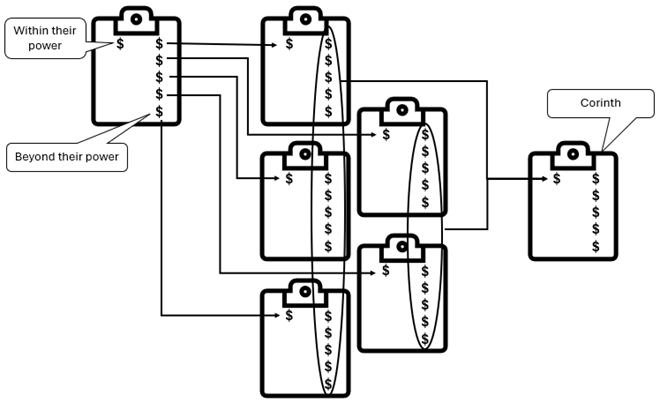
This is an illustration of the accounts involved in this story. I generally don’t think of money as grace, yet that is where it fits in the model.
The other thing that doesn’t seem to fit in the model is that the process was initiated with personal funds, not the love of God. The model says that we are first loved by Jesus, then we can love one another with that love. But perhaps we need to think differently about the money that we consider our property. Perhaps that money is his love for us. We can choose to spend that money on ourselves, or we can watch it multiply by giving it to one another.
They were willing to give beyond their power. When I sow and reap the harvest, am I willing to use part of that harvest to sow again? If I give ten dollars and reap twenty dollars, do I pocket the twenty?
The saints in Macedonia experienced abundance in a time of poverty, and their desire was to expand this experience to the church in Corinth. They were asking Paul to take their money to Corinth to be used as seed money to see it multiply in their hands as well.
This sounds like the prosperity gospel: sowing and reaping, but it was more like the feeding of the five thousand. It was the disciples who fed the five thousand, not Jesus. Jesus gave bread to the disciples, but the bread multiplied in the hands of the disciples. It began with someone initiating the process, sacrificing their lunch: five loaves and two fishes. From there it abounded to the extent that everyone was fed. What was left was gathered by the disciples, each one collecting a basketful. They ate last, but they ate.
In verse four, the saints in the church of Macedonia are pleading with Paul to take their offering as seed money that would flourish into a harvest. Titus was commissioned to take the money to Corinth so that what had begun in Macedonia could be finished in Corinth.
In verse five, Paul was reluctant to take their money because of their dire poverty (not as we hoped.)
The verse goes on to say how they first gave of themselves, but then by the will of God. What could that mean?
This is a good time to explain the will of God. When you are loved by Jesus, often through another, a law is written upon your heart. That law is fulfilled when you work together with the Spirit, giving as you have received. The law written upon your heart is the will of God for you. His will is in the sight of God, in the realm of things not seen. His will for you is only visible to you when you receive his grace, as it travels through the corridor where it can be seen. Once it arrives, it is buried in the heart, in the realm of things not seen.
When Jesus tells us to remember, he is telling us to recall what he has done for us, so that we can fulfill, with the Spirit of Christ, in others what he has done for us. Remembrance is the only way to know the will of God, because once it is written on the heart, it disappears. Communion is an interesting example, an example for another day.
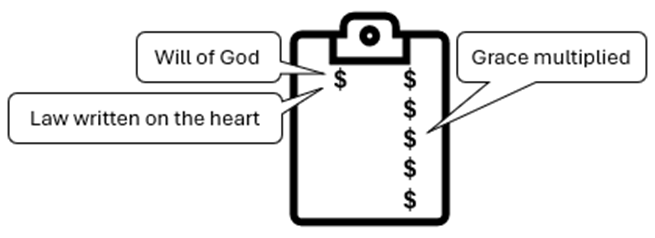
Romans 6:13Neither yield ye your members as instruments of unrighteousness unto sin: but yield yourselves unto God, as those that are alive from the dead, and your members as instruments of righteousness unto God.
Our members are our resources we are to yield as instruments of righteousness. Our resources include our money.
I experienced this firsthand when we were living in Delaware. We attended an independent church called Faith City. The message that was predominant almost every Sunday had to do with giving, as if the expression of faith was about giving money.
Pam and I were getting a little fed with the pressure of giving. One mid-week service, a visiting missionary was giving the message on giving – again. At one point he had the ushers pass out little pieces of paper to everyone. Here it comes, I thought.
These were his instructions: In the upper left corner of the paper, write down the amount of money that you can afford to give this ministry for the next three months. This is from known resources: resources that you already have.
In the upper right corner of the paper, write down an amount that you can trust God to provide for the next three months. This is from money that you do not have. This will be from unexpected sources.
At that point, I asked Pam to borrow her pen. I was going to sign up God for some money. I am willing to play this game once and never have to deal with it again. I signed up for ten dollars from me, and ten dollars from God. The offering would not be taken that night, but it would be collected beginning in one month for a period of three months.
The month passed. It was Saturday afternoon, the night before the offering was to be taken. I pulled out ten dollars and put it on the fireplace mantle. “Here is my ten dollars. Where is yours.” I was taunting God.
That night there was a couples banquet at the church for the choir. There was a ten-dollar charge for the event, and being the choir director, it was my obligation to attend. That night, the pastor’s wife approached me, saying that I was their guest and I was not supposed to pay the ten dollars. She refunded my ten dollars. There it was.
I don’t remember how long it took for my skepticism to return. “OK, God. Pretty sneaky. But you have two more months.”
The next month, the company I worked for announced that they would be increasing their contribution to our health insurance. That amount was roughly twenty dollars a month. God picked up his pledge and mine as well. The amazing thing was that the increase did not cease after the two months. This was abundant grace.
Ephesians 1:1-2
Ephesians1:1Paul, an apostle of Christ Jesus by the will of God, To the saints who are in Ephesus, and are faithfulin Christ Jesus: 2Grace to you and peace from God our Father and the Lord Jesus Christ.
This is generally considered a greeting, but I learned that it is not a greeting. It was during an argument I had with God, which I lost.
I was memorizing Ephesians 1, and I confronted God about how he continually wasted prime real estate by opening books in the New Testament with a greeting. This is how my argument went:
When I memorize a chapter, I begin memorizing verse one. When I move on to verse two, I rehearse verse one. Every time I say verse two, I say verse one. I say verse one more times than any other verse, and it is wasted on a greeting, devoid of legitimate content. I also pointed out that it was not a complete sentence, having no verb.
In his still, silent voice, he shined his light on these opening verses. I immediately understood that these verses are the most important verses in the whole book. These are statements of intent, statements of purpose. The purpose of this letter is that grace would come to you from the author, and from you it would be propagated throughout the world. This is an invitation to join the front lines in the mission, working directly with operatives at the highest level.
Let’s break this down, step by step.
Paul identifies himself as an apostle, which means he was sent. He was sent by the will of God because the law written on the heart is the will of God. When Jesus revealed the gospel to Paul, the law was written on hid heart. Details of the gospel were shared with Paul that had not been revealed to anyone else.
How frustrating that must have been: Paul being sent to share the gospel with others, but instead finding himself in jail, isolated from those he was supposed to disciple. All he could do was write letters and hope that someone, somewhere would pick up the baton and run with it. Sitting in jail, he had no idea the impact his letters would have on future generations. He felt sidelined.
He addressed the letter to the Ephesians and the faithful in Christ Jesus, intended. Grace to you, and peace. May this grace be multiplied through you to the world.
Hebrews 4:16
Hebrews 4:16Let us then with confidence draw near to the throne of grace, that we may receive mercy and find grace to help in time of need.
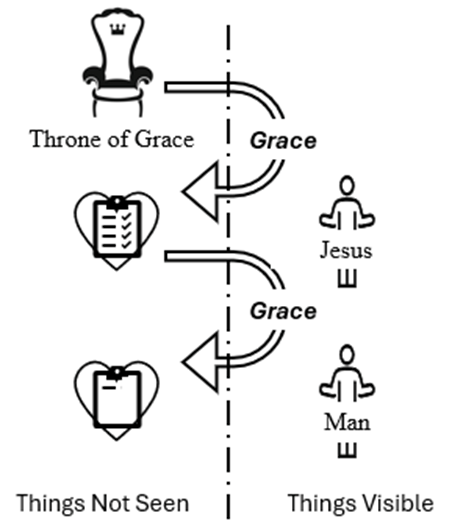
The throne of grace is where all grace originates.
Mercy is a class of grace that involves forgiveness. This topic will be covered in detail in the section on forgiveness. Briefly, mercy is received as forgiveness, a packet of love from Jesus. As with all grace received by way of Jesus, forgiveness falls under the New Commandment. When we pray, Forgive us our trespasses as we forgive those who have trespassed against us, we apply the New Commandment to the love received in the form of forgiveness: forgive one another as I have forgiven you.
Mercy is the mechanism that holds us accountable when sins are remembered no more.
We receive grace in our time of need, grace that will address the need in the power of the Spirit, not the weakness of the flesh.
Hebrews 13:9
Hebrews 13:9Be not carried about with divers and strange doctrines. For [it is] a good thing that the heart be established with grace; not with meats, which have not profited them that have been occupied therein.
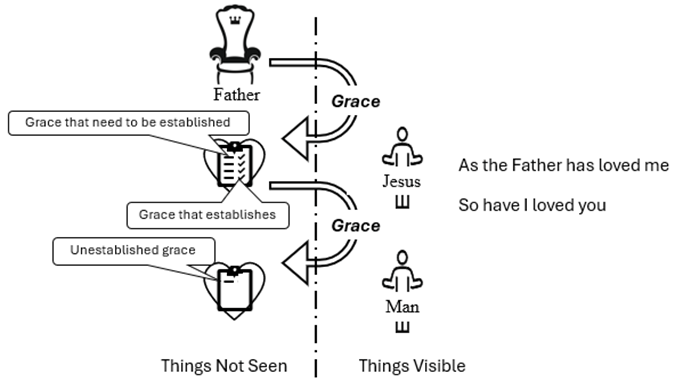
The heart is where the account is located. The objective is not to be entertained with mind games, but to establish the heart, storing up treasures in heaven.
That said, the things I am writing about are not mind games, but a perspective that will help align our lives with the things that will matter in eternity.
James 4:6
James 4:4You adulterous people! Do you not know that friendship with the world is enmity with God? Therefore whoever wishes to be a friend of the world makes himself an enemy of God. 5Or do you suppose it is to no purpose that the Scripture says, “He yearns jealously over the spirit that he has made to dwell in us”? 6But he gives more grace. Therefore it says, “God opposes the proud but gives grace to the humble.”
Instead of working with Jesus, we choose to work with others. That is adultery because we are the bride of Christ.
The proud rely on their own strength. They suffer from delusions of adequacy. The humble receive grace in their time of need.
1 Peter 1:10
1 Peter 1:1Peter, an apostle of Jesus Christ, To those who are elect exiles of the Dispersion in Pontus, Galatia, Cappadocia, Asia, and Bithynia, 2according to the foreknowledge of God the Father, in the sanctification of the Spirit, for obedience to Jesus Christ and for sprinkling with his blood: May grace and peace be multiplied to you.
On the subject of election: election is according to the foreknowledge of God. This tends to resolve the perceived conflict between the sovereignty of God vs. the free will of man. The sovereignty encapsulates the free will of man. God knows beforehand who are his.
This verse confirms the concept that grace is multiplied.
Having received the grace of God, and the law is written upon your heart, fulfillment of that law, although it establishes the grace received, does not diminish your ability to fulfill it again. When you love one another as you have been loved, your capacity to love yet another is not diminished. Peter’s prayer for you is that grace would be multiplied in you.
Grace as Favor
The definition that many ascribe to grace is God’s unmerited favor. Although grace is often translated as favor in the Bible, the unmerited aspect of the definition limits the scope of its usefulness to a narrow range of contexts, as we will see. Embracing this definition stunts our understanding of the scriptures.
Luke 1:30
Luke 1:30And the angel said to her, “Do not be afraid, Mary, for you have found favor (χαριν, charin) with God.” (ESV)
This is the first instance where grace is first found in the New Testament. This is where God’s love for his Son began.
God loves people through people. Love is the product of a partnership between God and people: God in the realm of things not seen, and people in the realm of things visible. To have a child it takes a father and a mother, and in this case, Mary is the mother.
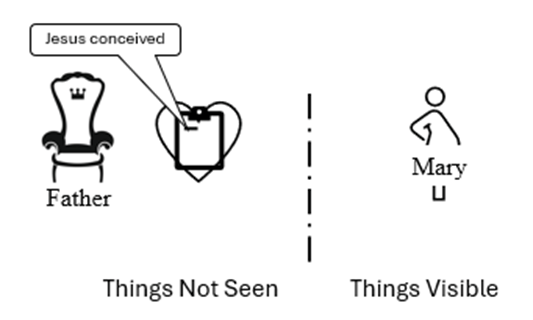
It is interesting that the angel was sent to approach Mary and not the Lord. It would be awkward if the Lord had come to her to asked her if she would be his mom.
Remember how I said that the first step in the New Commandment is to receive the love? Before you can love one another, you must first receive love, the as I have loved you part. The angel asked Mary for permission: would she be willing to receive the love of God and conceive his Son? When she agreed, grace was planted in her in the realm of things not seen. Grace was found in her, in the sight of God.
Luke 2:52
Luke 2:52And Jesus increased in wisdom and in stature and in favor (χαριτι, chariti) with God and man. (ESV)
This passage is interesting because charis (favor) is used once in this verse but found in two contexts: grace with God, and grace with man.
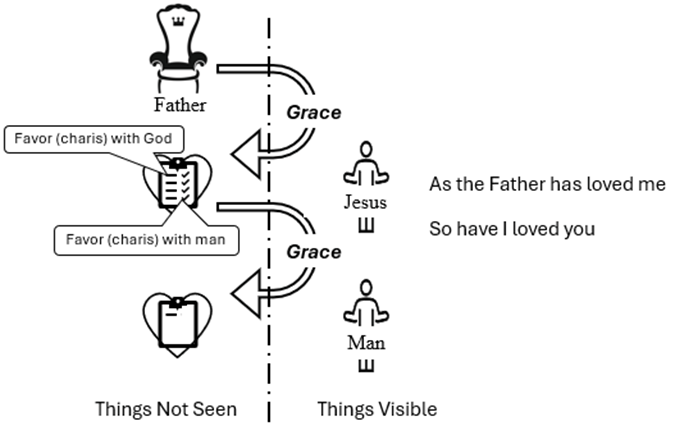
In the context of this passage, Jesus was on earth, in the realm of things visible, so here he is shown on the right.
The first context is favor with God (charis with God). Here, grace is the law written on the heart. Each time the Father loved Jesus, a new law was written upon his heart, and as the Father continued to love his Son, grace increased in the law column of Jesus’ account. This column corresponds to his relationship with God. This favor was unmerited, but given with expectations.
The second context is favor with man (charis with man). In this context, grace is the fulfillment of the law credited to the account. Each time the Son loved man as the Father had loved him, the law written upon his heart was fulfilled and credited to his account in the righteousness column. As he continued to love man, he increased in grace with man. This favor was merited, the direct result of action taken on the part of Jesus.
Acts 2:47
Acts 2:47praising God and having favor (χαριν, charin) with all the people. And the Lord added to their number day by day those who were being saved.
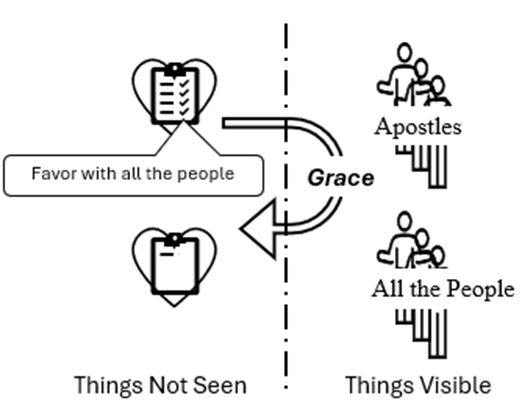
We saw how Jesus grew in favor with man. Now the apostles are seen having favor with the people, as the salvation of the people was visible, as grace traveled through the corridors of things visible.
We also grow in favor with all the people whose lives we touch with the message of the gospel. Grace credited to us in the righteousness column corresponds to our relationship with others.
Acts 7:10
Acts 7:9“And the patriarchs, jealous of Joseph, sold him into Egypt; but God was with him 10and rescued him out of all his afflictions and gave him favor (χαριν, charin) and wisdom before Pharaoh, king of Egypt, who made him ruler over Egypt and over all his household.” (ESV)
In the King James version, instead of before Pharaoh, it says in the sight of Pharaoh. This is interesting because the things written on the heart are in the realm of things not seen. How could they have been seen by Pharaoh?
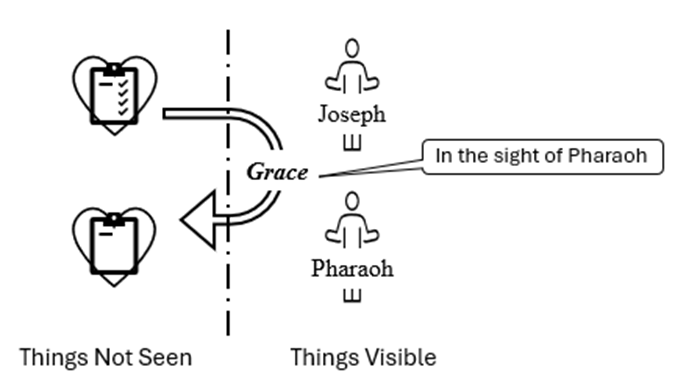
As Joseph delivered the grace that had been given to him, that grace briefly passed into the realm of things visible where Pharaoh could see them.
Acts 7:46
Acts 7:44“Our fathers had the tent of witness in the wilderness, just as he who spoke to Moses directed him to make it, according to the pattern that he had seen. 45Our fathers in turn brought it in with Joshua when they dispossessed the nations that God drove out before our fathers. So it was until the days of David, 46who found favor in the sight of God and asked to find a dwelling place for the God of Jacob.
This passage is interesting because it shows that the concept of grace was not new; it existed in the Old Testament. David found favor in the sight of God, in the realm of things not seen, i.e. the heart, specifically the account.
David was under the New Covenant. He had a heart after God because he had received a heart of flesh when he entered the New Covenant. Do you have a heart after God like David did? If you have been born again, you have received a heart of flesh. It is after God because the only things written in the action column follow what has been written in the law column, which is God’s will for you.
Entering into the New Covenant was not limited to the New Testament Christians. People in the Old Testament entered into the New Covenant the same way we do. If you are interested, you can skip ahead and read the chapter on Entering the New Covenant. It explains with clarity how salvation works. This is where we sit down and have a conversation about the birds and the bees, the facts of life in Christ Jesus. I know the first time I heard about it from my mother; it seemed pretty unbelievable to me. You do not need to know the facts of life to be born again, but it helps to know them if you are planning to have kids of your own.
Acts 24:27
Acts 24:24After some days Felix came with his wife Drusilla, who was Jewish, and he sent for Paul and heard him speak about faith in Christ Jesus. 25And as he reasoned about righteousness and self-control and the coming judgment, Felix was alarmed and said, “Go away for the present. When I get an opportunity I will summon you.” 26At the same time he hoped that money would be given him by Paul. So he sent for him often and conversed with him. 27When two years had elapsed, Felix was succeeded by Porcius Festus. And desiring to do the Jews a favor (χαριτας, charitas), Felix left Paul in prison. 25:1Now three days after Festus had arrived in the province, he went up to Jerusalem from Caesarea. 2And the chief priests and the principal men of the Jews laid out their case against Paul, and they urged him, 3asking as a favor against Paul that he summon him to Jerusalem—because they were planning an ambush to kill him on the way.
Grace is translated as favor in this passage. It is being used here in a secularized context. The motivation of both Felix and Festus was for gain, from Paul or from the Jews. The concept of doing a favor to get a future benefit: to give a favor to get a favor.
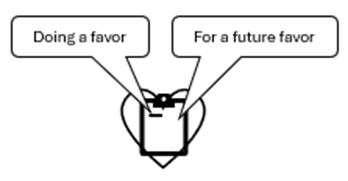
This is equivalent to the Spirit writing a law upon our hearts with the hope that it will bear fruit. As it turned out, their favors did not bear fruit as they had hoped.
Grace as Benefit or Thank
Luke 6:32
Luke 6:32“If you love those who love you, what benefit (χαρις, charis) is that to you? For even sinners love those who love them.” (ESV)
This grace does not map into the model, and that is the point of the verse. The New Commandment says, Love one another as I have loved you. When you love one another as others have loved you, nothing gets credited to your account – there is no benefit, the benefit being grace credited to your account.
My mission while I am on the earth is to accumulate as much grace as possible in my account. When I stray from that mission, there is no benefit. If you think you will be satisfied with entry into heaven, the “think” you have coming will come to late, when there is nothing you can do about it.
Luke 17:9
Luke 17:7“Will any one of you who has a servant plowing or keeping sheep say to him when he has come in from the field, ‘Come at once and recline at table’? 8Will he not rather say to him, ‘Prepare supper for me, and dress properly, and serve me while I eat and drink, and afterward you will eat and drink’? 9Does he thank (χαριν, charin) the servant because he did what was commanded? 10So you also, when you have done all that you were commanded, say, ‘We are unworthy servants; we have only done what was our duty.’” (ESV)
I have included context to verse 9, because it makes an important point. This passage makes a distinction between the commandments in the two laws, the Father’s commandments and Jesus’ commandments. Although it is our duty to do what the Father has commanded, doing our duty does not benefit our account.
But that raises the question, is harm done to my account if I neglect my duty? The better question is this: are there consequences for neglecting my duty as it concerns the Father’s commandments. The answer is yes, but it is best explained in the section on forgiveness.
Romans 6:17
Romans 6:17But thanks (χαρις, charis) be to God, that you who were once slaves of sin have become obedient from the heart to the standard of teaching to which you were committed,
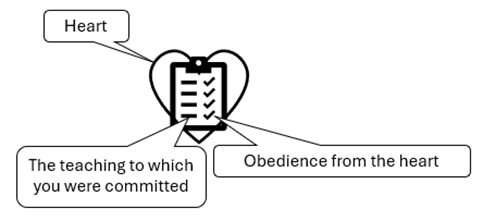
Obedience from the heart is intrinsic to the New Commandment. The teaching to which you were committed is the predicate of the New Commandment – as I have loved you. Obedience from the heart is obedience to the New Commandment – love one another.
1 Timothy 1:12
1Timothy1:12I thank (χαριν, charin, εχω, echō) him who has given me strength, Christ Jesus our Lord, because he judged me faithful, appointing me to his service,
Two Greek words are translated as thank, one word, in this verse. Echō means to have, and charin is grace. The first part of the verse basically says that I have grace which gives me strength. This grace gives me strength because it is fulfilled with the strength of the Spirit, not in the weakness of the flesh.
Jesus appointed me to his service (varieties of service) because he judged me faithful. He knew he could count on me as a willing partner, offering my resources as instruments of righteousness.
To appreciate this more fully, the chapter on faith will cover this concept in depth.
In Conclusion
As I stated at the beginning of the chapter, the objective is to provide an understanding of grace that transcends context. And here it is:
Grace is the product of our partnership with God. It is God working in us: Christ in us and us in Christ. Grace is God’s strength plus our resources for his purpose, all documented in our account. Here is a verse that illustrates grace at large.
Romans6:13Neither yield ye your members as instruments of unrighteousness unto sin: but yield yourselves unto God, as those that are alive from the dead, and your members as instruments of righteousness unto God.
This verse highlights our part in the grace phenomenon: yielding our resources as instruments of righteousness unto God.
It may seem that this definition includes the fruit of righteousness, but not the seed that is in the fruit. However, the seed comes from the fruit of someone else yielding their members as instruments of righteousness unto God. That which is grace when it is delivered to you is still grace when you receive it.
2 Corinthians 5:1For we know that if our earthly house of this tabernacle were dissolved, we have a building of God, an house not made with hands, eternal in the heavens. 2For in this we groan, earnestly desiring to be clothed upon with our house which is from heaven: 3If so be that being clothed we shall not be found naked.
The house with which we will be clothed upon is the righteousness of Christ. Paul desired to be clothed upon with our house which is from heaven, yet, as hard as it was for him on earth, he said he would rather be here than naked in heaven.
Many believe that heaven is for those who are free from sin. Being free from sin is necessary, but not sufficient. If you are born again, you are free from sin. Without righteousness, however, no one will enter the kingdom of heaven.
Beyond that, grace will affect our quality of life in eternity. Eternity is a long time to be homeless in heaven.
 New Wine