Seek Ye First
Matthew 6:33But seek first the kingdom of God and his righteousness, and all these things will be added to you.
I would like to encourage you to follow the logic that justifies the approach I have taken. I assure you the journey is just as interesting as the destination.
Hebrews 1:1 God, having of old time spoken unto the fathers in the prophets by divers portions and in divers manners, (ASV)
Prior to Jesus, the scriptures had provided only piecemeal details of the kingdom of heaven. I chose the American Standard Version because it is one of the few that accurately interprets the Greek, in my opinion. Other versions use diverse times instead of diverse portions. The Greek word is polymerōs, meaning many parts, not many times.
That said, the prophets gave us piecemeal descriptions of the new covenant, each prophet contributing the pieces of the puzzle they had been given. But the piece of the puzzle that was missing was the one piece that connected them into a coherent picture of the kingdom of heaven. When Jesus came, he provided the missing piece, the one that connected them all. That piece was the cornerstone, and that is the piece that all the other pieces were connected to. Without this piece, nothing else connected, so it stands that this piece, the cornerstone, had to be placed first, and upon that cornerstone the foundation of the apostles and prophets could be constructed.
This is interesting because this proves that the scriptures are inspired, at least to some extent. Each of the authors had their parts to contribute, but none had seen the complete picture. Each of them must have been given their pieces by the one who had seen the complete picture, otherwise they could never have been connected. Jesus, providing the missing piece of the puzzle, if indeed that piece allows all the other pieces to be connected, authenticates him as the one who inspired the prophets.
We are back to the challenge: what piece did Jesus reveal, the piece that had been hidden?
John 1:17For the law was given by Moses, but grace and truth (αληθεια, aletheia) came by Jesus Christ.
Truth came by Jesus Christ. The Greek word for truth is aletheia. It begins with an alpha, a negative particle, negating the remainder of the word, lanthano, which means hidden. Truth means to reveal that which had been hidden. So, the question is, what did Jesus reveal that had been hidden?
The journey begins by looking for something that had been hidden, and it comes from a most unlikely place. Bear with me. We have all read books or watched movies that have multiple plots running simultaneously. This is one of those. Trust me, it is not a rabbit hole that leads nowhere.
Priesthoods and Their Laws
Hebrews 7:12For when there is a change in the priesthood, there is necessarily a change in the law as well. (ESV)
A priesthood governs according to its own set of laws, and the priesthood you are subject to determines the set of laws that apply to you.
This verse implies that there must be at least two priesthoods, so it would be informative to know what the two priesthoods are and their associated laws.
Hebrews 7:11Now if perfection had been attainable through the Levitical priesthood (for under it the people received the law), what further need would there have been for another priest to arise after the order of Melchizedek, rather than one named after the order of Aaron? (ESV)
According to this verse, the two priesthoods are the Levitical priesthood after the order of Aaron, and the priesthood after the order of Melchizedek, king of righteousness, prince of peace.
Chronologically, Melchizedek was the first priesthood, and Aaron was the second. Accordingly, the law associated with the first priesthood was the first law, and the one associated with the second priesthood was the second law. This may seem trivial, but the order is critical to the narrative.
The second law is detailed in Deuteronomy (meaning second law in Greek), and that law is expanded in Leviticus, confirming its association with the second priesthood, after the order of Aaron, of the house of Levi.
The specifics of the first law, however, were never provided in the Old Testament: they were hidden. We are only given clues, like in Genesis 15 where Abraham was justified by faith, a clue that the first law somehow involved faith.
But Abraham was not the only Old Testament figure justified by faith. Hebrews 11 lists other saints whose faith-based works are recorded, but these works didn’t suggest any specific law that could justify them.
Abel’s sacrifice, Noah building the ark, Sarah giving birth to Isaac, Abraham relocating, and later offering his son on the altar: these works have no discernable common denominator that could provide even a clue as to what that law could be.
The First Priesthood Reinstated
Hebrews 5:5So also Christ did not exalt himself to be made a high priest, but was appointed by him who said to him, “You are my Son, today I have begotten you”; 6as he says also in another place, “You are a priest forever, after the order of Melchizedek.” (ESV)
When Jesus came after the order of Melchizedek, he reinstated the first law. Those under his priesthood would become subject to the governance of his priesthood, the first law, the details of which had yet to be disclosed.
Truth came through Jesus Christ when he revealed that which had been hidden: the details of the first law. But he did not stop there. He also provided a bigger context for that law, revealing the structure of the kingdom of heaven, the piece of the puzzle that had been missing.
John 15:1“I am the true vine, and my Father is the vinedresser.” (ESV)
In John 15, Jesus, identifying himself as the true vine, revealed that which had been hidden (truth). The vine that Jesus described had within it the thing that had been hidden from ages and generations: the first law.
The true vine is the piece of the puzzle that was missing, the piece that all the other pieces were connected to. To reconstruct the kingdom of heaven, this is the piece that must be placed first. Once that piece is placed, all the other pieces can be placed, connected to the central piece.
It is time to construct the model of the kingdom of heaven.
Visualizing the Kingdom of Heaven
The True Vine
John 15:9As the Father has loved me, so have I loved you. Abide in my love. 10If you keep my commandments, you will abide in my love, just as I have kept my Father’s commandments and abide in his love. 11These things I have spoken to you, that my joy may be in you, and that your joy may be full. 12“This is my commandment, that you love one another as I have loved you.
Embedded in this passage is the New Commandment, the first law. Notice that Jesus made a distinction between the Father’s commandments and his own commandments. He kept the Father’s commandments and we are to keep his.
John 1:17For the law was given by Moses, but grace and truth (αληθεια, aletheia) came by Jesus Christ.
The Father gave his commandments, the second law, through Moses when he wrote them on tablets of stone. Grace, the first law, was given by Jesus Christ in John 15 when he said, this is my commandment, that ye love one another as I have loved you.
It would appear that Jesus told us to keep his commandments (plural), but then only gave us one commandment. This apparent paradox will be resolved when you see the model.
This is a straight-forward illustration of these verses. It is so simple that it can be hard to see how this construct could unveil anything.
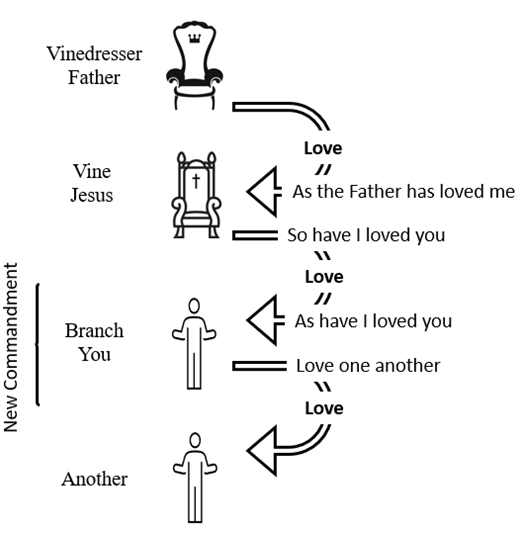
In the beginning of the book, I asserted that words were meant to represent things, and that the words would inherit their meaning from the things they represent. Having seen this simple model, we are in a position to make our first assignment, and this is to be done scientifically, with a hypothesis (the first step after stating the problem.) In other words, I am going to guess, for that is what a hypothesis is.
Even in its simplest form, there is one thing that stands out as being predominant in the model of the kingdom of heaven. That thing is the love that originates with the Father, flows through Jesus to you, then on to one another. This love touches everything in the kingdom, and it deserves to be assigned a special name. Love falls short as an appropriate word, because it is not specific enough: its meaning is too colloquial. This love is very specific, and it deserves a special word to represent its significance.
My guess is shown shown below in the revised illustration.

Grace is the term I chose to assign to the love that cascades through the kingdom of heaven. In the current theological scheme, grace has many contextual definitions, and it would seem that grace becomes something different in each of its contexts. But grace represents only one thing: the love that emanates from the throne of grace and flows like a river through the kingdom. It is like sap flowing through the vine providing nutrients to all the branches.
I don’t want to dwell here, but neither do I want to hold you in suspense concerning word assignments. In the section on Visualizing the Language, there is a section on grace that shows how this visualization of grace applies to all contexts. This is the test, the next step in the scientific method that confirms or denies the hypothesis.
For now, suffice it to say that, if this assignment is inaccurate, it will introduce conflicts as further assignments are made, and the house of cards will collapse. If my assignment is accurate, however, it will be found to be in harmony with all future assignments.
I will continue to make informal assignments as they appear in the model, then later support them by looking at the various contexts where they are found in the scripture. If you are so inclined, you may skip ahead to see the test results.
Let’s get back to developing the model.
Piecemeal Revelations
Ezekiel 36:26And I will give you a new heart, and a new spirit I will put within you. And I will remove the heart of stone from your flesh and give you a heart of flesh.
As you can see below, the heart is added to the model. The Spirit is added by italicizing Love, highlighting the role of the Spirit in the kingdom of heaven. The love permeating the kingdom is divine love, enacted by the Spirit.
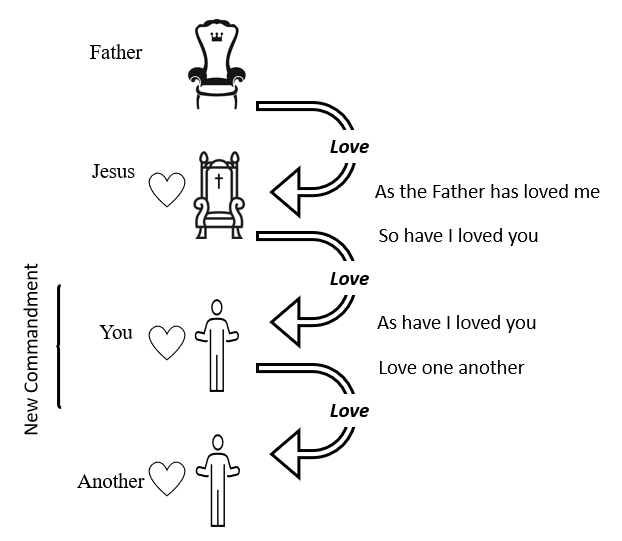
Before I move on, there is something significant about the heart that compels me to reorganize the model.
1 Samuel 16:7But the Lord said to Samuel, “Do not look on his appearance or on the height of his stature, because I have rejected him. For the Lord sees not as man sees: man looks on the outward appearance, but the Lord looks on the heart.”
To more accurately model the kingdom of heaven, I split the model into two sections: on the right is the outward man, visible to everyone. On the left is the inner man, visible only to God. The inner man is in the realm of things not seen.
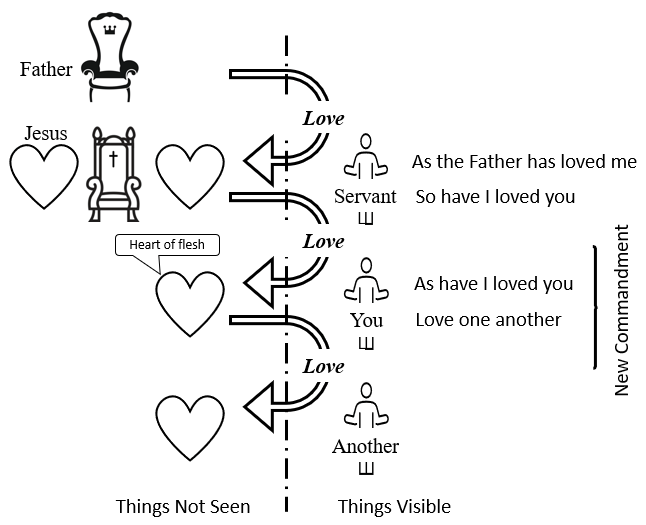
The heart is only visible to God. It is hidden from man, so it is depicted in the domain of things not seen.
In the diagram above, Jesus is also shown in the domain of things not seen. When he was on the earth, being fully man, he was in the domain of things visible, where the servant is currently shown.
Currently being in the domain of things not seen, Jesus loves us through others. We are his hands and his feet (and his voice). I have added a servant to the diagram to indicate the ones through which Jesus works (by the Spirit).
The heart to the left of the servant belongs to the servant. The heart to the left of Jesus belongs to Jesus.
This reconfiguration is a significant modification to the model, since the scriptures often speak of things not seen.
Jeremiah 17:9The heart is deceitful above all things, and desperately wicked: who can know it? 10I the Lord search the heart, I try the reins, even to give every man according to his ways, and according to the fruit of his doings.
The heart is deceitful because it is hidden from our view. Who can know it? It would seem that this question is rhetorical, the answer being no, but that is not the case. This scripture says that the Lord searches the heart, its content being visible to him.
Before continuing to develop the model, an example would be informative, perhaps even necessary for you to see the kingdom of heaven. Please take a moment to consider how the love of the Father flows through the Son, on to you, then continues to another. Here you can see how love flows through the kingdom of heaven.
The Account
Matthew 12:35A good man out of the good treasure of the heart bringeth forth good things: and an evil man out of the evil treasure bringeth forth evil things. 36But I say unto you, That every idle word that men shall speak, they shall give account (λογον, logon) thereof in the day of judgment. 37For by thy words (λογων, logōn) thou shalt be justified, and by thy words (λογων, logōn) thou shalt be condemned.
Here, Jesus talks about the treasure of the heart being all good or all bad. How could this be, since good people sometimes do bad things and bad people sometimes do good things? As it turns out, the way in which the account is managed depends on the law the person is under. Since the model being developed here is for the kingdom of heaven, the priesthood is Melchizedek, and the law is the first law. Under the first law, only good things are entered, and under the second law, only bad things are written.
The account that every man will give him in the day of judgment contains treasure, and that account is located on the tables of the heart. The Greek word for account is logon (λογον). It is a log of everything that will be considered on judgment day: the account contains all admissible evidence, and anything not in the account will not be considered. As this passage indicates, the content of the account, the logōn (λογων), will determine whether a man will be justified or condemned.
The figure below adds the account to the model. It is located on the tables of the heart, and it plays an important role in the visualization of the kingdom of heaven as you will see.
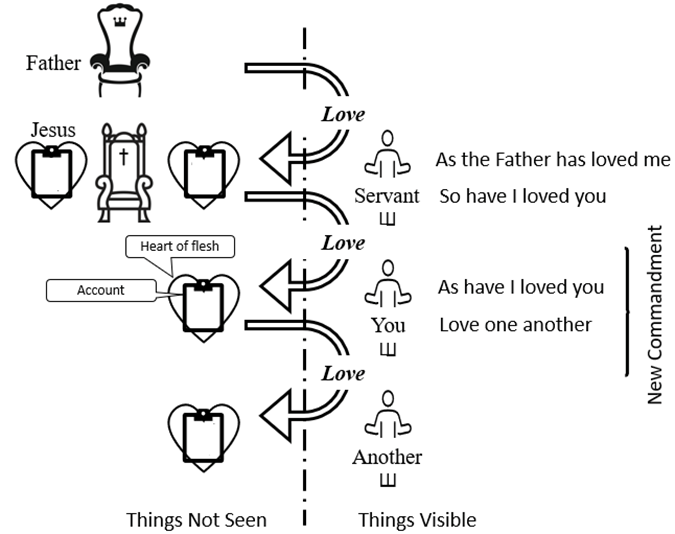
Since we will be judged by the content of our account, it is important to know what is written there, and how the account is managed.
The Law Written upon the Heart
Jeremiah 31:33For this is the covenant that I will make with the house of Israel after those days, declares the Lord: I will put my law within them, and I will write it on their hearts. And I will be their God, and they shall be my people.”
Jeremiah provides another aspect of the New Covenant, another piece of the puzzle. I will write my law on their hearts. This begs the question: what laws are to be written upon their hearts?
Since the law comes from the commandment, and the commandment in the kingdom of heaven is the New Commandment, love one another as I have loved you, the law written upon the heart is the as I have loved you part of the commandment.
Another interesting observation in the John 15 passage is that Jesus told us to keep his commandments, plural, but gave us only one commandment: love one another as I have loved you. This single commandment becomes plural as the Lord’s love to you becomes plural. He loves you in many ways, and each time he loves you the Spirit writes a new law upon your heart.
The law written on the heart is added in the model below.
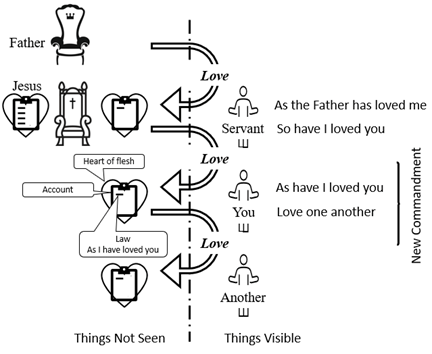
Jesus was loved by the Father in many ways, so there are many laws written upon his heart. Each time he loves you, a law is written on your heart.
What is written upon our hearts is not the only thing of interest, what is not written there is also important.
Credits
Jeremiah 31:34And they shall teach no more every man his neighbour, and every man his brother, saying, Know the Lord: for they shall all know me, from the least of them unto the greatest of them, saith the Lord: for I will forgive their iniquity, and I will remember their sin no more.
God remembers things about us by writing them upon our heart. Under the New Covenant, he remembers our sin no more. No longer are sins credited to our account.
Romans 8:1There is therefore now no condemnation to them which are in Christ Jesus, who walk not after the flesh, but after the Spirit.
For those of us under the first priesthood, there is no condemnation because our accounts are free from sin. That does not mean that our lives are free from sin, but that our account is free from sin.
Having our sins not credited to our account does not mean that we will not be held accountable, however. We will see later that under the New Covenant we will be held accountable in a different way.
Jesus took our sin-laden account when he took our heart of stone, our heart of flesh came with an account free from sin, and our account remains free from sin since our sins are remembered no more. Our heart, invisible to us for the moment, will be opened on judgment day, and we will be judged according to the content of our account. This should underscore the importance of being under the right priesthood.
Jeremiah 17:1The sin of Judah is written with a pen of iron, and with the point of a diamond: it is graven upon the table of their heart, and upon the horns of your altars;
Those of us under the second priesthood are free from righteousness. Their laws were written on tablets of stone, and their sins are written on the tables of their hearts, written in stone with the point of a diamond, their permanent record. Under the second priesthood, there is no provision for righteousness. Those who are under the second priesthood are condemned.
Romans 4:3For what does the Scripture say? “Abraham believed God, and it was counted (ελογισθη) to him as righteousness.”
Abraham’s faith was counted as righteousness. The Greek word for counted contains the root word for account, logon. When a law written upon your heart is fulfilled, it is credited to your account as righteousness. The law, as I have loved you, is fulfilled by keeping the commandment, by loving one another. This is the work of the Spirit of Christ, so it is considered the work of Christ, the righteousness of God. This is shown in the model by putting a checkbox next to the law.
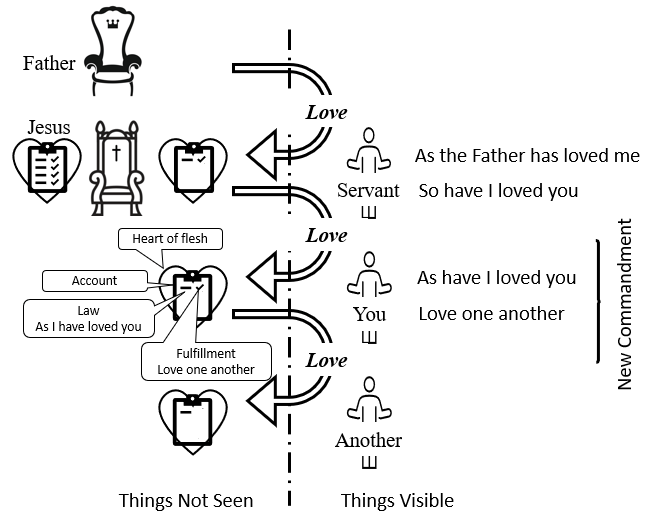
John 3:3Jesus answered and said unto him, Verily, verily, I say unto thee, Except a man be born again, he cannot see the kingdom of God.
Having seen the model of the kingdom of God, I would like to explain the process of being born again. I assure you that it will be interesting even to those of you who are already born again. It will be a different perspective. Having been born the first time, that experience did not make me an expert on how my birth had come about. In the same way, a person can be born again without knowing the details of how it happened, and not knowing how it happened does not mean that it did not happen.
Knowing the details of how it happens, however, is helpful when it is your turn to bring children into the world.
 New Wine