The Household of God
Ephesians2:19So then you are no longer strangers and aliens, but you are fellow citizens with the saints and members of the household of God, 20And are built upon the foundation (θεμελιω , themeliō) of the apostles and prophets, Jesus Christ himself being the chief corner stone (ακρογωνιαιου, akrogōniaiou);
The household of God is built upon the foundation of the apostles and prophets. Jesus Christ was the chief corner stone. Themeliō, the Greek word for foundation, denoted the concept of laying down a foundation.
We think of a corner stone as being placed at the corner of the foundation, but the Greek word indicates otherwise. Akro means extremity, or highest point. Gōnea means corner, or angle. A keystone is angled differently from all the other stones in a foundation. Whereas a building has multiple corners, an arched foundation, especially a twelve sided foundation, would have a keystone with complex angles.
The other interesting aspect of the keystone is that it is the stone that is last to be put into place. Before the foundation could be completed, all the other stones had to be put in place.
Hebrews 1:1God, who at various times (πολυμερως, polymerōs)and in various ways (πολυτροπως, polytropōs) spoke in time past to the fathers by the prophets, 2has in these last days spoken to us by His Son, whom He has appointed heir of all things, through whom also He made the worlds;
Polymerōs, the Greek word for various times, has nothing to do with time, but what the prophets were given was piecemeal. Polymerōs means many parts: poly meaning many, and merōs meaning part. The pieces they were given would first have to be put into place. Only then could the foundation be complete by adding the keystone, of which there is only one.
In these last days, Jesus spoke. He was the piece that was missing: the piece through which all the other pieces connected. He was the cornerstone.
1 Corinthians 3:11 For no one can lay a foundation other than that which is laid, which is Jesus Christ.
The keystone of the kingdom of God is Jesus Christ, and he is positioned at the apex of the foundation of the model that will be developed in this section: the piece that , once put in its place, supports all the other pieces.
With that introduction, we can begin assembling the model of the kingdom of God by starting with the keystone.
The True Vine
John 15:1“I am the true (αληθινη, alethine) vine, and my Father is the vinedresser. 9As the Father hath loved me, so have I loved you: continue ye in my love. 10If you keep my commandments, you will abide in my love, just as I have kept my Father’s commandments and abide in his love. 11These things I have spoken to you, that my joy may be in you, and that your joy may be full. 12This is my commandment, That ye love one another, as I have loved you.
Alethine, the Greek word for true, means to reveal that which had been hidden. Alpha, a negative particle, negates lanthano, meaning hidden. A webpage is devoted to this term to reveal the true meaning of true.
Whenever true is found in scripture, it signifies the thing that was hidden, and has now been revealed. The sign below illustrates truth as it appears in this context.
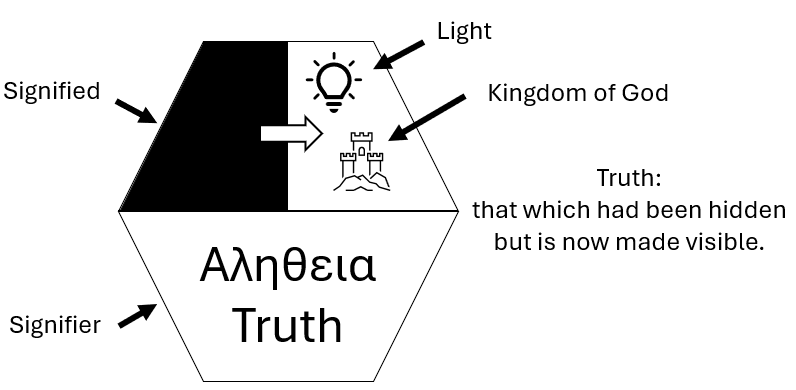
The bottom half of this sign indicates the signifier, and the upper half illustrates the thing that is signified. Truth is a dynamic word in that it indicates an action. Truth is not just something that is visible, but something that had been hidden, and is now manifested: made visible. The upper left quadrant is what you can see before it is revealed, and the upper right quadrant is what you can see once the light is turned on. What truth signifies depends on context: what was hidden in the passage in which truth is found.
John 3:3Jesus answered and said unto him, Verily, verily, I say unto thee, Except a man be born again, he cannot see the kingdom of God.
In this case, what was hidden is the kingdom of God. Up to this point, no one had been born again. Up to this point, no one could see the kingdom of God. What is revealed in this passage is the keystone placed in the foundation of the kingdom of God.
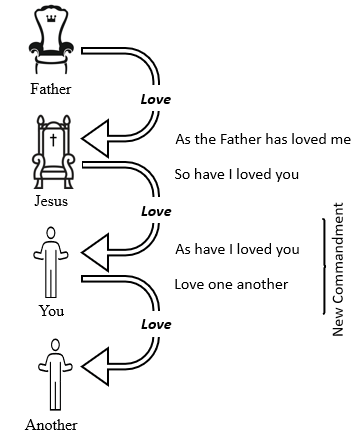
The vine is true because it reveals that which had been hidden from ages and generations. This vine connects all the pieces spoken by the prophets. This is the keystone which supports the entire foundation upon which the of the kingdom of God is built.
The figure shown above illustrates the true vine, as Jesus described it. There are four characters in this script: the Father, Jesus, you, and another. They are characterized by the vinedresser: the Father, the vine: Jesus, and two of the branches: you, and another. In this description, love flows from one to the next to the next, like living water flowing through the vine.
It is surprising that something so simple could be the stone that was missing in the foundation, the stone without which none of the pieces of the puzzle given to us by the prophets could be supported.
The law of the kingdom is the New Commandment. This law is similar to the law under Melchizedek, in that commandments are specific to the individual, not the same for everyone. New Commandment law is different from the law under Melchizedek, however, differing in the manner in which the laws are communicated. Rather than the Lord telling individuals what to do, in this kingdom commandments are passed as love letters: as I have loved you, love one another. We follow Jesus by loving one another the way he loved us.
He loves us with the power of the Spirit, and we are to love others in the same way, and with the same power. Because of the involvement of the Spirit, this is also referred to as the law of the Spirit of life in Christ Jesus. It is distinctly different from the law of Moses, where we are to love with all our heart, soul, mind, and strength: items of the flesh (but no Spirit). The law of Moses was to be kept through the weakness of the flesh. The law of the Spirit of life was to be kept through the power of the Spirit.
Laying the Foundation
Having a rudimentary structure in place, the remainder of the foundation can now be laid by adding details from the prophets in the Old Testament.
A New Heart and a New Spirit
Ezekiel 36:26And I will give you a new heart, and a new spirit I will put within you. And I will remove the heart of stone from your flesh and give you a heart of flesh.
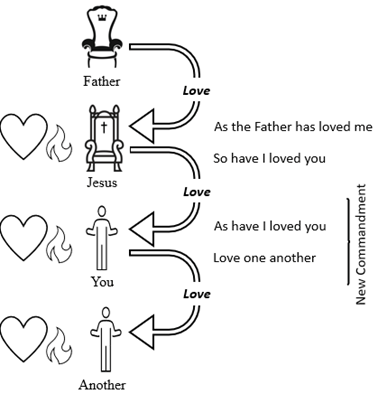
We are born with a heart of stone. When we enter into the kingdom of God, our heart of stone is removed, and we are given a heart of flesh. As you will see, this plays a critical role in the plan of salvation.
We also receive a new Spirit. Instead of depending on the weakness of the flesh, the Spirit of Christ is now the source of our strength. There is more to us than meets the eye. Christ is in us.
The figure below adds the heart of flesh and the Spirit of Christ, shown as a flame of fire.
The Natures of Sin and Righteousness
The Greek word for sin, αμαρτια (hamartia), is composed of two parts: alpha, a negative particle, and merōs, meaning part (as we saw earlier). Sin is what one does apart from God.
Romans 8:28And we know that all things work together (συνεργει, sunergei) for good to them that love God, to them who are the called according to [his] purpose.
Sunergei, the Greek word for work together is where we get our word, synergy, from: ergo is work, and sun is together.
What we do know is that things do not perform work. It is not things that word, but it is God who does the work. We also know that God works with people, not things. What this verse is saying is that everything we do together with God is good: righteous.
John 15:5“I am the vine; you are the branches. If you remain in me and I in you, you will bear much fruit; apart from me you can do nothing.
We can only bear fruit if we remain in Christ. Like in nature, fruit requires two parents. Without him, we cannot bear fruit. And without us, he cannot bear fruit. It takes two to bear fruit.
The “all things” in Romans 8:28 do not include the nothings we do apart from Christ in John 15:5.
In summary, sin is everything we do apart from God, and righteousness is everything we do together with God.
Romans 3:10as it is written: “None is righteous, no, not one; 11no one understands; no one seeks for God. 12All have turned aside; together they have become worthless; no one does good, not even one.”
Righteousness is fruit. No one is righteous because it takes two to bear fruit.
Sin Remembered No More
Jeremiah 31:34And no longer shall each one teach his neighbor and each his brother, saying, ‘Know the Lord,’ for they shall all know me, from the least of them to the greatest, declares the Lord. For I will forgive their iniquity, and I will remember their sin no more.”
When we enter into the New Covenant, past sins are taken away, and future sins are not counted against us. Our past sins were written on the tables of our heart. They were taken away when he took our heart of stone.
When we were given a heart of flesh, it came with a clean slate, but it is better than that. Our sins are remembered no more.
Romans 4:8Blessed is the man against whom the Lord will not count his sin.
We saw where the production of fruit requires two parents.
Genesis 4:1And Adam knew Eve his wife; and she conceived, and bare Cain, and said, I have gotten a man from the Lord.
When Adam knew Eve, they bore fruit. When we bear fruit with the Lord, we know each other: he knows us and we know him. Everyone will Know the Lord in the kingdom of heaven because everyone will have born the fruit of righteousness. Without righteousness, no one will enter the kingdom of heaven.
There is a distinction between the kingdom of heaven and the kingdom of God. When one enters the kingdom of God, there is no righteousness credited to our account. Recall that Abraham was credited with righteousness when he obeyed the commandment that was given to him.
We are not credited with things done by Christ apart from us. We are not credited with things done by us apart from Christ. We are only credited with things done by us together with Christ. This probably contradicts what you have learned as a Christian, but let’s keep this in the hypothetical for now.
The Account
Matthew 12:35The good person out of his good treasure brings forth good, and the evil person out of his evil treasure brings forth evil. 36I tell you, on the day of judgment people will give account (λογον, logon) for every careless word they speak, 37for by your words (λογων, logōn) you will be justified, and by your words (λογων, logōn) you will be condemned.
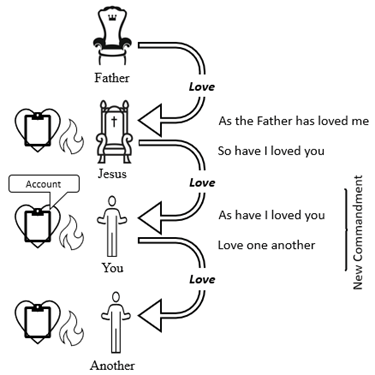
Logon is the Greek word for account. This is the account that all will give on judgment day. It is the content of the account, the logōn, that will justify or condemn us. This account contains all the evidence that will be considered on that day.
The treasure that is brought forth on that day will either be all good, or all evil. The ones bringing forth good treasure are the ones who have received a heart of flesh. They have eaten fruit from the tree of life. That fruit contains seed that will reproduce after its own kind when pollinated. The ones who bring forth evil treasure are the ones whose hearts were seeded from the fruit of the tree of the knowledge of good and evil. They have lived their lives apart from God.
Laws Written on the Heart
Jeremiah 31:33For this is the covenant that I will make with the house of Israel after those days, declares the Lord: I will put my law within them, and I will write it on their hearts. And I will be their God, and they shall be my people. (ESV)
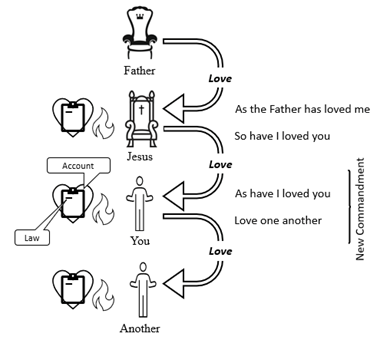
Laws are based on commandments. The New Commandment is Love one another as I have loved you. Each time he loves you, a law is written on your heart.
John 15:10If you keep my commandments, you will abide in my love, just as I have kept my Father’s commandments and abide in his love. 12“This is my commandment, that you love one another as I have loved you.
Because of the indirect nature of this commandment, this one commandment becomes many: his commandments are based on multiple future events.
This allows laws to be directed to individuals, just like they were under Melchizedek. His love is personal; his laws are personal. The only difference is how the personal instructions are delivered. Under Melchizedek, commandments were communicated perhaps telepathically. With the kingdom of God, commandments are delivered with love.
Righteousness
Romans 4:3For what saith the scripture? Abraham believed God, and it was counted (ελογισθη, elogisthe)unto him for righteousness.
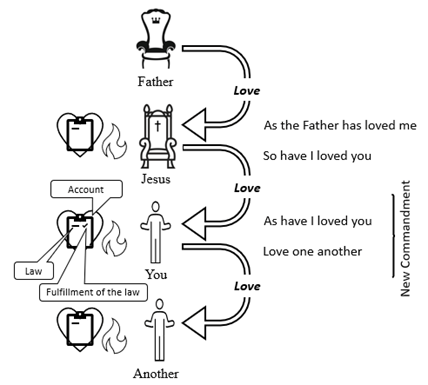
The base of the Greek word for counted is logos. It is the same base as the word for account. Righteousness is counted when it logged into the account.
When you receive love from Jesus, the power of the love comes from the strength of the Spirit. When you love another as Jesus loved you, the power of the love also comes from the Spirit. Righteousness is God’s power using your resources for his purpose, and it is credited to your account.
I do not get credit for deeds Christ does without me. I do not get credit for deeds I do without God. I only get credit for things we do together, and everything we do together is good.
Justification
Romans 5:18Therefore as by the offence of one judgment came upon all men to condemnation; even so by the righteousness (δικαιωματος, dikaiōmatos) one the free gift came upon all men unto justification (δικαιωσιν, dikaiōsin) of life.
I am using this verse to show the relationship between righteousness and justification: both Greek words share the same root. We will be justified if righteousness is found in our account on judgment day.
The good treasure that is brought forth from our heart on judgment day includes both the law and the fulfillment of the law: righteousness. Laws that are not fulfilled will be consumed by fire on that day.
Justification includes past, present, and future aspects. We have been justified if righteousness has been added to our account. Righteousness is the steadfast love of the Lord. Once it is entered into your account, it is permanent.
Justification is ongoing, in that as we fulfill the laws written on our heart, righteousness is credited to our account. Consider Abraham:
James 2:21Was not Abraham our father justified by works, when he had offered Isaac his son upon the altar?
Abraham was justified when he offered Isaac upon the altar. At this time, Abraham was circumcised.
Romans 4:9Is this blessing then only for the circumcised, or also for the uncircumcised? For we say that faith was counted to Abraham as righteousness. 10How then was it counted to him? Was it before or after he had been circumcised? It was not after, but before he was circumcised.
Before he was circumcised, Abraham was justified, as was recorded in Genesis 12. Being justified is a state of having righteousness in your account.
Matthew 12:37for by your words (λογων, logōn) you will be justified, and by your words (λογων, logōn) you will be condemned.
Justification also has a future component, when our account is given and the righteousness that was previously entered in the account is revealed.
Things Seen and Things Not Seen
Samuel 16:7But the Lord said to Samuel, “Do not look on his appearance or on the height of his stature, because I have rejected him. For the Lord sees not as man sees: man looks on the outward appearance, but the Lord looks on the heart.”
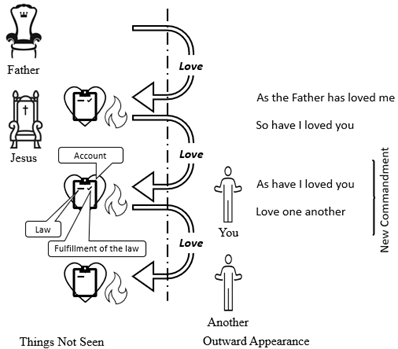
Man can only see the outward appearance, but God looks on the heart. The concept of things not seen requires a reorganization of the model, a boundary between the outward appearance and the things not seen.
This detail is critical to the model because things not seen plays a major role in the kingdom of God. This concept is foundational to the understanding of faith, for example, the second element of which is the evidence of things not seen.
This concept complicates the model because Jesus has played roles on both sides of the line: when on earth, he was visible, but now he has moved to the other side where he is no longer visible.
You in Me; Me in You
John 15:4Abide in me, and I in you. As the branch cannot bear fruit by itself, unless it abides in the vine, neither can you, unless you abide in me.
God works in partnership with people. The branch cannot bear fruit of itself unless it abides in the vine, but it is the branch that bears the fruit, not the vine. Both parts are necessary. We cannot produce fruit apart from him, but he cannot bear fruit apart from us.
The Servant Model
Isaiah 9:6For to us a child is born, to us a son is given; and the government shall be upon his shoulder, and his name shall be called Wonderful Counselor, Mighty God, Everlasting Father, Prince of Peace.
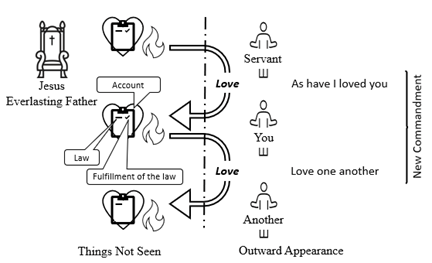
This is the condensed version of the model. It illustrates the kingdom of God as it exists now. While Jesus was on earth, he was on the right where he could be seen. God the Father was on the left empowering Jesus, the Son.
Now that he is in heaven, Jesus is in the realm of things not seen. In the kingdom of God, Jesus is in the role of the Father. In that role, he is able to love us as the Father had loved him: through others.
Matthew 23:11But he that is greatest among you shall be your servant.
In the kingdom of God, there is a hierarchy, and in this hierarchy, the servant is greater, as you can see from the model.
There are several contexts in which the servant is found. If one is a servant of sin, for example. Is sin the master he is serving? Or is sin the one receiving his service? Or is sin the thing being served?
Romans 6:18Being then made free from sin, ye became the servants of righteousness.
Servants of righteousness are the ones who deliver righteousness to others, planting seeds of righteousness in the hearts of others.
We are free from sin when there is no sin in our account.
Romans 6:20For when ye were the servants of sin, ye were free from righteousness.
Servants of sin are the ones who deliver sin to others, planting seeds of sin in the hearts of others.
We are free from righteousness when there is no righteousness in our account.
The Kingdom of Heaven
There is a distinction between the kingdom of God and the kingdom of heaven.
Matthew 7:21“Not everyone who says to me, ‘Lord, Lord,’ will enter the kingdom of heaven, but the one who does the will of my Father who is in heaven. 22On that day many will say to me, ‘Lord, Lord, did we not prophesy in your name, and cast out demons in your name, and do many mighty works in your name?’ 23And then will I declare to them, ‘I never knew you; depart from me, you workers of lawlessness.’
In this passage, those who did the mighty works in his name were in the kingdom of God, but they did not enter the kingdom of heaven because they were not justified: they never fulfilled the law, and there was no righteousness in their account.
Jeremiah 31:34And no longer shall each one teach his neighbor and each his brother, saying, ‘Know the Lord,’ for they shall all know me, from the least of them to the greatest, declares the Lord. For I will forgive their iniquity, and I will remember their sin no more.”
We saw this passage before, but there the concept of everyone knowing the Lord was not addressed. This passage references the kingdom of heaven, where everyone already knows the Lord. Anyone who never knew the Lord had been dismissed at this point. They never made it to heaven.
Producing fruit is a partnership between you and Jesus. When Adam knew Eve, they had kids. When Jesus knows you, you bear the fruit of righteousness, and it is credited to your account.
The works that were done in his name were performed by the Holy Spirit, but not the Spirit of Christ.
1 Corinthians 12:4Now there are varieties of gifts, but the same Spirit; 5and there are varieties of service, but the same Lord; 6and there are varieties of activities, but it is the same God who empowers them all in everyone.
The works referred to were works performed under the varieties of gifts category. Works counted as righteousness are performed under the varieties of service category. Salvation is by Jesus alone. Jesus is the one who paid the price, not the Holy Spirit. Unless you bear fruit with Jesus, although you are in the kingdom of God on this earth, you will not be invited into the kingdom of heaven.
Theology
Many theological concepts have been introduced in this webpage. These concepts are not precepts: an agenda used to bias the final outcome. Rather, these concepts were the conclusions arrived at by allowing the theology room to flex to conform it to the Scriptures. These conclusions must remain flexible in order to conform to the Scriptures: in the kingdom of God, nothing is written in stone.

