Recap
Genesis 2:19Now out of the ground the Lord God had formed every beast of the field and every bird of the heavens and brought them to the man to see what he would call them. And whatever the man called every living creature, that was its name.
Let’s go back to the beginning to see how language was supposed to work. For each animal Adam saw, he assigned a name. Words did not get their meanings from how they were used in text, rather they inherited their meaning from the things they were assigned to represent.
This is how language was meant to work: text gets its meaning from the words, and words inherit their meaning from the things they represent. Each word represents one thing or one group of things. Words do not mean something different when they are found in a different context.
The day science begins to study non-physical phenomena, it will make more progress in one decade than in all the previous centuries of its existence. – Nikola Tesla
Science enters the process at this point, where words are assigned to things found in the kingdom of heaven. The scientific method begins with a problem to be solved. The problem of the moment is the word assignments: what things in the kingdom are worthy of words to represent them.
The second step in the scientific method is to form a hypothesis. Hypothesis is nothing more than a fancy word for making a guess. Each time you guess, you test it to see how close you got. Each time you guess wrong, you learn a little more, and your next guess will be a more educated one.
Each word assignment I make will be a guess, a hypothesis. Each assignment will be illustrated, pictured in the kingdom of heaven. Luckily for you, I will not be publishing the ones I got wrong. You will be spared from all my missteps.
The test is the next step in the scientific process. But I would like to step back and consider the main premise of this book. The main premise is also a hypothesis: that Biblical words represent things. Unless all Biblical terms can be shown to represent things that transcend context, the main hypothesis is a bad guess. The success of the main hypothesis is dependent on the success of all the sub-hypotheses. All the term assignments must be tested and proven to be accurate for the main hypothesis to be true. Therefore, each assignment is critical and must be handled with diligence. That said, if I show that this hypothesis is correct for even a few words, I would consider it a significant finding.
Testing the accuracy of a word assignment is done by examining the assignment in every context in which the word is encountered. I use the Greek when searching for context, not English, because of the variation found in all the different versions.
Obviously, an exhaustive test would exhaust the reader as well as the author. I will be limiting the extent of the test to what I feel is a reasonable amount of evidence, attempting to cover at least one example of every context.
I will begin with grace, the word that is found in more contexts than any other term in Christian theology.
That said, the only contexts that matter are the ones found in scripture. For example, grace being something you say before the meal is not relevant. That context is not found in scripture and is a mere artifact of our evolving language.
Grace – χαρις, charis
The Greek word for grace is charis. This one Greek word is translated into many words in all the English versions. In King James, charis is translated as grace, favor, thank, thanks, pleasure, acceptable, benefit, gift, gracious, joy, liberality, thanked, and thankworthy. Each time it was found, a contextualized version of the word was used to help the reader process the passage according to the views of the translator. Some translations are more interpretations than transliterations. This adds another level of obfuscation to the text.
Since different version of the Bible use different words to express their interpretation of what the scripture is saying, the only reliable way to do a word study is to use the Greek, and that is what I shall do.
Please look again at the diagram of the kingdom of heaven. Is there something that stands out that could be grace? What things would you assign grace to?
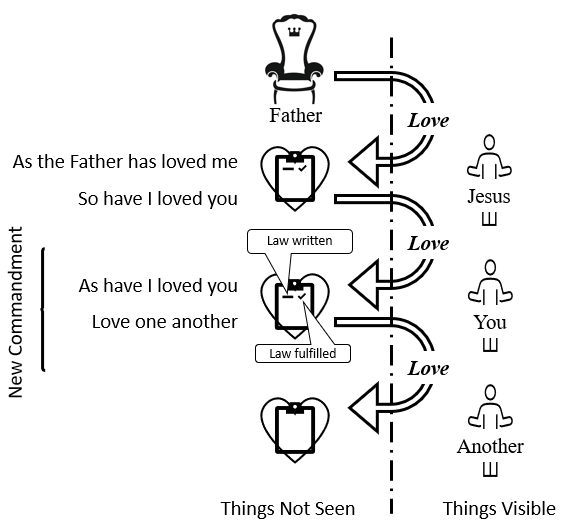
Looking at the model, my first guess would be that grace, charis, is the love of God: the love that originates from God, directed to us through his Son, and circulates through the kingdom as he loves one another through us.
That is my hypothesis, that grace is the divine love of God. It is illustrated in the diagram below.
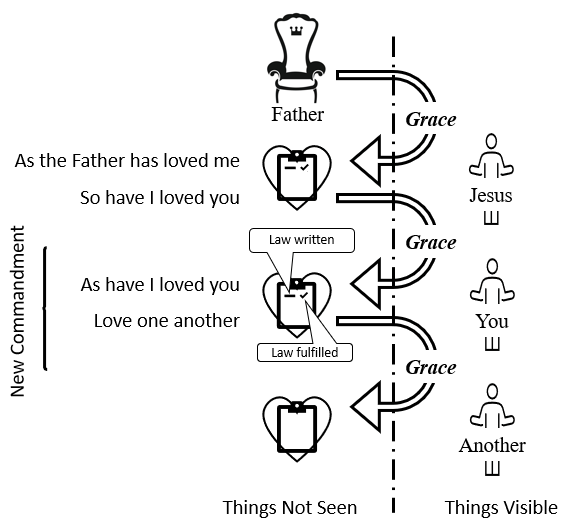
Before we proceed to the test, I would like to comment on the different contexts we can see from the model.
When you receive love from Jesus, grace becomes the law written on your heart. It is the predicate of the law, love one another as I have loved you.
When the Spirit fulfills in you the righteousness of the law, love one another as I have loved you.
A fourth dimension is added to the scripture when you follow grace up and down the ladder. Grace received by you must have also been received by Jesus from the Father. When you study how Jesus received a particular form of love, you follow his lead by receiving his love the same way he received it. When he loves you in a certain way, you follow him by loving others the same way, by the Spirit.
The acid test is to examine the places where charis (grace) is found in the Bible. When visualizing grace in a given context, if it does not agree with your current belief system, that does not mean it is wrong, and that does not mean that you should attempt to assimilate this new finding into your belief system. Instead, Jesus suggested that you create a new belief system, like a new wineskin, where you pour all your findings. In that belief system, all your findings must be consistent, free from conflicts, but you leave your existing belief system intact.
Here is a link that examines grace, the object, in a wide range of contexts.
As we visualize the scriptures, grace will be involved in almost every discussion.
Mercy – ελεος, eleos
Grace and mercy are closely related in that love is at the core of both. Where grace is provoked love (as I have loved you, love one another), mercy can be love unprovoked. The intersection of mercy and grace is forgiveness.
Where grace is based on the New Commandment, mercy is based on the Golden Rule (treat others the way you should be treated). The Golden Rule is common law.
Matthew 7:12Therefore all things whatsoever ye would that men should do to you, do ye even so to them: for this is the law and the prophets. (KJV)
Romans 2:14For when Gentiles, who do not have the law, by nature do what the law requires, they are a law to themselves, even though they do not have the law. 15They show that the work of the law is written on their hearts, while their conscience also bears witness, and their conflicting thoughts accuse or even excuse them 16on that day when, according to my gospel, God judges the secrets of men by Christ Jesus.
Where grace finds its identity in the New Commandment, mercy finds its identity in the golden rule.
The golden rule is almost the New Commandment in reverse. Instead of loving others as we have been loved, we love others as we would like to be loved.
Forgiveness has a foot in both laws: the New Commandment and the golden rule. In the golden rule God’s response to our offences is patterned after our response to others who offend us. Yet God’s initial response to us is mercy, giving us a pattern to follow that we should also respond with mercy when offended. But in the end, our response circles back to us as he forgives us as we have forgiven those who trespass against us.
Consider this verse:
Luke 10:36Which of these three, do you think, proved to be a neighbor to the man who fell among the robbers?” 37He said, “The one who showed him mercy.” And Jesus said to him, “You go, and do likewise.”
This is the conclusion to the parable of the good Samaritan. The good Samaritan showed mercy to the one he found in distress.
How we treat others becomes a pattern as to how he should treat us.
In his book, Mere Christianity, C. S. Lewis spends a great deal of space developing the concept of common law. Realizing that the law of Moses applied to Israel, what about the rest of us? Common law is the answer to that question. Although C. S. Lewis did not make this connection, mercy is the aspect of the New Covenant that holds us accountable, even while our sins are remembered no more.
When we receive his forgiveness, we receive his love, and a law is written upon the tables of our heart. God’s initial reaction to our offense is forgiveness, but his final response is determined by the golden rule: the way I treat others for a similar offense is the way I should be treated. I determine how I am to be treated by the way I treat others. This is the “common law.”
Matthew 25:40And the King shall answer and say unto them, Verily I say unto you, Inasmuch as ye have done it unto one of the least of these my brethren, ye have done it unto me.
The way I treat others is the way I treat God. When I offend others, I am offending God. When I respond to the offense of others, I am determining God’s response to my offense. According to the golden rule, this is how I indicate how I should be treated.
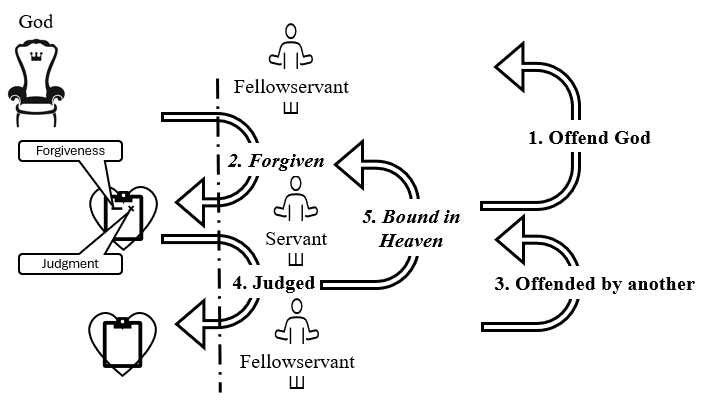
Mercy involves a sequence, as illustrated above. The sequence is initiated when I offend God (by offending another.) Step 2: God’s responds with forgiveness, and a law is written upon my heart. To fulfill that law, I must forgive as I have been forgiven, but in order for that to happen, I must be presented with an opportunity to forgive. This is called reaping what you sow. Step 3: a fellow servant is recruited to offend me as I have offended God (another.)
Matthew 18:19Verily I say unto you, Whatsoever ye shall bind on earth shall be bound in heaven: and whatsoever ye shall loose on earth shall be loosed in heaven.
Step 4: my response to this offense will determine how things will be handled in heaven. Will I bind the other and be bound in heaven? Or will I loose the other and be loosed in Heaven?
Matthew 7:1Judge not, that ye be not judged. 2For with what judgment ye judge, ye shall be judged: and with what measure ye mete, it shall be measured to you again.
Step 5: on the day of the Lord, the measure you mete will be measured to you again.
The offenses for which you do not forgive others on earth (bound on earth) shall be the offenses for which you are not forgiven in heaven (bound in heaven). That is what C. S. Lewis referred to as common law. Common law is this: “What is good for the goose is good for the gander.” This is a direct implementation of the New Commandment, which is the basis for all law under the New Covenant.
Since forgiveness is a form of grace, God’s divine love, let us substitute that word for love in the New Commandment. Forgive one another as I have forgiven you. Does that sound familiar?
A further discussion of mercy provides ample support for this claim. Mercy involved forgiveness, and forgiveness is a topic that can elusive. Plan on spending significant time here. How we handle forgiveness on earth will determine how we are handled in eternity.
Faith – πιστις , pistis
Ephesians 2:8For by grace are ye saved through faith; and that not of yourselves: it is the gift of God:
This familiar verse links faith to grace. It provides a clue as to where to look for faith in the kingdom: faith is closely associated with grace.
Hebrews 12:2Looking unto Jesus the author and finisher of our faith;
Jesus authorizes and finalizes our faith, providing another clue: faith is a composite, not just a singular entity.
Hebrews 11:1Now faith is the substance of things hoped for, the evidence of things not seen.
Faith is universally thought of as being equivalent to belief, but according to Hebrews 11, faith is composed of two related but separate elements: the substance of things hoped for, and the evidence of things not seen, and neither of these have anything to do with belief (as we know it).
We are looking for something that is connected to grace, authorized by Jesus with an element of hope, and when finalized becoming evidence of things not seen.
Faith, as with most terms, relates directly to the New Commandment. Faith is authorized by Jesus as I have loved you. This is grace in the context of being received.
Faith is finalized by the Spirit of Christ as he works in you to love one another. This is grace in the context of being delivered.
We are saved by grace, but it is grace through faith. We are saved by grace, the law written upon our heart, which is the substance of things hoped for, plus grace, the righteousness of the law fulfilled in us, which is the evidence of things not seen. This is grace through faith.
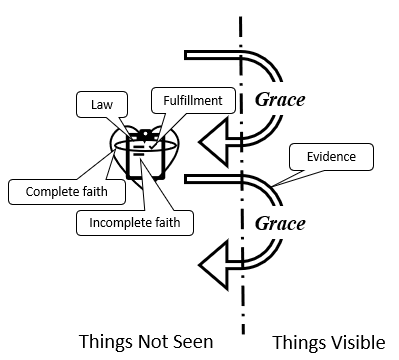
How does grace delivered become evidence? Consider the figure above. When grace is delivered to you, it briefly makes an appearance as it passes through the realm of things visible. It must be visible for it to be evidence. Evidence that is not evident is not evidence.
The thing not seen is the law written on your heart, hidden in the domain of things not seen. When grace is delivered by you as you fulfill the law, it once again travels through the domain of the visible, providing evidence of the law not seen. (There cannot be fulfillment of the law where there is no law. Evidently there must be a law)
The thing not seen for which there is evidence is the substance of things hoped for.
Romans 8:24For we are saved by hope: but hope that is seen is not hope: for what a man seeth, why doth he yet hope for? 25 But if we hope for that we see not, then do we with patience wait for it.
The thing hoped for is the thing not seen.
Faith that is authorized but not finalized is still faith, but it is incomplete faith. As James 2:24 would say, incomplete faith is dead. Faith remains incomplete until it is finalized by the keeping of the law.
2 Corinthians 6:1Working together with him, then, we appeal to you not to receive the grace of God in vain.
We receive the grace of God in vain when we receive his grace but fail to deliver. We avoid receiving the grace of God in vain by working together with him, fulfilling the righteousness of the law .
Faith is finalized when we work together with God. Fulfilling the law is a team sport, not something I can do apart from God. It is not something that can be done in the flesh (heart soul, mind, and strength.)
Faith is like a seed. You begin with the seed in your hand, in the domain of things visible. You plant the seed, putting it in the ground in the realm of things not seen. When you see a plant pop out of the soil, it could be from the seed that was planted, or it could be a weed. When it bears fruit, you have the evidence of the thing not seen, the seed that was put in the ground, out of sight.
A lack of faith is not a state of mind, it is not a hyped belief. Faith is a condition of the heart. When we harden our heart, we prevent the Spirit from planting his seed. This is an unwillingness to receive his grace.
Commendation – συνιστωντες
2 Corinthians 4:2But have renounced the hidden things of dishonesty, not walking in craftiness, nor handling the word of God deceitfully; but by manifestation of the truth commending ourselves to every man’s conscience in the sight of God.
Where faith is comprised of one person and two events, commendation is comprised of one event and two persons. Commendation is diagrammed below.
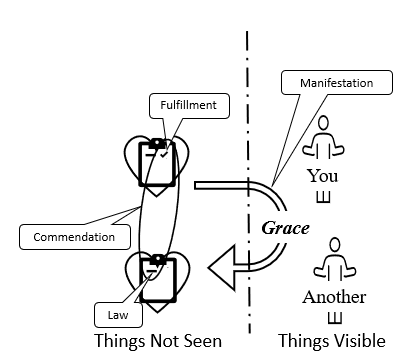
The two persons involved in commendation are you and another. As grace is being passed from you to another, it is manifested, making an appearance in the visible domain. Commendation is a composite entity. It is comprised of the fulfillment of the law credited to your account, plus the new law written on the heart of the other, as illustrated in the diagram above. This single grace event results in two records of grace written on the hearts of two people. It is the fulfillment of the law written on your heart, and the law written on the heart (conscience) of the other.
Next to the law written on their conscience (their heart) is your name. That is how we commend ourselves to the conscience of another.
2 Corinthians 3:2Ye are our epistle written in our hearts, known and read of all men: 3Forasmuch as ye are manifestly declared to be the epistle of Christ ministered by us, written not with ink, but with the Spirit of the living God; not in tables of stone, but in fleshy tables of the heart.
Next to the law written on the other’s heart is your name. In this verse, manifestly refers to the manifestation of the grace as it passes from you to another. Declared refers to the act of writing on the tables of the heart. This is a declaration because it will be used as evidence on judgment day when we give account for all that was done in the body. These are not things you did, but were done in you by the Holy Spirit. They are acts of righteousness credited to your account.
Commendation is comprised of two parts: both parts are grace.
By now you should begin to understand that the collection of all accounts comprise a distributed database. Each individual in the database will need a primary key that uniquely identifies him (her).
Isaiah 62:2And the Gentiles shall see thy righteousness, and all kings thy glory: and thou shalt be called by a new name, which the mouth of the Lord shall name.
In database terminology, the new name you receive would be a primary key. Your new name uniquely identifies you, which would be necessary for tracking all grace events through history. Your unique ID can be used to pull up your record containing everything in your account. When you (the Spirit) loves another (through you), your new name is written on their heart as part of the record of the event. The event is also recorded on their heart, and your new name is included in that record.
Matthew 20:16And the Gentiles shall see thy righteousness, and all kings thy glory: and thou shalt be called by a new name, which the mouth of the Lord shall name.
As Adam named all the animals in the Garden of Eden, the Second Adam names everyone in the kingdom of heaven. The new name is assigned when you enter the kingdom of heaven. This must be the case because it is the new name that is used to identify us in the divine transactions.
Righteousness – δικαιωμα – dikaiōma
Romans 8:4That the righteousness of the law might be fulfilled in us, who walk not after the flesh, but after the Spirit.
Righteousness is grace in the context of the law being fulfilled in you. The law is fulfilled in you by the Spirit, not in the flesh. It is performed by the Spirit of Christ, and so it is the righteousness of Christ.
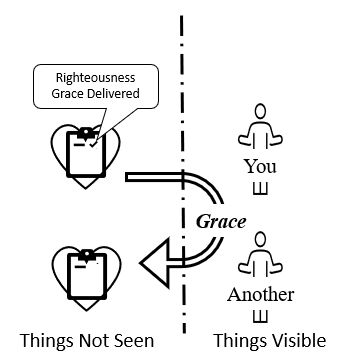
The essence of righteousness is that it is work performed in partnership with God: God doing his work using your resources for his purpose.
Romans 8:28And we know that all things work together (συνεργει, sunergei) for good to them that love God, to them who are the called according to his purpose.
This is a well-known verse that, in my opinion, has been universally misunderstood. Work together is a single word in the Greek, from which we get our English word, synergy. This begs the question: who are the parties that are working together. This is something that we should easily agree with, since the verse opens with “and we know.”
Ephesians 1:11In whom also we have obtained an inheritance, being predestinated according to the purpose of him who worketh all things after the counsel of his own will:
Here is a verse that identifies God as one of the parties doing the work, but it does not identify who God works together with. There is someone else identified in Romans 8:28 that could be candidates for this partnership: them that love God.
All things we work together with God are good. Righteousness is a product of us working with God: his strength, our resources, his purpose, credited to our account. This limits the scope of all things to include that things we do with God.
I do not get credit for things God does without me. Nor do I get credit for things I do without God. But all things that I do together with God are good.
This concept is strengthened when we look at the opposite of righteousness: sin.
Sin – αμαρτια – hamartia
Sin is the opposite of righteousness. Righteousness is what we do together with God. Sin is what we do apart from God.
The Greek word, αμαρτια , begins with an alpha, a negative particle which negates the remainder of the term. The term being negated is meros. Meros is often translated as part in the Bible. English also has a negative particle, “a”, that is used to negate the remainder of the word. When I add the English negative particle to “part”, the meaning of meros, I get “apart.” Sin is what we do apart from God.
Jeremiah 17:1The sin of Judah is written with a pen of iron, and with the point of a diamond: it is graven upon the table of their heart, and upon the horns of your altars;
When we were under the law of sin and death, our hearts were hearts of stone. Our sins were written with the point of a diamond on our hearts, written in stone, our permanent record.
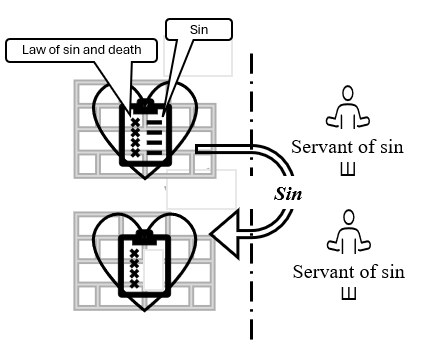
Our sins are somewhat like grace in that they are fruit that contained seed to be planted in others which would produce fruit after its own kind. This is the nature of original sin. Much like faith, when sin is planted it is incomplete and remains incomplete until it produces fruit.
Until we are joined with Christ, all we can do is sin. We can choose to do “good” things or bad things, but all that we do is still sin. The definition of sin is important when we attempt to win others to Christ. When we call people sinners, there is a negative connotation that is generally offensive, and it is not good practice to offend those you are attempting to influence.
We characterize sin as an evil act, but the tree of the knowledge of good and evil is not just evil; it includes good as well. Even after we are “saved”, we continue to do things apart from God, so in that sense we are still sinners. The only difference is that, under the law of the Spirit of life, our sins are remembered no more. Sins are no longer credited to our account, so our account remains free from sin. If sinners are those whose account contains sin, we are not sinners. This is how even those who sin, who work apart from God, remain free from sin. It all depends on which law you are under: the law of sin and death, or the law of the Spirit of life.
When I label someone a sinner, in their eyes I am accusing them of being a bad person. We attempt to soften the insult by saying that we are sinners, too, but the insult has already been launched. That ship has sailed.
A better approach to winning souls is to study Genesis 24 and see how Abraham’s servant went about searching for a bride for his master’s son, which is what we have been asked to do. Rather than focusing on the shortcomings of the candidate bride, Abraham’s servant focused on the strengths of the family into which she would be invited. After all, when we are winning souls, we are making proposals by proxy; we are inviting them into a partnership with the bridegroom.
When the issue of sin is brought up, I explain how our sins are written upon our heart, and that when we give our heart to Jesus, we are giving him our list. This is in effect how we confess our sins to him, giving him our complete list of sins. When he takes our heart, he takes custody of our permanent record, and he gives us a new heart, a heart of flesh, where our sins are remembered no more.
Repentance – μετανοησατε – metanoeo
Acts 2:38Then Peter said unto them, Repent, and be baptized every one of you in the name of Jesus Christ for the remission of sins, and ye shall receive the gift of the Holy Ghost.
Repentance – metanoeo. This Greek word is a combination of two words, meta, meaning change, and noeo, meaning knowledge. Repentance means to turn away from the tree of the knowledge of good and evil and turn to the tree of life.
When you repent, you give your heart of stone to Jesus, you give your account to Jesus. This is the remission of sins because you no longer have custody of your sin-laden account, Jesus does.
He gives you a new Spirit and a new heart, and your new heart comes with a clean account, one that is free from sin. This account remains free from sin because you are no longer under the law of sin and death, because our sins are remembered no more.
Romans 7:1Know ye not, brethren, (for I speak to them that know the law,) how that the law hath dominion over a man as long as he liveth?
To get out from under the law, you must die. For this process to work, your death must be synchronized with your heart transplant. There would be no advantage to receiving a new heart if you are still under the law: sin would continue to be written to your account, and your account would be spoiled. Salvation requires both the absence of sin and the presence of righteousness.
The diagram below contrasts the condition of the heart under the law of sin and death, and the heart under the law of the Spirit of life. Under the law of sin and death there is no provision for righteousness. Under the law of the Spirit there is no provision for sin.
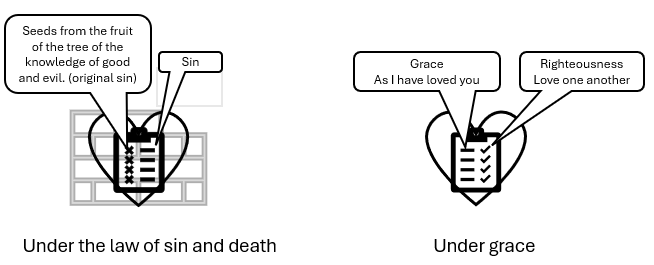
We are to move from the law of sin and death to the law of the Spirit of life. Walking after the Spirit means to follow his lead. We are to love one another (by the Spirit) as we have been loved (by the Spirit).
Sanctification – αγιασατε – hagiasate
Sanctification is generally seen as a process. I think it is most interesting to look at it as a metric. You look at your gas gage to see how much fuel you have in your tank. It gives your current status. Like your gas gage, sanctification is an indicator.
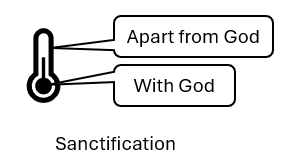
We are human. We operate as humans, doing our own works. We are invited into God’s rest, to participate with him doing his works. If we were to keep the Sabbath on the seventh day and do our own works the other six days, our sanctification metric would be a little over fourteen percent, or one seventh. On a scale of one to seven, our sanctification would be one. Seven would be the perfect score. A score of seven would be completely sanctified.
Sanctification is a metric: how many days of the week do you spend your time working with God? Jesus’ sanctification score was seven throughout his time on earth: a perfect score.
All Things – παντα – panta
All things is a single word in the Greek. It is found hundreds of times in the New Testament, and at face value the meaning of the word would suggest that all things are included. However, that is not the case.
Romans 8:28And we know that all things (παντα , panta) work together for good to them that love God, to them who are the called according to his purpose.
As we saw under the heading of righteousness, all things are all things we do together with God. In this verse, “all things” does not include the things we do apart from God.
Ephesians 1:10That in the dispensation of the fulness of times he might gather together in one all things (παντα , panta) in Christ, both which are in heaven, and which are on earth; even in him:
The all things being referred to here are the riches of Christ, grace. They are the treasures hidden in the hearts of his people.

Philippians 4:13I can do all things (παντα , panta) through Christ which strengtheneth me.
This does not mean I can do “all things.” The all things that I can do are things done through Christ who strengthens me, and before I can do things, before I can deliver grace, I must have previously received grace.
Matthew 7:12Therefore all things (παντα , panta) whatsoever ye would that men should do to you, do ye even so to them: for this is the law and the prophets.
This is a corollary to the New Commandment. Where the New Commandment is the law of grace, love one another as I have loved you, this is the law of mercy, love one another as you want to be loved.
The point here is that all things are recorded in the hearts of man. All things are elements of grace, treasures in heaven.
Dispensation – οικονομιαν
Ephesians 1:10That in the dispensation of the fulness of times he might gather together in one all things in Christ, both which are in heaven, and which are on earth; even in him:
Dispensation in the Greek means administrative management. Administrative duties are performed by the Holy Spirit. These duties include writing records in the heart of man, both grace received and grace delivered. Data entry is a full-time job.
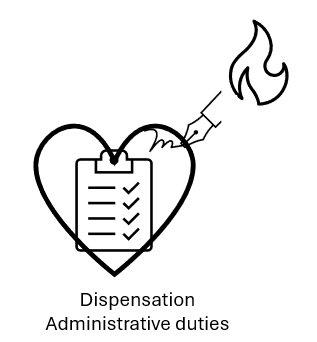
It is in the hearts of men where all the records are kept, and it is the administrative work of the Spirit that will allow God to gather together “all things” in Christ. All things only include the righteousness of God, the things that are done in partnership with God. Things we do on our own are not included in “all things.”
Servant – δουλοι (doulos)
Matthew 23:11But he that is greatest among you shall be your servant.
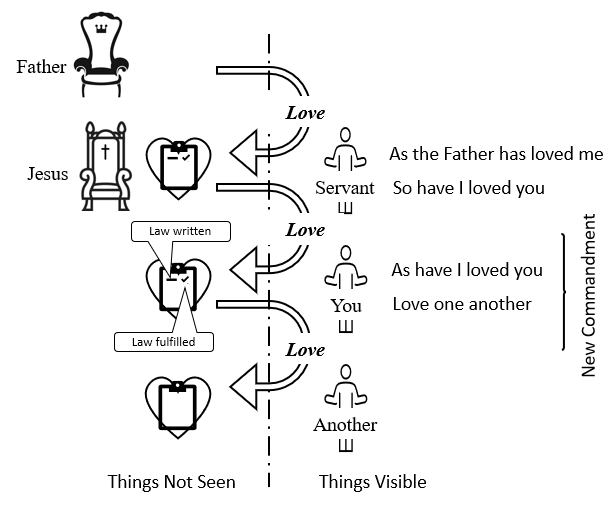
Looking at the figure above: who is greater? The one delivering grace, or the one receiving the grace? It is the one delivering the grace. The one delivering the grace is the servant.
There are several aspects to the servant. Who is the servant working for? What are the services being rendered? Who is he serving?
Matthew 23:11 speaks from the perspective of the one being served: that is you. The one delivering grace to you is the greater.
Romans 6:18Being then made free from sin, ye became the servants of righteousness.
After receiving your heart of flesh, your sins were remembered no more. You were made free from sin when you received your new heart.
Being a servant of righteousness is talking about what is being served: righteousness.
Romans 6:20For when ye were the servants of sin, ye were free from righteousness.
This verse is also talking about what is being served, not who the servant is working for. The servant of sin serves sin to others, planting seeds that will germinate sin in the lives of others.
This servant is free from righteousness, which means that there are no records of righteousness recorded on the tables of his heart. This person is under the law of sin and death. Under this law the only events being recorded are violations of the law: sin. Under this law, there is no provision for righteousness. For example, under the law of sin and death, I get no credit for keeping the law, I only get condemned for violating the law. . I do not get credit for not killing anyone. This law only works against me.
Gifts
This word is tricky because many Greek words are rendered as gift: charisma and dōron (δωρον) are two of the many examples.
There are two types of gifts spoken of in the scriptures. Consider the parable of the talents.
The master gave talents to the servants according to their ability. They were not given talents based on anything they had done, but on what they would be able to do. If, however, they failed to gain a talent, that talent would be forfeited. This gift had strings attached. It was contingent on gaining a talent; it was not free.
The servants thought that when the master returned, he would claim both the talents given and the talents gained. They were mistaken. When he returned, he let them keep both the talents given and the talents gained. The talents gained were gifts with no strings attached: they were free.
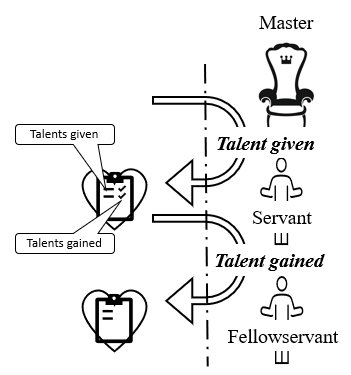
This illustrates the power of the model. From the parable, we had no idea how a servant was to go about gaining a talent. From the model, we see that a talent is gained by fulfilling the New Commandment: loving one another as the Lord has loved you.
When gift is used in the scriptures, it is important to understand the context: is it a gift, or a free gift. The free gift is the one with no strings attached: it is grace delivered. When grace is delivered, it implies that the grace was first received.
Romans 6:23For the wages of sin is death; but the gift (χαρισμα, charisma) of God is eternal life through Jesus Christ our Lord.
This verse can easily lead one to believe that eternal life is a free gift, but that would be a mistake. That interpretation directly contradicts the previous verse. For a complete discussion on this, please go to the visualization of Romans 6.
Complete in Christ
Colossians 1:28Whom we preach, warning every man, and teaching every man in all wisdom; that we may present every man perfect in Christ Jesus
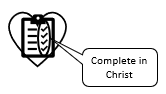
Complete in Christ is the concept of checking all the boxes at least once so that no grace is lost on the day of the Lord. There are ramifications to this verse, in that it gives us a responsibility to assist others by facilitating the checking of their boxes.
For example, when leading a couple to the Lord, deal with them together separately. Bring one into the kingdom, and give the one an opportunity to lead the other one to the Lord. The first law is written on their heart when they come into the kingdom. If they can check that box immediately, you have immediately made them complete in Christ.
It would be interesting when baptizing a group, to baptize the first one and allow each to baptize the next. Help them to check the box. When God uses you to write a law on someone else’s heart, help make them complete by providing opportunity to fulfill that law. We tend to hoard opportunities, accumulating grace to our own hearts and not giving opportunities to others.
First Fruit
The importance of the first fruit is that it establishes the grace received, securing it for the day of the Lord. It is this fruit that fulfills the law.

First Love
The first love is the first law written upon the heart. It is the same for everyone. When you are born again, you are given a new heart, a heart of flesh. Your heart of stone is taken, along with your sin-laden heart. Your new heart is blank, but when you receive your new heart, being conceived of the Spirit is an act of love, and that love is the law written upon your heart.

When you are born again, your first element of faith is authorized. Faith that is authorized but not finalized is vaporized. It will burn on the day of the Lord if not finalized. This is one instance of grace that one cannot afford to lose on the day of the Lord.
Matthew 7:21Not every one that saith unto me, Lord, Lord, shall enter into the kingdom of heaven; but he that doeth the will of my Father which is in heaven. 22 Many will say to me in that day, Lord, Lord, have we not prophesied in thy name? and in thy name have cast out devils? and in thy name done many wonderful works? 23 And then will I profess unto them, I never knew you: depart from me, ye that work iniquity.
A worker of iniquity is one who receives grace, but fails to deliver that grace to another. When Adam knew Eve, and Eve knew Adam, they had a child. You fulfill your first love by bringing a new baby into the kingdom of heaven. Jesus is the Father, and you are the mom. Yes, even men in the kingdom are the bride of Christ and have the ability to bear children. The good news is that the curse on the woman, under the new covenant, has been lifted. Bringing children into the kingdom is only joy, no pain.
Hebrews 8:11And they shall not teach every man his neighbour, and every man his brother, saying, Know the Lord: for all shall know me, from the least to the greatest.
Everyone will know the Lord because anyone who did not know the Lord never entered the kingdom of heaven. This is how it will be after the day of the Lord. Many will have received their new heart, found under the law of the Spirit of life, but falling short when it comes to consummating the marriage.
Justification δικαιωθεντες – dikaiōthentes
The Greek word for justification has the same root as righteousness. It is the act of crediting righteousness to ones account. It serves to finalize ones faith.
Justification involves grace in that it is grace delivered that is credited to ones account.
It is the account that allows us to be justified, past tense, even though it will not be announced until the day of the Lord, in the future, when all accounts will be open.
Account – λογον – logon
The account is on the tables of the heart. The account is a log of all admissible evidence that will be used for you or against you on the day of the Lord.
Matthew 12:35A good man out of the good treasure of the heart bringeth forth good things: and an evil man out of the evil treasure bringeth forth evil things. 36 But I say unto you, That every idle word that men shall speak, they shall give account (λογον – logon) thereof in the day of judgment. 37 For by thy words (λογων – logōn) thou shalt be justified, and by thy words thou shalt be condemned.
The good treasure of the heart is grace. The evil treasure of the heart is sin. It is written in the account on the tables of the heart.

The account is in the domain of things not seen.
Assurance
When I receive grace, it travels to me through the domain of things seen. The grace is visible for a brief moment. This is the point when Jesus authorizes our faith.
When I deliver grace, it also travels from me through the domain of things seen. This grace is visible for a brief moment, and this is when Jesus finalizes our faith. Finalized faith is saving faith.
Faith is comprised of two components of grace, that is what it means to be saved by grace through faith. Saving grace is faith authorized plus faith finalized.
You are assured of your salvation when you see the evidence of things not seen: grace delivered. I would like to caution you, however. Grace finalized is grace retained, but I strongly advise you to secure your first love. The grace of being born again is not a grace that you can afford to lose. You have a lifetime to lead someone else to the Lord. If you show up late to the game, make sure you leave a legacy such that the Holy Spirit can continue to perform the work he began in you. You can bring children into the kingdom even after you physically die. The thief on the cross had no time to convert anyone to the Lord, but he left a legacy, his testimony, recorded in scriptures, bringing souls into the kingdom even to this day and beyond.
Impute
Impute means to attribute something to someone else. Imputing sin means to make a sin entry in an account. It is entered in your account even though you were not the one who did it. If you didn’t do it, who did? And what is it that you did that you didn’t do?
Romans 7:16If then I do that which I would not, I consent unto the law that [it is] good. 17Now then it is no more I that do it, but sin that dwelleth in me.
Paul is clearly talking about something I did, but it was really sin that did it in me. This goes back to the trees that bear fruit that contains seed that reproduces trees after their own kind, bearing fruit that contains seed that can reproduce after its own kind. The seed that is within the person who is under the law of sin and death has no choice but to bear the fruit of sin. That person is operating apart from God. The point is that even though the sin was performed in my body, it was sin that dwelled in me that did it. This can perhaps be better understood when we look at righteousness.
When the Spirit of Christ works in me, that work is the fulfillment of the righteousness of the law in me. I did not do it, the Spirit did, but it was attributed to me, credited to my account. The work was done in me, but I didn’t do it, the Spirit did. The work of the Spirit of Christ is the work of Christ. I am saved by his righteousness. But work that he does apart from me is not credited to my account. Work I do apart from him is not credited to my account. But everything we do together is credited to my account, even though it was not me who did it. It was the fulfillment of the righteousness of the law in me.
The Will of God
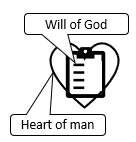
It should be obvious by now that the will of God for your life is the sum of the laws written upon your heart.
Philippians 2:13For it is God which worketh in you both to will and to do of his good pleasure.
God works in you two ways: to will, and to do. When he works in you to will, he is writing a law on your heart, establishing his will. He does that through someone else when he loves you through them.
God works in you to do when he fulfills the righteousness of the law in you by loving another through you.
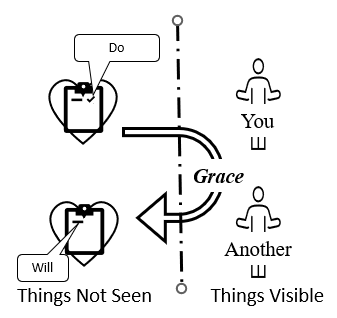
When God works in you to do, he is working in the other person to will at the same time: one grace event involving two people. See the illustration above.
When you pray according to his will, you need not wonder what his will is: it is written in your heart. Unfortunately, your heart is in the realm of things not seen. You only get to see them when he writes his will on your heart, or when he fulfills his will in you by fulfilling the law. We would do well to keep track of his will by looking at the things not seen when they do make their appearance, during the transactions both in and out. This is what it means to walk by faith, not by sight.
If you pray a conditional prayer saying, “If it is in your will”, your prayer is not a prayer of faith. The necessary component of faith, the substance of things hoped for, is the law written upon your heart, it is the will of God. If you are not sure whether what you are asking for is written upon your heart, ask him to write it there. It will probably be accompanied by suffering, but it will be worth it!
Joy
John 15:9As the Father hath loved me, so have I loved you: continue ye in my love. 10 If ye keep my commandments, ye shall abide in my love; even as I have kept my Father’s commandments, and abide in his love. 11 These things have I spoken unto you, that my joy might remain in you, and that your joy might be full. 12 This is my commandment, That ye love one another, as I have loved you.
Verse 11 contains a powerful incentive which can also be seen as a veiled threat. If you do not keep my commandment you will lose your joy. What could joy be that you would lose it? The joy is the grace received that is vulnerable to forfeiture if it is not secured by grace delivered.

Nehemiah 8:10the joy of the Lord is your strength.
Joy, grace received, is my strength because it is the basis for the Holy Spirit’s work in me. It empowers action in the strength of the Spirit instead of the weakness of the flesh.
Rejoice
Philippians 4:4Rejoice in the Lord always: and again I say, Rejoice.
Rejoicing is fulfilling the righteousness of the law. Joy is receiving grace; rejoice is delivering grace to another.
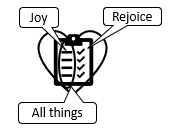
If everything we do involves delivering grace, we have entered into his rest. Like Jesus did nothing of himself, that is what we should be doing. If you have seen Jesus, you have seen God. If I rejoice in the Lord always, if you have seen me, you have seen Jesus, although not in his fullness.
Hope
Romans 8:24For we are saved by hope: but hope that is seen is not hope: for what a man seeth, why doth he yet hope for?
There are many components that lead to salvation, and hope is one of them. If we are saved by faith, and faith alone, how can we be saved by hope? Hope is a component of faith, the initializing component. Faith is the substance of things hoped for, but complete faith includes the evidence of things not seen. The things not seen is the substance of things hoped for. To put Hebrews 11:1 in another way, Faith is the substance of things hoped for, and the evidence of the substance of things hoped for (things not seen).
Ephesians 1:18The eyes of your understanding being enlightened; that ye may know what is the hope of his calling, and what the riches of the glory of his inheritance in the saints,
Hope is not our wishful thinking. Hope is not something we generate within ourselves in an attempt to conjure up faith. The seed of faith is planted by the Holy Spirit in hope of a harvest. Hope is the Spirit’s hope, it is not our hype.
Hope is the Spirit’s motive for writing the law upon your heart. Since your heart is in the realm of things not seen, the only way you can know the hope of his calling is to recognize grace when you receive it, or when it becomes evident as the Spirit works in you to love one another.
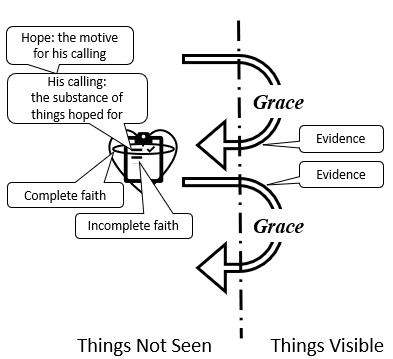
When you come to know the hope of his calling, the hope becomes your hope as well. You have a glimpse of his will and your hope anticipates what he is about to do in your live, with your life, as you yield your members as instruments of righteousness unto God (Romans 6:13)
Hope is grace in a specific context. Most things in the kingdom of heaven relate to grace in a specific context. The song, Amazing Grace, does not do grace justice. How many verses would it take to fully explain how amazing grace is?
Overshadowing of the Holy Spirit
This is when the Holy Spirit works in the lives of two people at the same time: grace delivered / grace received.
Baptism
Jesus received grace from the Father when he was baptized by John. The Great Commission is a specific implementation of the New Commandment, to love one another as I have loved you.

Mark 16:16He that believeth and is baptized shall be saved; but he that believeth not shall be damned.
It is important to understand the role baptism plays in salvation.
Romans 6:3Know ye not, that so many of us as were baptized into Jesus Christ were baptized into his death? 4Therefore we are buried with him by baptism into death: that like as Christ was raised up from the dead by the glory of the Father, even so we also should walk in newness of life.
Baptism is death and resurrection. To understand the role baptism plays in salvation, you must understand the role death plays in salvation.
Romans 7:1Know ye not, brethren, (for I speak to them that know the law,) how that the law hath dominion over a man as long as he liveth?
Death is what brings us out from under the law, and sin is not imputed where there is no law. Death is what takes us out from under the law of sin and death and puts us under the law of the Spirit of life.
When we were under the law of sin and death, we were limited by the weakness of the flesh (heart, soul, mind, strength – everything but the Spirit). When we are under the law of the Spirit of life, we worship in Spirit and in truth. Recall that truth reveals that which had been hidden. Worship in Spirit means to allow the Spirit to fulfill the righteousness of the law as written upon our heart, bringing into the realm of things seen the glorious grace of God.
Is baptism required for salvation? No, but death is required to get you out from under the law. Baptism is one shadow of death that satisfies the death requirement, but it is not the only one. This is consistent with Mark 16:16 – believe and be baptized and you will be saved. It goes on to say that belief is necessary. Baptism is sufficient, but not necessary.
That brings me to another thought. Receiving a clean heart must be synchronized with death that brings you out from under the law. You would not want to get your new heart while still under the law of sin and death. That would put the stain of sin in your new heart. It makes sense to me that you would get your heart transplant at the same time you experience your shadow of death.
That said, if baptism is your chosen shadow of death, it does not make sense to delay the baptism. Standard practice seems to require a waiting period to assure that the belief is sincere. That would require the person to operate under the law of sin and death for a period of probation, setting him up for failure.
There should be no delay between the profession of faith and baptism. When they are ready to give their heart to Jesus, letting go of their reliance on the good things they have done as well as the shame for the bad things, baptism should not be delayed.
This is my conclusion when looking at the scriptures. Is that confirmed by my experience? No. My baptism was delayed awaiting a probation period, yet I experienced an immediate newness of life. I do not have an explanation for this, I am just sharing what I am seeing.
The Sabbath
You are given six days to do what you need to do, but on the seventh day whatever you do should be in partnership with God. This is interesting because God should already be resting and not doing work. That is true, but, although the work had been done from the foundation of the world, the physical completion of the work is yet to be done.
A case in point is the work of Christ on the cross. Though the Lamb had been slain from the foundation of the world, the physical action did not happen until Jesus actually died on the cross thousands of years later.
The Sabbath was time for God’s work to get done.
Mark 2:28Therefore the Son of man is Lord also of the sabbath.
Theoretically, the Pharisees did not have a problem with Jesus healing on the other days of the week, but no work was to be done on the Sabbath. Actually, Jesus was treating every day like the Sabbath. The Pharisees did not understand the purpose of the Sabbath, that the Sabbath was to be reserved for the works which God before ordained that we should walk in them. The Sabbath was for his works, not ours.
Ephesians 2:10For we are his workmanship, created in Christ Jesus unto good works, which God hath before ordained that we should walk in them.
Bread
Consider the feeding of the five thousand in John 6. Each of the twelve disciples was given bread to distribute to the crowd. The bread was actually multiplied in the hands of the disciples, not Jesus. How does this relate to the model? Put yourself in the role of the disciple.
You receive bread from Jesus, and you give some to everyone in your group. Bread is shown in the illustration below.
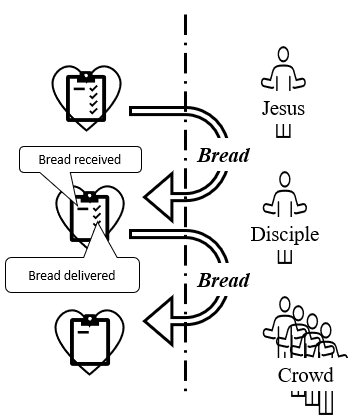
Bread received and delivered is grace received and delivered. This is how grace works. You received grace and a law is written upon your heart. That law can be fulfilled any number of times by loving one another. Each time that law is fulfilled, your capacity to fulfill that law is not diminished. This is why grace should be abundant.
When we ask for our daily bread, we are asking for our instructions for the day. Jesus gives us bread for the day, and our task is to share that bread with another, hopefully many others. Today’s bread is good for the day. If you share yesterday’s bread, it is spoiled, that is unless it is the Sabbath. If you were to enter into his rest, every day is the Sabbath, and your bread will never spoil.
There is much more to be said about bread, and the section in Visualizing the Scriptures covering John 6 covers those details. John 6 is considered perhaps the most difficult chapter to explain. That chapter is where Jesus said that unless you eat my body and drink my blood, you cannot enter the kingdom of heaven. Many were offended by that statement. It was difficult for them to hear as well.
Verily, Verily
Matthew 13:10And the disciples came, and said unto him, Why speakest thou unto them in parables? 11He answered and said unto them, Because it is given unto you to know the mysteries of the kingdom of heaven, but to them it is not given.
Whenever Jesus said, “Verily, verily,” you can take what he said at face value. It is not being hidden from those who were not “given to know.”
In the Name of Jesus
John 14:12Verily, verily, I say unto you, He that believeth on me, the works that I do shall he do also; and greater works than these shall he do; because I go unto my Father. 13 And whatsoever ye shall ask in my name, that will I do, that the Father may be glorified in the Son. 14 If ye shall ask any thing in my name, I will do it. 15 If ye love me, keep my commandments.
Is it enough to say at the end of our prayer, “In Jesus’ name”? Or what does it mean to ask in his name?
Let’s go to the model to see what we are dealing with.
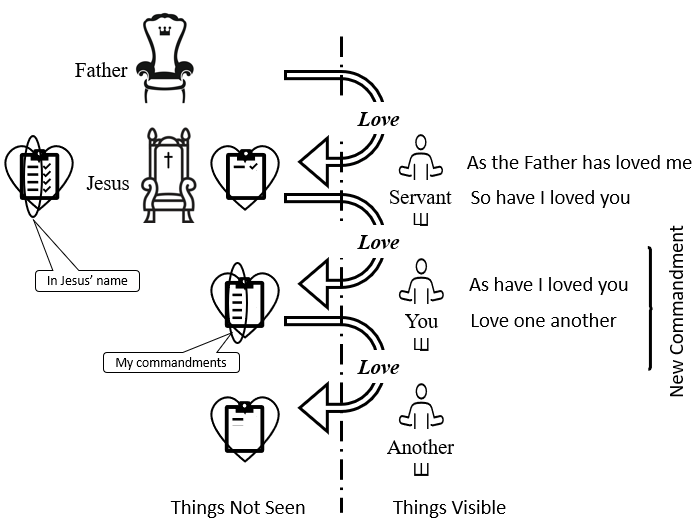
An additional column has been added to the model to explain this phenomenon. The heart to the left of Jesus belongs to Jesus. Jesus, being fully God, is currently in the realm of things not seen. He always works with servants (dead or alive) who are (or were) in the realm of things visible.
We have seen earlier that Jesus did nothing on his own. His love was limited to love that he received from the Father. In other words, Jesus cannot love you with love he has not received from the Father.
Here is an example where his disciples asked him something that was not “in his name.”
Matthew 24:3 And as he sat upon the mount of Olives, the disciples came unto him privately, saying, Tell us, when shall these things be? and what shall be the sign of thy coming, and of the end of the world? 36 But of that day and hour knoweth no man, no, not the angels of heaven, but my Father only.
The only thing that Jesus is able to give you is grace, divine love. I would like to renew the context of this discussion – it is in the context of what it means to ask in his name. When you are asking for something in Jesus’ name, you are asking for grace to be transferred from him to you or from him to someone else. If you are asking for grace that Jesus has not received from the Father, you are not asking in his name.
If your prayer is on the behalf of a third party, the channel may either be you, or someone else; Jesus does not work on his own. His work is performed by the Holy Spirit working through another, alive or dead. The channel through which his love can be delivered may be you, or it may be someone who has already received that love and has the law already written on their heart. If the channel is someone else, you can facilitate that transaction by asking that Jesus work with that person as a channel to deliver the grace for which you are asking. This is faith because you are using the principles of faith, grace received / grace delivered, as a basis for your request.
If you are not aware of a channel for this love, someone with the appropriate law written upon their heart, you could ask him to make you a channel for this grace. When asking for a particular gift of grace, you are asking according to the will of God because you are asking for the law to be written upon your heart, making it the will of God. The will of God is written upon the hearts of man.
Let’s talk about what it would take for you to become a specific channel of love. You would begin by confirming that the gift you are asking for is a gift that Jesus received from the Father. This is important because, when you receive this gift, you will need to receive it as Jesus received it from the Father.
Hebrews 5:8 Though he were a Son, yet learned he obedience by the things which he suffered;
Jesus received love from the Father through suffering. Suffering is probably how you will receive love from Jesus, the same way he received it from the Father.
Matthew 7:9 Or what man is there of you, whom if his son ask bread, will he give him a stone? 10 Or if he ask a fish, will he give him a serpent? 11 If ye then, being evil, know how to give good gifts unto your children, how much more shall your Father which is in heaven give good things to them that ask him?
When you ask for something, you will get what you asked for, but it may not come to you in a form that you recognize. For example, if you ask for a fish, you will get a fish, but it may sting like a serpent.
James 1:2 My brethren, count it all joy when ye fall into divers temptations; 3 Knowing this, that the trying of your faith worketh patience. 4 But let patience have her perfect work, that ye may be perfect and entire, wanting nothing.
Count it all joy? Joy, we saw earlier, is the law written upon your heart. That law will become a new source of strength, because it will be exercised by the agency of the Spirit. Have patience. Wait for it. You are receiving a gift. Sometimes the gift comes to you as a result of a request, sometimes not. When suffering is involved, grace is knocking at your door. Harden not your heart. Allow the Holy Spirit to write a new law on your heart. You are about to become a channel of his love to others, doing works greater than these. Wait on God. Have patience. Welcome his gift, even if it stings like a serpent.
This opens some interesting options. You are free to go shopping for grace by considering the different ways the Father loved the Son. For example, Jesus was able to walk on water. How would you like to be able to do that? Peter was the only one recorded who ever asked for this gift. But be advised, he received the gift in the middle of a storm that was so terrifying that he could only sustain his gift for a moment. Floats like a butterfly, stings like a bee.
I went shopping. I found something interesting in Isaiah 50.
Isaiah 50:4 The Lord God hath given me the tongue of the learned, that I should know how to speak a word in season to him that is weary: he wakeneth morning by morning, he wakeneth mine ear to hear as the learned. 5 The Lord God hath opened mine ear, and I was not rebellious, neither turned away back.
This is how Jesus learned what he knew by the age of twelve when he spoke with the teachers in the temple. I asked Jesus to love me as he had been loved by the Father. Subsequently, when I would awaken in the early hours, I would ask him to speak, that I could hear as the learned. When he spoke in his still, silent voice, I would rise and write down the things he showed me.
The thing I failed to do was to continue reading verses that followed.
Isaiah 50:6 I gave my back to the smiters, and my cheeks to them that plucked off the hair: I hid not my face from shame and spitting. 7 For the Lord God will help me; therefore shall I not be confounded: therefore have I set my face like a flint, and I know that I shall not be ashamed.
I was not prepared for the firestorm that was to unfold. I was cut off from numerous churches for sharing with others what I had learned in those early hours.
In retrospect, I am glad I did not realize what was in store, lest I count the cost and decide it was not worth it. The question I had to answer: Are the principles that are important to me more important than the people that are important to me? According to the model, I felt compelled to share the things I received from the Lord.
1 Corinthians 13:2 And though I have the gift of prophecy, and understand all mysteries, and all knowledge; and though I have all faith, so that I could remove mountains, and have not charity, I am nothing.
How to share in love? Sometimes when I share, it is like asking the people I am attempting to love to drink from a firehose. I need to learn to share with patience. I need to wait on God. The love I need to share with is the divine love of God, the work of the Spirit, not my ability to persuade. I need to learn to share with grace, like Jesus did, not like Moses who delivered to the extent that his audience begged him to stop. More like Jesus, less like Moses.
 New Wine